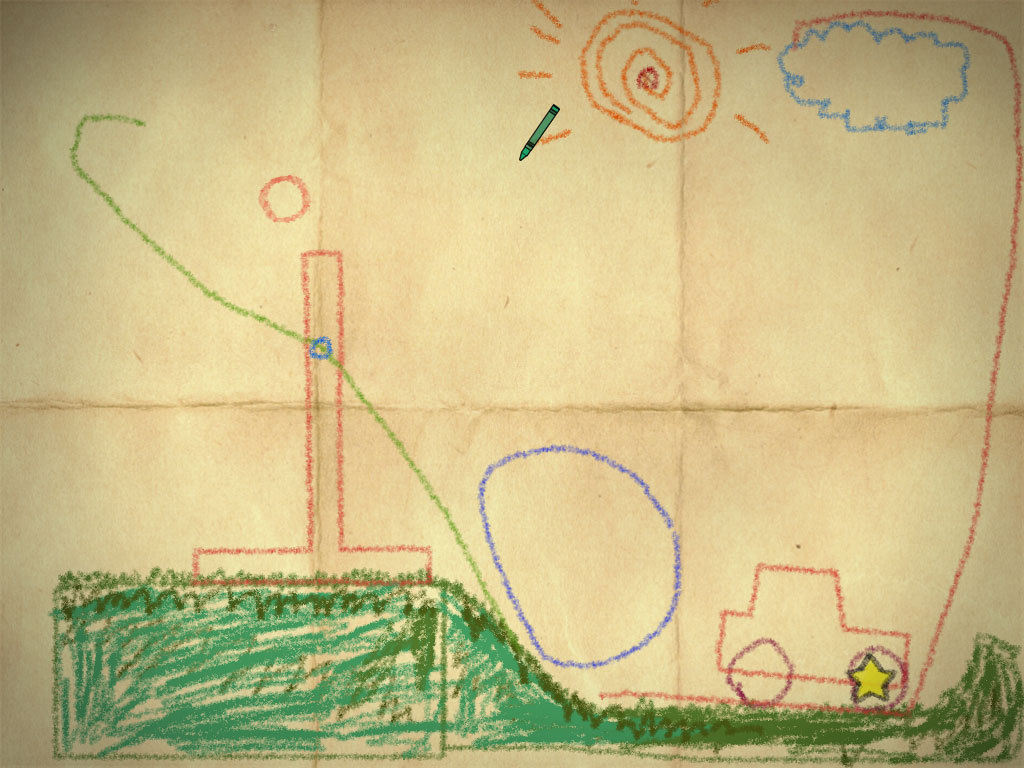
Crayon Physics Deluxe is a whimsical 2D puzzle adventure that transforms simple hand-drawn doodles into fully functional physical objects. Released on January 7, 2009, this casual indie title challenges players to guide a tiny red ball through gravity-driven environments by sketching ramps, levers, wheels, and rockets directly onto the screen. With a Metacritic score of 79.00 and the prestigious grand prize at the 2008 Independent Games Festival, the game has earned widespread acclaim for its innovative approach to physics-based problem solving.
Crayon Physics Deluxe Gameplay Mechanics
At its core, the objective of each level is straightforward: navigate a small ball from a starting point until it touches every star placed on the screen. Unlike traditional platformers, players cannot directly control the ball's movement. Instead, they must influence its trajectory by drawing physical elements that interact with the laws of gravity, mass, kinetic energy, and momentum transfer. Depending on how a line is sketched, it automatically becomes a rigid surface, a pivot point, a rolling wheel, or a hanging rope. These drawn objects possess realistic weight values based on their size and will react accordingly when struck by the ball or other falling items. Players can also gently nudge the ball left or right with a single click, while later levels introduce rockets that can be used to launch the character for an extra boost. The design heavily rewards elegant, physics-based solutions over brute-force tactics, ensuring that creativity is always the primary tool for progression.
Story & Setting Overview
Crayon Physics Deluxe does not rely on a traditional narrative structure or dialogue-heavy plot. Instead, its charm stems entirely from its visual presentation and environmental storytelling. The entire game world resembles a child's crayon sketch rendered on textured butcher paper. This hand-drawn aesthetic creates an incredibly relaxing atmosphere where every puzzle level feels like a unique drawing page waiting to be solved. The absence of a complex storyline allows each challenge to stand independently, letting players focus entirely on mastering the underlying physics concepts embedded within the whimsical environments.
Platform Availability
- PC (Windows): Originally launched as a freeware prototype titled Crayon Physics in June 2007, the upgraded Deluxe edition officially released on Windows on January 7, 2009.
- macOS: Arrived on Apple's desktop operating system on August 26, 2011, distributed through Steam alongside the Linux version.
- Android: Available since 2009, allowing players to experience the complete puzzle collection and level editor while on the go.
Notable Features
Beyond its core mechanics, the title includes several standout features that extend its longevity. The built-in level editor empowers users to design their own physics challenges, which can then be shared and downloaded via an online service called the Playground. This community hub ensures a steady stream of fresh content long after completing the base game's seventy-plus official levels. The simulation engine accurately calculates how drawn shapes behave in real time, meaning objects will fall, roll, or bounce exactly as expected based on their mass and placement. Additionally, the game offers multiple valid solutions for nearly every puzzle, providing a genuine sense of accomplishment when players devise their own clever workarounds.
Who It Appeals To
This title is an ideal match for casual gamers who enjoy intellectually stimulating puzzles without steep learning curves. Fans of sandbox creativity and physics simulations will appreciate the freedom to experiment with mass, momentum, and gravity in unpredictable ways. Its charming artistic style and soothing soundtrack make it highly accessible to younger audiences, while the deeper mechanical layers and precision drawing requirements keep seasoned puzzle enthusiasts engaged. Whether played on a desktop or mobile device, Crayon Physics Deluxe delivers a uniquely satisfying creative experience that proves simple mechanics can yield endlessly complex solutions.