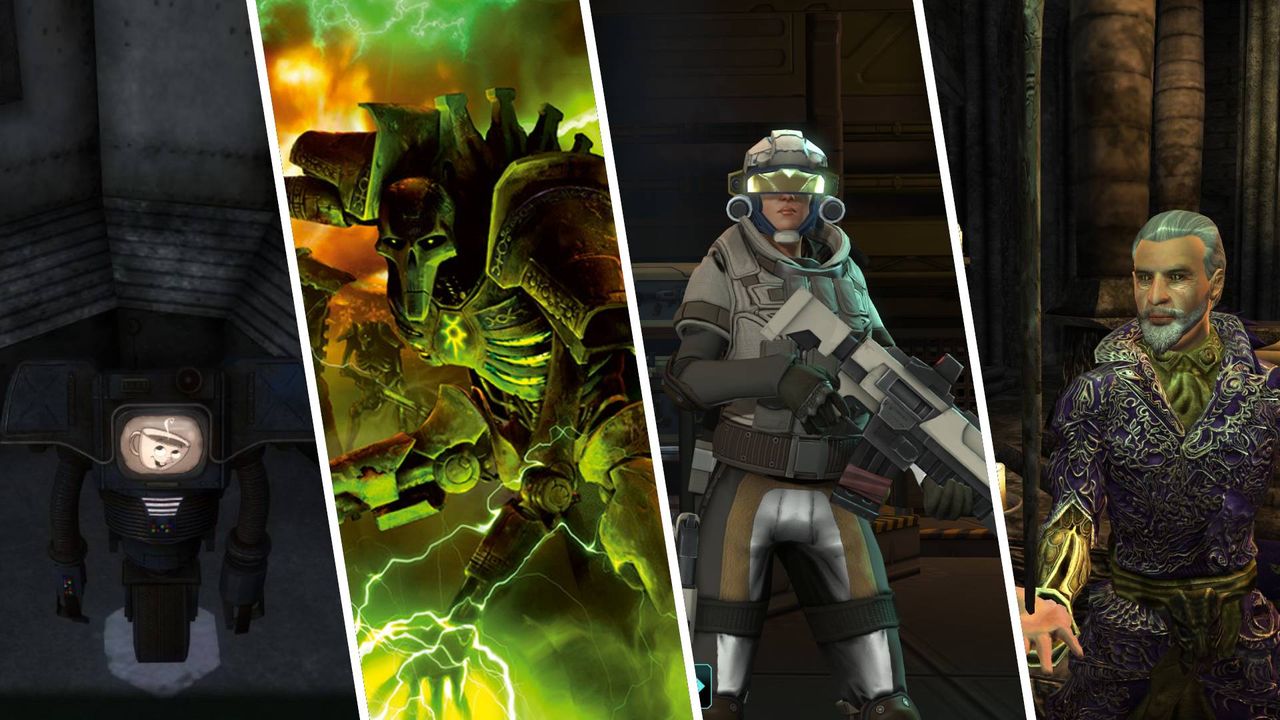
Expansions should be improvements on the base game, you say. The whole point of them is that they're adding cool new stuff, and the same game with a bunch of cool new stuff added should always be better. Except often that isn't the case.
The list of add-ons that feel like they misunderstood what made the original good, or dragged it out unnecessarily, or were just sort of fine in a "second helping of the same meal" kind of way, is a long one.
The lists of expansions that were genuinely better than the game they were expanding in the first place is much less long. It's like 10 things tops, and these are those 10 things.
DishonoredThe Knife of Dunwall and The Brigmore Witches
You can understand why Arkane thought Dishonored needed a silent protagonist. You've got a whole arsenal of tools and powers to approach problems with, and players should feel free to use the whole box instead of being constrained by questions like, "What would Corvo do?" But even without a voice players projected a persona onto Corvo, one that was at odds with the ability to possess a guard, walk him up to an electric Wall of Light, then exit just before that guard stumbled vomiting over the threshold and was cooked to death by it.
Dishonored's two-part story DLC wisely chose a voiced protagonist, and what a voice it was. Michael Madsen's Daud, the regretful assassin who was Corvo's most characterful antagonist, introduces each mission with a cynical film noir drawl. Now that's a man who wouldn't hesitate to kill someone while they were vomiting.
The Knife of Dunwall and The Brigmore Witches were full of learnings from Dishonored. The Blink power gained a timestop element that felt so good it became the default way Blink worked in subsequent games, and every level felt built for climbing around without seeming gimmicky. Dishonored's DLC levels aren't just better than Dishonored, they're better than a lot of Dishonored 2.
(Image credit: Relic)Warhammer 40,000: Dawn of WarDark Crusade
Dawn of War's campaign was enjoyably bombastic, but you had to play it as the boring old space marines. The first expansion, Winter Assault, let you choose from a couple of sides but funneled you through linear levels that had to be played in specific ways rather than letting you come up with your own tactics.
With the Dark Crusade campaign they finally got the balance right. You can pick from a bunch of 40K's factions, including two added with this expansion (necrons and tau), and the campaign is a proper paint-the-map struggle as you fight over the world of Kronus. Famously, Dark Crusade even remembers where you built turrets and the like, so if the computer attacks a territory you previously conquered your buildings will still be there to help you defend it—an element the final expansion, Soulstorm, lacked.
(Image credit: Bethesda)The Elder Scrolls 4 OblivionThe Shivering Isles
Remember how weird Morrowind was? Giant mushrooms, bizarre architecture, a culture that felt properly alien? Compared to that, Oblivion was a much more vanilla flavor of fantasy. Until a year after its release when The Shivering Isles expansion came out, adding a whole new landmass with giant mushrooms, bizarre architecture, and a culture that felt properly alien.
The Shivering Isles are divided in half, with the colorful realm of Mania and the spooky Dementia as symbolic halves of their ruler's personality. That ruler being Sheogorath, Daedric Prince of Madness, a quirky questgiver who makes Oblivion's parade of potato-faced blandees seem twice as boring by comparison.
(Image credit: EA)Mass Effect 3Citadel
The real ending of Mass Effect 3 is in Citadel, the beloved final DLC that gave Shepard and the crew of the Normandy the send-off they deserved. It combined an action-packed story full of one-liners and shootouts with a generous downtime zone where you could just hang out with your surviving companions, which is all any player of the Mass Effect trilogy really wanted.
The centrepiece is an indulgent sequence where you throw a party for your pals, getting to see them interact with each other in a less formal and life-threatening situation, cutting loose on shore leave and being themselves one last time. It's an oasis of cozyness in a desert of strife and consequence.
(Image credit: Bethesda)Fallout: New VegasOld World Blues
Some of the games on this list were saved by expansions that fixed their problems. I don't want to imply that New Vegas is one of those—it would still be an all-time great without Old World Blues—but Old World Blues is the one add-on I rate even higher than New Vegas itself.
It sends you to the Big MT, a wasteland where mad science holds sway and a bunch of Futurama-style brains in jars are at war with a rival called Dr. Mobius who has built an army of robotic scorpions. It brings back the wacky 1950s sci-fi B-movie side of Fallout, all the stuff that keeps it from being an endlessly grim Mad Max apocalypse and lightens it with a touch of humor. Morbid humor for sure—this is a DLC that begins with your brain being stolen and replaced with a computer, and ends with you having to convince said brain to return to its original home—but humor nonetheless.
Borderlands 2Tiny Tina's Assault on Dragon Keep
Playing Borderlands 2 with friends was knockabout fun, but then I went away and started a new character solo so I could play through it while actually having a chance to understand the story and pay attention to the villainous Handsome Jack's hilarious ribbing of the heroes. About 50 hours later I was so involved in that story its more emotional scenes caught me by surprise.
Tiny Tina's Assault on Dragon Keep seems like it's going to be a delightful palate-cleanser after that, a DLC where the heroes basically sit around playing Dungeons & Dragons while making jokes about bad dice rolls and what the difference really is between a wizard and a warlock. And then, several hours later, I found out its story was also a surprisingly affecting meditation on grief and the role of games as coping mechanisms. Goddamn it, Borderlands 2, you got me twice.
(Image credit: 2K)Borderlands 3Psycho Krieg and the Fantastic Fustercluck
Compared to Borderlands 2, well, Borderlands 3 doesn't really compare at all. If the games are just bishy-bashy multiplayer fun for you I guess it's fine, but if you were hoping for a continuation of Borderlands 2's excellent storytelling then you're going to be disappointed.
Until you hit Borderlands 3's DLC, and suddenly it all comes flooding back. I'm choosing to highlight the add-on where you go inside your psychotic friend's subconscious to perform a kind of FPS therapy on his damaged brain, but basically all of Borderlands 3's expansions were better than the original game.
(Image credit: Paradox)Shadowrun ReturnsDragonfall
The digital version of cyberpunk fantasy TTRPG Shadowrun was supposed to be more of a DIY adventure creator kit than anything, with its base campaign, Dead Man's Switch, intended as an example of the kind of stuff you could do with it. Only after release did the developers realize how many players would rather have a videogame RPG to play rather than a toolkit for making their own.
The response was Dragonfall, a DLC that far outclassed Dead Man's Switch. For starters it let you recruit an entire party of companions with BioWare-level backstories and secrets, and its futuristic Berlin setting felt like a real community you could embed yourself in and change with your actions. Dragonfall was so good it was eventually spun off into a standalone director's cut, which plenty of people have experienced without knowing it was originally "just" a DLC.
Fallout 3Broken Steel
Fallout 3's original ending was legendarily bad and it's just luck that the internet of 2008 wasn't quite as toxically organized as the internet of 2012 when Mass Effect 3 came out, or Bethesda would have had a consumer revolt on their hands.
Which is not to say that people didn't complain. They did, but instead of releasing the DLC that fixed Fallout 3's ending for free as part of a grand social media apology tour, we had to pay for Broken Steel. Still, it did what we wanted, and rewrote the nonsensical ending of the original game as well as letting us carry on after it. The subsequent hillbilly mutant island expansion, Point Lookout, was also better than the base game, but if it weren't for Broken Steel nobody would have bothered with it.
(Image credit: 2K)XCOMEnemy Within
XCOM 2's expansion War of the Chosen added loads of neat stuff—perhaps too much, given how packed the base game already was. By comparison, XCOM: Enemy Unknown's expansion Enemy Within added things I wouldn't want to be without on a replay. It fixed some of Enemy Unknown's weak spots, adding more maps and a whole new enemy faction in the EXALT, as well as sprinkling the Meld upgrade currency across the battlefield to encourage you to advance and grab it before it expired.
As well as back-of-the-box additions like those, and the genetics and cybernetics lab including two more ways to develop your soldiers, Enemy Within included smaller quality-of-life features nobody should miss. Like foreign squaddies speaking their native languages, a button to free up gear from soldiers who were back in the barracks when you were outfitting your squad on the tarmac, and way more hats and helmet options. It's the little things, you know?