Big Walk is one of the best games of 2026. I explain why in my Big Walk review, but if you're reading this, you don't seem to need me to convince you to play it; you're already considering it. Big Walk is an open-world co-op puzzle-adventure with few rules and no quest markers, and part of the fun is in getting lost and exploring the world. I definitely don't want to rob you of that experience.
However, since beating the game, I've heard from others who are getting stumped by some aspects of House House's latest project. So I've put together some Big Walk tips meant to iron out some of the details the game doesn't clearly tell you.
Focus on one tower at a time…The game begins with a tutorial section of the island. You'll need to solve four puzzles, unlock and shape a key, then use it to lower a footbridge that wraps around a mountain. At that point, you can pretty much go anywhere. What you should do is focus on one of the colored mountaintop towers at a time.
There are red, blue, green, and yellow towers. Filling in each tower's console with enough puzzle MacGuffins (my group took to calling them "eggy things") means you'll unlock whatever major item comes with a tower's completion. I won't spoil what each of these towers gives you, but there is arguably a best place to start. For more on that, keep reading.
…And the red tower firstThe order in which you complete these towers is totally up to you, but Big Walk gently nudges you to complete the red tower first, by way of starting you so close to it. It's a good suggestion due to the reward that comes with completing it.
It's going to make the rest of the game easier, and though that's true of any tower reward, I'd argue it's most true of the red tower. So start there, fill in five eggy things, and unlock a big prize.
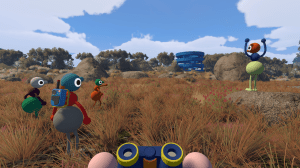
Check out these blue structures for helpful itemsOn your travels, you'll notice quite a few buildings that look like this blue one in the image. Inside each one will be either a backpack or a belt, on which you can store one item each. This means, along with your hands, each person can carry up to three items.
Unlike your hands, those in your backpack or belt also can't be dropped when you plummet a great distance, so they're super reliable. Just know that the game's intense co-op design means you can't equip or unequip these items or those they store without a friend's help.
Be mindful of what you're holding when you close the gameBig Walk does tell you about this, but it's easy to miss. In the gym area where each session begins, there's a Lost and Found table. On it will be whatever items you and your group were holding when the most recent session ended. This means, if you find, say, a flashlight that you want to have from the get-go next time you play, make sure someone is holding it when the host ends the session. It'll appear there at Lost and Found to make it easy to find again. And if you're wondering, yes, your backpack, belt, and the items they carry count as held items, too.
If you forget to do this, don't worry; items will spawn back at where you first found them, so you'll at least know where to go and grab it again.
You can communicate across long distances with more than just walkie-talkiesNaturally, a walkie-talkie is a great way to stay in chatting range of your group when you split up. But it's far from the only way. At the gym, you'll find signs that you can write messages on, which can be read from a distance with spyglasses or binoculars. You can climb to any tower and use the radio stations to chat with people who have walkie-talkies, or fire off a flare that's always atop the towers to alert others to your location.
You can even use things like flashlights and the large bouncy bulbs found all over the island to communicate via signals. You don't need to know Morse Code in that case--though it would be a neat way to do it. You just need to establish your own terminology with friends, like one blinking light for yes, one solid light for no--things of that nature.
Learn the train's schedule to plan your journeyOnce you get the train moving (which I won't spoil how you do), you'll find it never stops moving unless someone is on it holding down the brake. That means you're best to learn when it's arriving, which you can do easily at any train station. Each of them features this real-time look at where the train is on the island, so you'll know whether it makes sense to wait a few minutes for it to take you away, or if you're best to head off on foot.
The train, like the ski lift you can also access, isn't particularly fast, but it's there to give you a new perspective on the island, help you spot more landmarks, and sometimes get you to a place more directly than hiking.
Think outside the boxWith dozens of puzzles to complete, Big Walk will test your mental mettle in many different ways. Some of them can seem obvious--one of the first puzzles my group encountered was essentially basketball. But others will surely stump you for much longer. One of the ingenious things Big Walk does is how it's sometimes so devilishly simple.
Make sure you're considering all angles to a puzzle--speaking figuratively and sometimes literally, communicating clearly with your group, and trying to spot hints at a solution. Everything has a purpose. Nothing is there by accident. There are many puzzles in Big Walk where the answer is staring right at you; you just have to know how to stare back.
You won't need to complete every puzzle to see the credits but…Once you really get a lay of the land, you may find yourself wondering, "Will we have to complete all of these puzzles? Yes and no. If you want to beat the game, you'll need to complete almost all of them. You could end it there, and the ending is one of the best parts, so you'll surely be pleased to have reached that point.
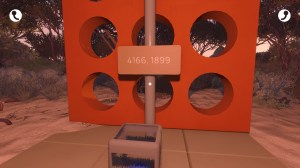
However, if you're finding the game as magical as I do, you may be inspired to keep going with the rest of the puzzles. There's good reason to do that, too, but naturally, I won't spoil that for you here. For more on the puzzle game, don't miss how to get shiny and how to solve the 4166, 1899 puzzle.