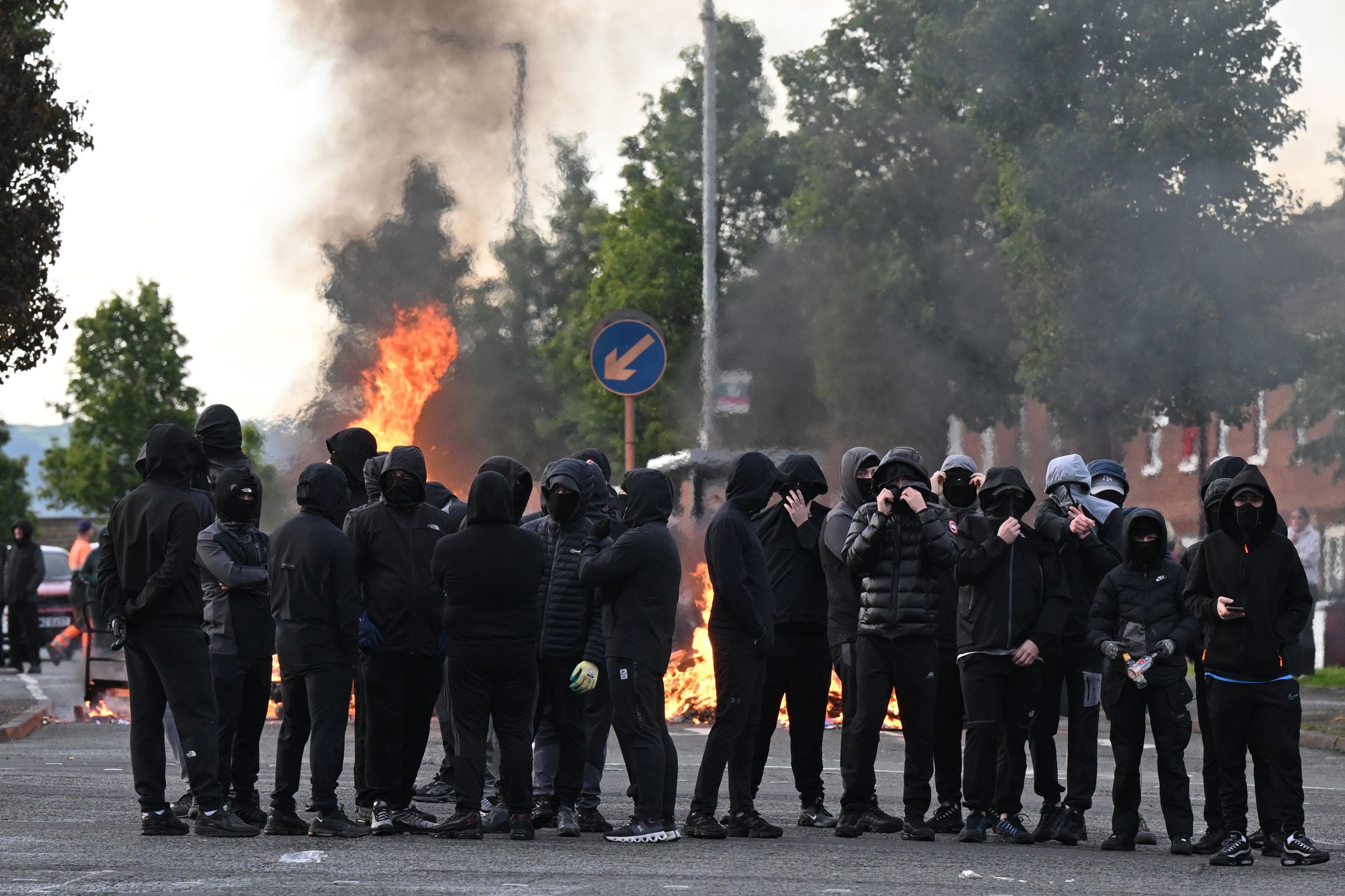
A White Supremacist Youth Group Helped Orchestrate the Belfast Riots
The riots in Belfast, initially framed as a spontaneous reaction to a violent crime, were in fact meticulously coordinated by a white supremacist youth network with global reach. This paradox — that a seemingly isolated incident could be turned into a flashpoint for organized far-right violence — reveals the deep interconnectivity of modern extremist movements. Far from being a chaotic outburst, the unrest was a calculated effort by groups like the Active Club and its Youth Club wing to transform fear and outrage into a broader campaign of racial violence.
The Role of Social Media in Mobilizing Extremists
The events in Belfast unfolded rapidly, fueled by posts from high-profile figures like Elon Musk and Tommy Robinson, but the real architects of the violence were operating in the shadows. The Active Club movement, a global network with chapters in the US, Europe, and beyond, used encrypted messaging apps and niche forums to coordinate the riots. Their Youth Club wing, in particular, provided tactical guidance to participants, ensuring the protests remained disciplined and effective.
The group advised protesters to avoid smartphones and other devices that could be used to identify them. They promoted the use of masks and nondescript clothing to obscure identities. Detailed instructions were shared on how to confront perceived threats and avoid law enforcement detection.
This level of organization and communication is a stark departure from the image of far-right extremism as a loose collection of isolated individuals. Instead, it highlights a well-oiled machine capable of scaling its influence across borders.
A Blueprint for Future Violence
The Belfast riots have already been analyzed by the Active Club movement, which sees them as a template for future unrest. In a post-mortem shared on Substack, the group praised the “organisation and professionalism” of the rioters and compared the events to a recent protest in Southampton, where similar tactics were used. The comparison underscores a growing trend: far-right groups are not only reacting to isolated incidents but actively planning and strategizing for broader campaigns.
The remigration agenda, a cornerstone of the far-right’s ideology, was explicitly referenced in the aftermath of the riots. This policy, which calls for the expulsion of immigrants and minorities from Western nations, was framed as a necessary response to the perceived threat of “third-worldist acts of violence.” The language used by the Ulster Youth Club and other affiliated groups was unmistakably racist and incendiary, reinforcing the idea that the riots were not just about a single incident but a broader cultural struggle.
The Unseen Architects of Chaos
While public figures like Elon Musk and Tommy Robinson received the lion’s share of criticism, the true orchestrators of the violence remained in the background. The White Youth In Revolt Telegram channel, closely associated with the Active Club network, was among the first to share the knife attack footage and call for retaliation. Their posts urged participants to “reignite your flame” and “reclaim your homeland,” echoing the rhetoric of the infamous 14 words: “We must take the future into our own hands.”
Even as the riots subsided, the movement was already looking ahead. The Will2Rise group, founded by Robert Rundo, who also co-founded the Active Club network, published a detailed analysis of the events, celebrating the success of the Belfast protests and drawing lessons for future actions. This indicates a shift in strategy: far-right extremists are no longer content with isolated acts of violence. They are building a playbook for coordinated, large-scale unrest that can be replicated in other cities and countries.
As the smoke from Belfast’s burning buildings still lingers, the real lesson is clear: far-right extremism is no longer confined to the fringes. It has found new life in the digital age, where ideology and violence can be mobilized with the click of a button.