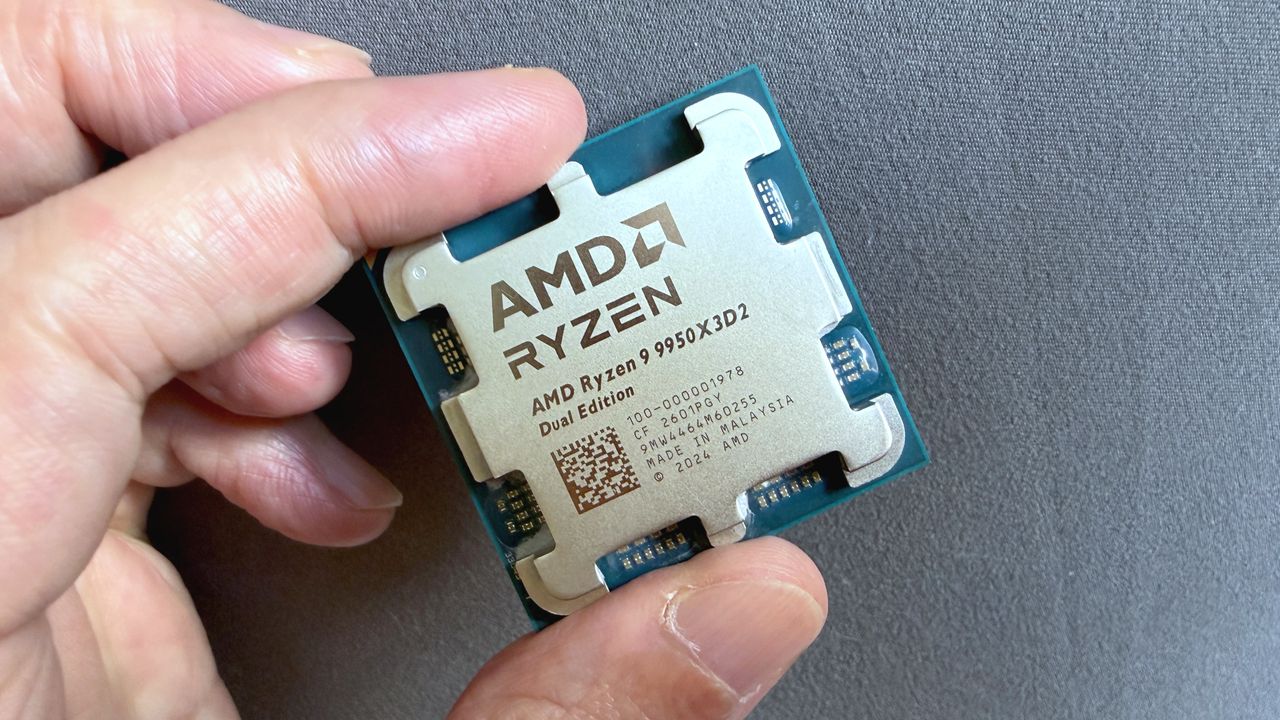
AMD previously dismissed the idea of a dual CCD Ryzen desktop processor with 3D V-Cache on both chiplets as "pointless" and "too expensive," arguing that games would not benefit. There was no technical barrier preventing such a design; it was simply a decision based on cost and perceived utility.
Yet, here we are with the AMD Ryzen 9 9950X3D2 Dual Edition. Priced at $899, this chip represents a significant departure from AMD’s previous stance. But is this dual-cache architecture actually worth the premium over the standard Ryzen 9 9950X3D, or is it another example of diminishing returns in the high-end CPU market?
The Dual CCD Advantage: More Than Just Cache
For that price, you are essentially getting a Ryzen 9 9950X3D with 192 MB of L3 cache instead of 128 MB. This configuration comes with a minor 100 MHz reduction in peak boost clock and a 30 W increase in Thermal Design Power (TDP). While the standard 9950X3D launched at $699, its price has dropped significantly in recent months, making the $200–$260 premium for the Dual Edition harder to justify for the average user.
At face value, the answer to whether this chip is worth the extra cost appears to be an emphatic "no." AMD avoided discussing this specific model during its official launch, implying that the standard 9950X3D remains the optimal choice for most. However, dismissing the AMD Ryzen 9 9950X3D2 Dual Edition entirely would be a mistake.
Solving the Thread Scheduling Problem
The primary benefit of the dual-cache design is not just raw capacity, but how it solves a historical weakness in AMD’s X3D processors. Previous chips like the Ryzen 7 7950X3D and standard 9950X3D relied on operating system drivers to handle thread scheduling to ensure critical game threads ran on the CCD equipped with 3D V-Cache.
This approach was inconsistent, particularly with Ryzen 7000-series chips. The 9950X3D2 eliminates this asymmetry through several key architectural changes:
- Symmetrical Cache: Both CCDs now feature 3D V-Cache, reducing the reliance on perfect thread scheduling.
- Consistent Clock Speeds: While the standard 9950X3D has asymmetrical peaks (5.4 GHz vs 5.7 GHz), the Dual Edition caps both chiplets at a uniform 5.6 GHz.
This architectural balance suggests that for workloads sensitive to scheduling inefficiencies, the 9950X3D2 offers a tangible, albeit subtle, advantage.
Gaming and Productivity Performance
To test the real-world impact of these changes, we utilized a high-end test rig featuring an MSI MEG X870E Godlike X Edition motherboard, 32 GB Lexar Thor OC DDR5-6000 CL32 RAM, and a Zotac GeForce RTX 4070.
Frame Rates and Stability
In Cyberpunk 2077, the 9950X3D2 delivered unexpected results. Driven by its consistent 5.6 GHz boost clock, it outperformed both the standard 9950X3D and the Ryzen 7 9800X3D by approximately 8% on average. More importantly, the 1% low frame rates were significantly improved, suggesting a smoother gaming experience with fewer stutters due to reduced scheduling friction.
In Baldur's Gate 3, performance aligned more closely with expectations, showing only marginal gains over the standard 9950X3D. However, in Homeworld 3, the Dual Edition pulled ahead again, confirming that its balanced architecture helps in CPU-intensive scenarios. Interestingly, in Factorio, performance matched the standard 9950X3D exactly, indicating that extra cache isn't a silver bullet for every title.
Content Creation: Where the Dual Edition Shines
While gaming gains are encouraging, the 9950X3D2’s true value lies in productivity. In standard content creation benchmarks, the Dual Edition takes a small but consistent lead over the standard 9950X3D. Crucially, this gain is not due to the extra L3 cache, but rather the symmetrical and higher boost clocks across both CCDs. For professional creators, these time savings in rendering or encoding can accumulate significantly over months of work.
Power Consumption and Thermals
The performance gains come with a notable increase in power demands. AMD has raised the TDP for the 9950X3D2 to 200 W, compared to 170 W for the standard 9950X3D. The Maximum Package Power (PPT) limit is set at 250 W, providing headroom for sustained heavy loads.
Under full load in Cinebench 2024, the 9950X3D2 can consume over 240 W. This high power draw results in elevated temperatures that require serious attention:
- Peak Temperature: The CPU reached 94°C during sustained workloads.
- Thermal Management: Cores frequently hit thermal limits, meaning a robust cooling solution is mandatory.
While the chip is incredibly capable, its value proposition is highly specific. It is a niche powerhouse designed for users who demand peak stability and symmetrical performance across all cores.