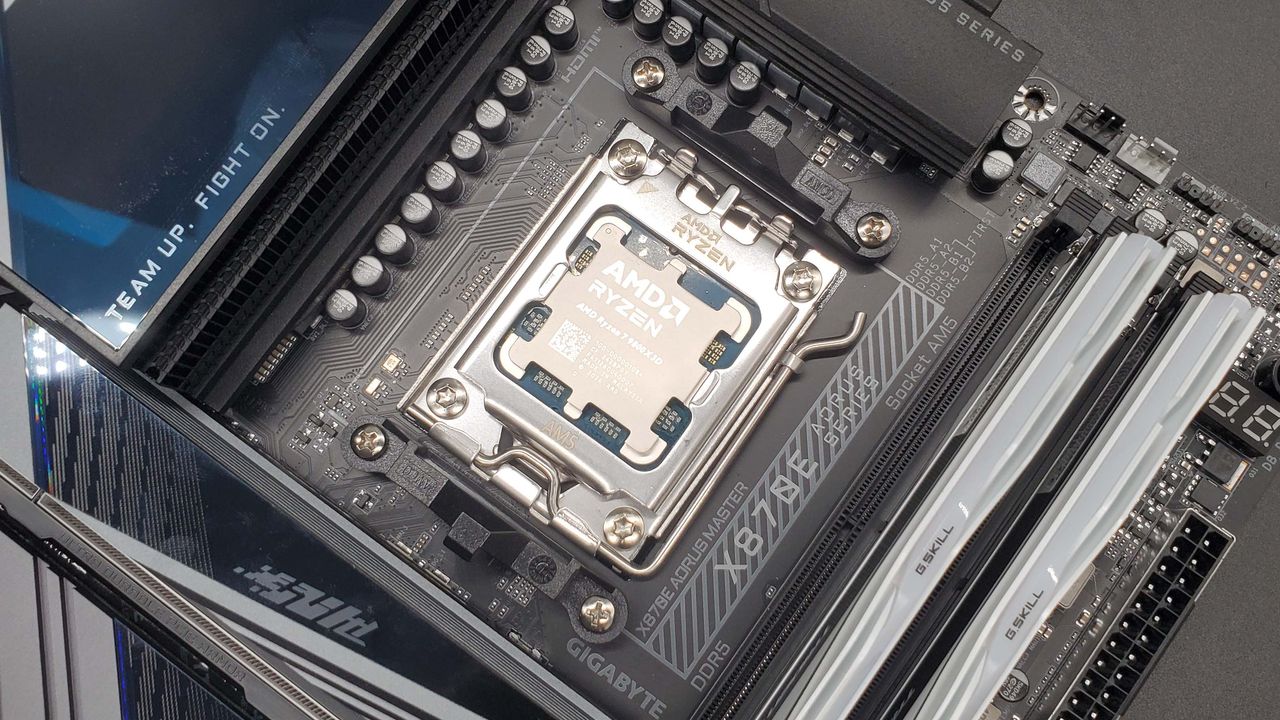
New Rumour Claims with '100%' Confidence That AMD's Next-Gen Zen 6 Desktop CPU Will Run at Over 6.5 GHz
We might end up having to wait until 2028 for new AMD graphics cards. But the company has confirmed that its next-gen Zen 6 CPUs are coming later this year. Even better, the latest rumours claim the chips will clock up beyond 6.5 GHz, potentially setting a record for factory-spec PC processors.
The source of this information is the Moore's Law is Dead (MLID) YouTube channel. While it doesn't have a perfect track record, it has been first with leaks that have later proven accurate. The channel is asserting that the clock speed part of its information on Zen 6 is "very high confidence" and "100%" confirmed. The specific claim is that Zen 6 will "clock above 6.5 GHz."
If true, that will be well above the 6.2 GHz boost clock achieved by the Intel Core i9-14900KS, which is currently the fastest PC processor in terms of raw operating frequency. For the record, AMD's current fastest clocking chips are the Ryzen 9 9950X and Ryzen 9 9950X3D, which both hit 5.7 GHz.
MLID says this is possible in part thanks to the use of cutting-edge TSMC N2 silicon. This bit is certainly very plausible. AMD is on record saying that its upcoming next-gen EPYC server CPUs based on the Zen 6 architecture will be built on TSMC N2. The Intel Core i9-14900KS is the current clock speed king of CPUs, hitting 6.2 GHz.
It doesn't automatically follow that AMD will also manufacture CPU dies for consumer desktop chips. But it does make the idea very credible. If it turns out Zen 6 desktop CPUs are indeed built on N2, it will mean AMD has effectively jumped a full node, leapfrogging N3 and going straight from an N5-class node to N2.
I say "N5-class" because the N4 node AMD uses for Zen 4 CPUs, including the AMD Ryzen 7 9800X3D, the current ultimate weapon of choice for PC gaming, has CPU dies built on TSMC N4, which is really just a minor variation of N5, not a true node class of its own.
However you slice it, the jump to N2, thus skipping N3, is both unusual and pretty exciting. Apart from clock speed, N2 ought to allow for a much larger transistor budget and hence, on the one hand, larger, more complex and more performant CPUs, and on the other, more of those new cores.
With that in mind, MLID says the Zen 6 desktop CPU die will contain 12 cores. With the top Ryzen CPUs traditionally containing two CPU dies, that adds up to 24 cores, a big step up from the 16 cores at which desktop Ryzen CPUs have maxed out for several generations now.
It's not currently known what kind of IPC or instructions per clock boost Zen 6 will offer. But there's certainly the potential for a substantial per-core performance boost given the rumoured boosted clock speed. Add in a big jump in core count, and the overall multi-threaded performance uplift could be something very special indeed.
And as I said, with Zen 6, the one thing we know for sure is that there's not long to wait. It's coming later this year.