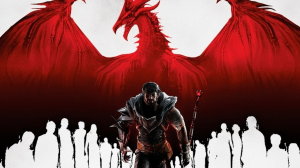
In a recent interview, Dragon Age creator Mark Darrah revealed that fans of the franchise are unlikely to ever see a remastered version of the first three games (via FRVR). Obviously, this is a huge bummer for Dragon Age lovers like myself. But the reason Darrah thinks Dragon Age will never get the Mass Effect Legendary Edition treatment is, arguably, even sadder.
"There's basically no one at BioWare anymore that understands the Aurora engine," Darrah explained. "So unlike Mass Effect, which is [built on] Unreal [Engine] … there are basically no companies that could help you [remaster it]."
Darrah added that before leaving BioWare in 2020 (after a 23-year tenure), he had plans for a "Champion's Edition" of Dragon Age, which would include remasters of Dragon Age: Origins, Dragon Age 2, and Dragon Age: Inquisition.
"That was always my plan," he said. "[It] was like, 'We're going to do a Champion’s Trilogy. These are three games with three different important figures, and we're going to retroactively turn it into a trilogy.'"
Dragon Age: Origins and Dragon Age 2 were built on BioWare's Aurora engine.Industry knowledge of Aurora is rare, as it was created by BioWare for BioWare games. Dragon Age: Origins and Dragon Age 2 both run on expanded versions of Aurora, while Dragon Age: Inquisition runs on an early version of Frostbite (which was later used to create 2024's Dragon Age: The Veilguard). This means that EA and BioWare cannot simply hire out a third-party studio to polish up the first two games--if anyone's going to do it, it has to be BioWare. On top of that, disagreements over Veilguard's direction--and its poor reception at launch--resulted in the team splintering. Many members of the BioWare old guard (including Darrah) left BioWare during Veilguard's development, or were laid off after its release--including developers who are fluent in Aurora.
When it comes to game preservation, Sony's unrelenting push for a digital-only future is the focal point of the conversation right now. And I get it, truly. But I fear that focusing solely on the preservation of physical media ignores another important way we keep games alive: remasters. Remasters are hugely important, because with enough time, all games become difficult to access. The disc rot sets in, modern hardware can't run the software, and eventually, newer fans of a franchise begin to see older titles as too difficult to understand, too hard to control, and too visually underwhelming to be worth playing.
Dragon Age: Origins and Dragon Age 2 are in desperate need of upgrades to both gameplay and visuals.Remasters are the best way to ensure that future generations can experience older games. But you can't remaster a game if the only people who understand the engine have been pushed out, laid off, or put to work on another game.
Sadly, that's the exact position BioWare currently finds itself in. Tension during the development of both Inquisition and Veilguard resulted in some developers jumping ship. Rather than keeping all hands on deck during the final year of Veilguard's development, EA laid off 50 employees in August 2023, and also parted ways with the game's recently unionized QA testers. In October 2024, Veilguard launched to very mixed reviews (no doubt a result of its troubled development cycle). In January 2025, EA openly admitted the game was a flop, and began making more cuts to the team. By February, less than 100 BioWare developers remained at the studio. Those who survived the cuts are currently working on Mass Effect 5, and fans are left to wonder whether it will be a repeat of the controversial Mass Effect: Andromeda. Nobody has the time--nor the understanding of the Aurora engine--to remaster the first two Dragon Age games.
Dragon Age: Inquisition was built on Frostbite, and still holds up visually.This is a tragedy. Dragon Age: Origins and Dragon Age 2 are in especially precarious positions because they're already starting to show their age, and desperately need visual upgrades. Unlike Inquisition--which runs on Frostbite and isn't nearly as visually dated as the first two games--the only way any of us will be playing a modernized version of Dragon Age: Origins or Dragon Age 2 will be if EA contracts a third-party studio to rebuild both games from the ground up, à la Bloober Team's Silent Hill 2 remake. But remakes are a pricier endeavor than remasters, and with BioWare in its current state, the future of the studio may hinge on the reception of Mass Effect 5.
Ultimately, the only solution here is to grab a time machine and travel back to the days before EA decimated the studio with layoffs.
Dragon Age: The Veilguard, like Inquisition, runs on the Frostbite engine.On the bright side, there does seem to be a flicker of hope for other beloved franchises. After years of re-re-remastering Skyrim, Bethesda dipped its toes into remastering a different Elder Scrolls title: Oblivion. The response from players was overwhelmingly positive, and Bethesda has made it clear the remastered nostalgia hits will keep coming, revealing that in addition to several new Fallout games currently in production, the studio is also working on remasters of both Fallout 3 and Fallout: New Vegas.
Here's hoping EA eventually decides to follow suit.