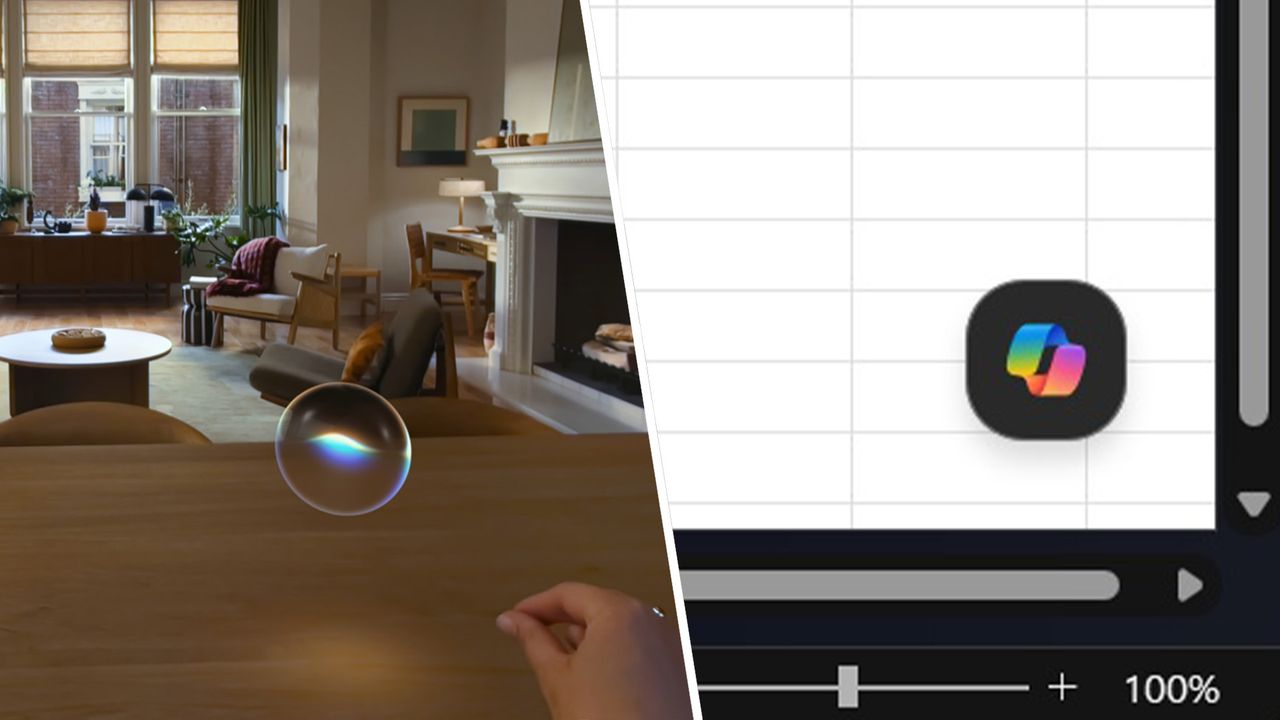
Apple's virtual Siri-ball is a glowing reminder to Google and Microsoft that user interfaces really matter in software
Now that AI is being integrated into every app and operating system, whether you want it or not, attention is being increasingly turned to the user interface. At one end of the spectrum, you have Google and Microsoft's unaccommodating efforts, and at the other, you have Apple's new orb-of-wonder, actively lighting its surroundings. This contrast highlights the growing importance of intuitive and thoughtful UI design in AI-driven software.
Later this year, an updated, fully AI-powered version of Siri will make its way to all of Apple's operating systems, though developers can already access it. For the likes of iOS and MacOS, Siri AI's interface isn't especially noteworthy, but on visionOS, the software that powers the Apple Vision Pro, it really stands out. The new Siri AI Orb gives off its own environmental lighting, as seen in a post on X by Brad Lynch, project manager at EOZ VR.
You'd expect that for an augmented reality setup, but what makes Apple's effort special is the little matter of the ball's lighting. The AR rendering of the ball includes an environmental effect, whereby surfaces and objects are 'lit' by the Siri AI interface. Hardly a revolutionary thing, but visual clues like this significantly help with how well virtual objects are experienced and interacted with in an augmented world.
If you look at the visionOS windows in the clip, you'll see that they appear flat and unnatural because they cast no shadows or light. For me, though, it's more about the fact that Apple has spent some time thinking about the interface, whereas Google and Microsoft have done almost the complete opposite for Gemini and Copilot, respectively.
Fire up the latest version of Excel, and you'll be treated to a Copilot button that hovers over the spreadsheet. You can't move the icon yourself; all you can do is 'dock' it to the edge of the window. But even then, it still overlaps cells, and the only way you can solve this problem is by disabling Copilot entirely (File > Options > Copilot, if you're interested).
At least you do have that option, though, unlike with Google's products, where Gemini icons festoon every application and first-run instructions routinely pop up, no matter how frequently you acknowledge or dismiss the reminders. No PC user needs to be told just how crucial the user interface is for an application. Apple's Siri-ball for visionOS isn't a miracle of design or coding: it just puts the user's experience first, over everything else, something that Google and Microsoft really don't seem to care about these days. You wouldn't want a ray-traced globe illuminating your spreadsheets, but a little more interactivity would be very welcome.
The Impact of UI Design on User Experience
The way an AI assistant is integrated into a user's workflow can significantly affect their overall experience. Apple's approach with the Siri-ball is a prime example of how a well-thought-out interface can enhance usability and immersion in virtual environments. In contrast, Google and Microsoft's implementations often feel intrusive and poorly integrated.
Google's Gemini AI, for instance, has been criticized for its aggressive presence in various applications. Users are frequently bombarded with pop-ups and reminders, making the experience less seamless. Microsoft's Copilot, while functional, has its own set of issues, such as the inability to move the assistant's icon freely and its tendency to interfere with the user's workflow.
These issues highlight a growing concern in the tech industry: the need for more user-centric design. As AI becomes more prevalent, the importance of intuitive and non-intrusive interfaces cannot be overstated. Users should be able to interact with AI tools without feeling overwhelmed or hindered by poorly designed interfaces.
The Future of AI Integration in Software
As we look to the future, it's clear that the way AI is integrated into software will play a crucial role in its success. Apple's visionOS and the Siri-ball are setting a new standard for how AI can be seamlessly incorporated into virtual environments. This approach not only enhances the user experience but also sets a benchmark for other tech companies to follow.
In the coming years, we can expect to see more innovations in AI integration, with a focus on creating interfaces that are both functional and aesthetically pleasing. The key will be to strike a balance between providing powerful AI capabilities and ensuring that the user's experience remains smooth and intuitive. As Apple has demonstrated, the user interface is not just a design element—it's a critical component of the overall user experience in AI-driven software.