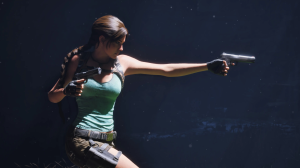
Despite being one of the most iconic video game characters of all time, Lara Croft might also be one of the most ever-changing. When compared to the likes of Mario, Link, Master Chief, or Solid Snake, the gun-toting globetrotter has been reinvented more frequently and dramatically then the lot of them. Sure, some things about Lara have remained the same--namely her English background and penchant for archeology--but across her catalog of games, multiple movies, and animated series, the finer details of the heroine have been rewritten time and time again.
With this in mind--and as we celebrate Croft's 30th anniversary--developer Crystal Dynamics faces a daunting task and difficult-to-answer question: How do you take 30 years of Croft, condense it, and create a version of her that rings true to as many fans as possible? This is no easy feat, especially considering there are two, distinct sides to the debate on how Lara should be portrayed
At this year's Summer Game Fest, GameSpot sat down with the team behind the series next entry, a remake of the first game titled Tomb Raider: Legacy of Atlantis, to discuss just that. According to game director Raul Siqueira, experience director Jeff Adams, and creative director Michał Kuk, the task is one they are approaching with equal parts excitement and reverence.
https://www.youtube.com/watch?v=DCGn0e3HcDQGameSpot: We've hit an interesting point in the Tomb Raider series. You have this whole legacy of the older games, then the Survivor trilogy, and now you have to merge everything--and that's not even mentioning the movies. What is it like taking on that gargantuan task?
Adams: It's really fun and cool. It's also a lot of responsibility because we know there's a lot of people that are super excited [and are thinking,] "You guys better get it right." We are really, really working hard to make sure that we're creating something that's going to be resonant for fans that have been waiting for it; at the same time, it's [also] going to be really good for new fans.
Siqueira: It's a blend between exciting and also a little bit terrifying, but in a good way. We don't lose sight of the responsibility of it, it's definitely something that we take into consideration. [But] we're very lucky because we're all Tomb Raider fans, so we get to do this and I think that mentality really helps us push through the task that it is.
Pulling on that thread a little bit more, what do you look at as kind of the core defining features from each of these eras--the things that you identified that you were like, "That's what made it special"--that you thought, "We need to put this in this game?"
Adams: I don't know if it was necessarily like a shopping list where we're like, "All right, we've got to get two parts acrobatics and one [of this] thing." It's more about--when you think about the story, when you think about the narrative, where Lara's at, what she's doing, and what [moments] launched her into people's head space--what were those attributes that she had? Then we find ways to say, "Cool. How can we bring those forward so that they feel modern?" We're trying to really replicate the first play experience, so what are those defining features?
What were some of those defining [features] then that you mentioned?
Adams: Well, I mean clearly Lara's attitude. She's confident, she's bold, [and] she owns the room. [Also] her physicality--she's not afraid to do the flip, she's not afraid to do the cool handstand walkover. Those are part of her [and her] core traversal abilities encompass that.
There's also things that you will see coming down the pipe a little bit later on that will show how we are bringing some elements in from past expressions of Lara and how she responds to things that we'll be happy to talk about.
Siqueira: Yeah, I think there's a confidence to Lara in the way that she moves and the way that she acts--it's important for us to get right both on gameplay and on narrative. We don't want anything that Lara does to be something that only makes sense for the story or something that only makes sense for the gameplay. We want to make sure that the two of them are married.
We talked about this a lot about how during the Survivor Trilogy. This was like her training, right? It was grounded. She wasn't confident enough to be able to pull off acrobatics while shooting. But Lara [at the] top of her game? She definitely can. Finding ways in which we can incorporate that into the gameplay has been super fun.
The focus mode is a good way for us to merge those two things together because we [can] go like, "Hey, this is something that she does that is her personality. She doesn't move like you and I would move." She flips around and she does it in a way that is beneficial to her, not a hindrance.
There are a generation of people, myself included, who have grown up with Lara. I remember when the first games came out--I probably shouldn't have been playing them, but I was. And I remember being in my college years when the Survivor Trilogy came out, and that was the perfect time for that to hit. What is it like continuing with this character who has grown up alongside this generation of women? What is it like bringing that to life and honoring that?
Adams: I would never try to pretend to try to frame an answer coming from a woman's perspective, but I will say that we have a lot of folks in our organization who are fervent fans of Lara and they are happy to see us kind of bringing Lara back into the mainstream in this way.
Siqueira: Even in your story, you kind of encapsulated perfectly why Lara is so iconic. She gets to capture, [and] you get to witness, all of the different eras of her growing up. There's something to be said about a character that made sense in 1996 and still makes sense in 2026. Making sure that that is right, that it resonates to the target audience, is something that we take very seriously.
I do feel like I have to address the elephant in the room: Generative AI. I want to ask if you could clarify how you are using it [and] if it's intended to be in the final product, if you don't mind talking about that for a little bit.
Adams: At Crystal Dynamics, we see AI as a tool that our teams can use to help get to a right answer fast. What that might look like in practice is, say in early level development we have an idea for an in-game object but we're not sure if we want to task the team with building it at that time. We can use a generative AI tool to quickly visualize what that object would look like in the world. And if we're like, "Hey, that works," we'll then move it into our traditional pipeline.
At that point, we will then concept it, build it, and make sure that all of the finished content in the final game is human-crafted. It's really important for us that we are making it as easy as possible for our devs to be able to create the highest quality experience, because that's what we know our fans deserve.
Have you used it at all in the design of Lara? Some people have been curious about that.
PR Representative: I think we'll probably leave the AI question there. I think we will be able to revisit it a bit later on because we're going to do a bit more of a deep dive on Lara a bit later in the campaign, but we're not quite ready.
Editor's note: Shortly after the interview concluded, the above PR representative asked me to return to the interview to ask the question again, as the development team informed them that they could not clearly hear it.
Adams: I'm going to ask you to ask the question again, because once again, I could barely hear it.
Yeah, of course. Following up on our discussion on generative AI, was any of that used in designing Lara?
Adams: No. Lara is 100% human-crafted.
Moving away from AI, there are people who critique Lara for being too pretty or too hot, right? So I'm wondering, how do you strike the balance between having someone who is very conventionally attractive and brilliant and talented, and making her come across as like a real person?
Adams: We try not to view it from either of those angles. We're not trying to make one camp happy and the other camp miserable. We don't think of it that way. We're just like, "Hey, this is Lara. This is who she is and this is the icon that we've come to know. How do we bring her into the most fully focused version that she's ever been presented in?"
She's Lara. She is the icon for a reason. So we just want to do justice to her.
Siqueira: And do justice to her personality, too. The confidence, the wittiness… The personality that she has is so important for us [and we're] making sure that we are doing that right. That's why we all love Alix [Wilton Regan] so much--she just nails it.
Obviously there's the visual component of it or how she looks, but how she acts is really important and I want to make sure that that is the thing that we get right. To what Jeff was saying, we're not trying to make one camp happy and the other one angry. We're just trying to [do her] justice.
Do you have anybody on the team who worked on any of the earlier titles?
Siqueira: We do, we do, we do.
Adams: The guy who [worked on] Lara for this game? That's [been] his job for the last 15 years, 16 years.
Kuk: 20 years!
Adams: Yeah, he's worked on every Lara from across this amount of time. You asked a question about why she's so beautiful--he doesn't even probably look in this perspective of her, just lives and breathes every detail of her. Even picking her hair, he was just literally picking strands of her hair [and] saying, "We need to move this up. We need to move this down." I'm like, "This guy is crazy. He just lives and breathes her."
I'm sure at a certain point it just becomes an extension of you. You see her as like, "That's my character."
Adams: Cam has [worked on] every Lara since Tomb Raider: Legend. And the fact that he's been able to go from the Legend era into Survivor and now he's here in Legacy of Atlantis… that just kind of shows [that] we're not status quo. It's not enough to say, "Yeah, I know what this is." Every time you come, you do it with fresh eyes. He sees everything as a fresh challenge.
Siqueira: We have a design director whose first job was to do layout for Anniversary. So when we were replaying Anniversary and figuring out how we were going to change this space, we would just ping Jason and be like, "Hey, remember this thing that you made? We don't like it. We're going to change it. Or, "Remember this thing that you made? It's awesome. We're just going to copy paste it."
Do you get to have fun with roasting folks? Like, "Why'd you do that?"
Adams: Game development doesn't exist without at least a light amount of roasting. We were doing initial early research and I came across a bunch of documentaries from Anniversary. I pulled clips of a couple of folks that we have from when they were babies and I said to them like, "Who are these kids?" And they're like, "Shut up, don't talk to me anymore."
To wrap things up, and since this is a 30-year celebration essentially, what were you most excited to kind of go back, revisit, and then bring to life for this new generation?
Kuk: The main thing for me personally, is to revisit all those places and all those iconic characters that were in the original Tomb Raider and bring them back to life with our own flavor. The T-Rex is a really good example, because we respect how it looked [and] we took the color palette from it, but we obviously made the visuals up to date and then added the red feathering on the back to make it more unique and ours.
There's a bunch of other stuff that we've done, with other places and other characters, like that. All of them are similar, [and] exciting.
Adams: Yeah, we don't want to lose the DNA that was there. These are iconic characters, and I know we're using that word a lot, but it's true. Realistically, this adventure established a baseline understanding of what the raptor looks like, what the T-Rex looks like...
We want to not just change [the game] because we have an opportunity to--we want to literally say, "Hey, how do we extract greater depth of realism out of [this] while still preserving the fantastic parts of it?" That kind of [touches on our] prior point, which is that Lara is in some ways human, and in some ways she's fantastic. She's larger than life, and I think we're trying everything we can to make her look, feel, and play that way.
Siqueira: I personally am excited about dual pistols being back. Coming up in the Survivor Trilogy, it was very clear to us that we had a different focus for it, but we always loved [them] and we wanted to celebrate [them].
So stepping into this game and being able to go like, "Dual pistols are back. We're going to make [them] awesome. We're going to make [them[ super cool." It's just a really fun feature.
I will say for me playing, that was my highlight. The second you slow down time and start doing the flipping, I was like "Okay, that's Lara."
Siqueira: That comment just made my day. Internally, a lot of times we'll say [this game is a] love letter to fans. We want to make sure that people that have spent a lot of time with [Tomb Raider] feel seen in this version of Legacy of Atlantis.
Kuk: You said [earlier in] the interview that you have memories of playing the original one--we want to awake those memories in people who have them and create a new ones in the people who haven't played the original; to create those feelings and those emotions that people can have with Lara and her adventures.
Adams: There is this great advantage of having a franchise [that's] 30 years old. There's a lot of different places where you can go in and trace back, and we're really hoping that we can reignite a lot of interest in the world.
We don't talk about a lot, but the world of Tomb Raider is actually kind of unique in how it approaches archeological adventure. We're really excited [for] when people start to play the game and they kind of see that, [and ask], "Hey, what can I learn about this?"