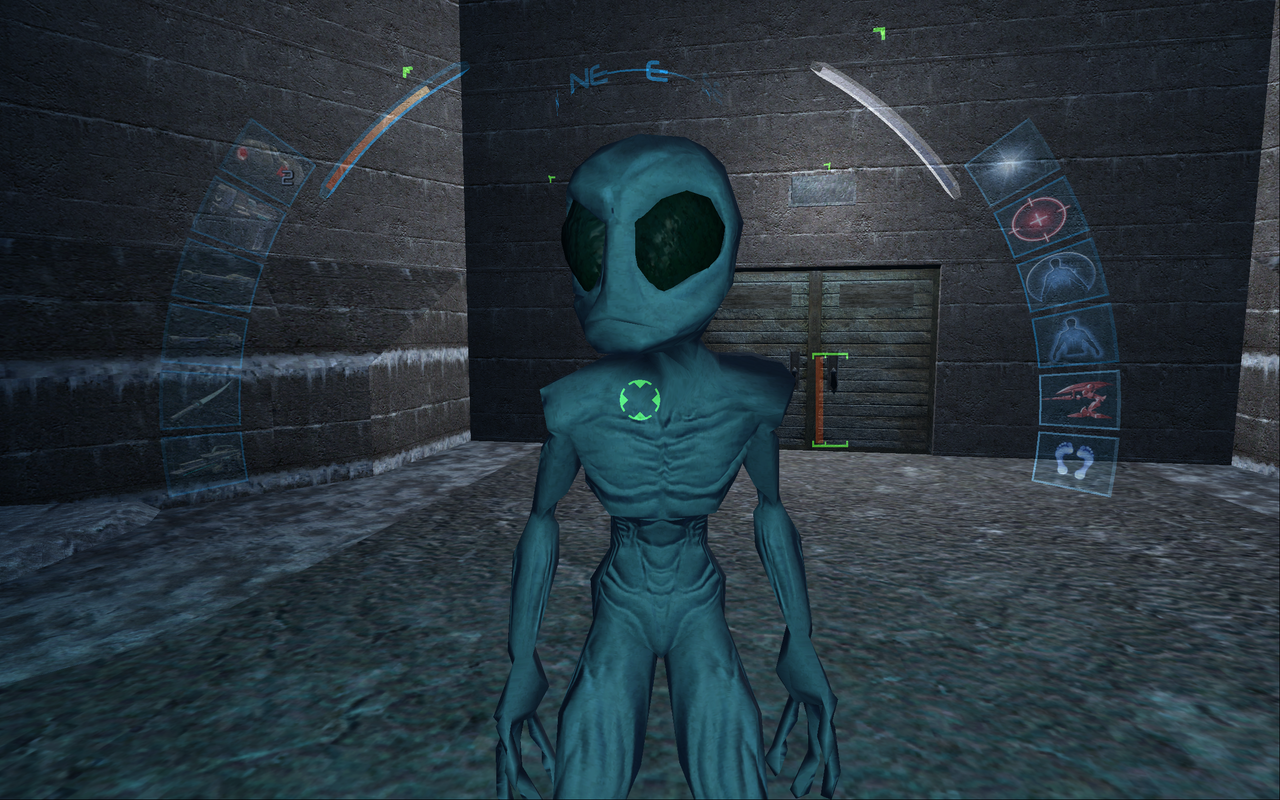
To hijack a robot, I have to remain nearby for a non-trivial amount of time. When I want to hack a chickenwalker military bot straight out of RoboCop, I sneak behind it while a timer counts down as it patrols. Every stomp shakes my screen as I follow it—right into the open where guards might see me.
The robot turns on the spot, heavy mechanical movement facing me just as the final second ticks past. I’m in. Looking through its "Terminator vision" camera feed, the first thing I see is myself, crouching in a courtyard like an absolute doofus. Then I see the guards and open fire, rockets ragdolling them into the sky.
People talk a lot of rubbish about Deus Ex: Invisible War, but I’ll say this for it: the guns shoot straight, and the extremely 2004 physics make every enemy pratfall a riot. However, to truly enjoy the experience, you need to be playing Deus Ex: Invisible War like it always should have been.
Fixing the Loading Screen Nightmare
The biggest complaint regarding Deus Ex: Invisible War was its constant loading screens. Much like developer Ion Storm’s other moody stealth romp, Thief: Deadly Shadows, the game was carved into tiny slices to fit the Xbox’s limited memory. This made its mission-rich hub areas a chore to navigate.
Doors and lifts constantly dumped you into a weird loading screen that would quietly crash, forcing the game to restart for arcane technical reasons. Some critics even called it an "invisible snore."
By using the Visible Upgrade mod, you can finally play the game like it always should have been. The loading screens fly by in seconds, and I can play at whatever ludicrous resolution I want. This mod offers several key improvements:
- Seamless Navigation: Loading screens are drastically reduced or eliminated.
- Modern Visuals: The ability to run the game at high resolutions.
- Retro Aesthetics: An option to restore the daft glowing eyes for all biomod-enhanced characters, just like the original trailer.
Exploring the Immersive Hubs of the Invisible War
The game features three main hub areas—Seattle, Cairo, and Trier—alongside visits to Antarctica and a return to Liberty Island. As an immersive sim, each hub is packed with side stories that are often more interesting than the central plot.
In many ways, the game suffers from a bit of an "Oblivion problem," where the main questline feels secondary to the world's atmosphere. The environmental storytelling shines through via:
- Seattle's Corporate Warfare: A rivalry between two coffee chains (both named after characters from Moby Dick) leads to missions ranging from corporate sabotage to straight-up firebombing.
- Global Conspiracies: While a massive invisible war is happening in the background, the local, ridiculous conflicts are much more engaging.
- The Starscream Experience: As freelance cyborg badass Alex Denton, you aren't locked into one faction; you can betray parties repeatedly to maximize profit.
As Denton, you can be delightfully noncommittal. When offered a wad of cash to murder a corporate stooge, you can simply say, "I'll see what I can do." You can even tell the target you've been hired to kill them, then barter for a bigger paycheck to instead assassinate a nightclub owner who thought they were being clever by hiring you.
AI Surveillance and Parasocial Relationships
The nightclub scene introduces one of my favorite chains of side missions—a worryingly prescient tale of AI surveillance and parasocial attachment. At Club Vox, you encounter a hologram of pop star NG Resonance (portrayed by Free Dominguez from the band Kidneythieves). She acts as a chatbot that fans can interact with while she dances in a circle like a ballerina on a music box.
I overheard a fan named Bud Puckett, who turned to her for dating advice, sadly reporting that it didn't work out. The AI commiserates and promises that messages are passed to the real NG Resonance. It is a hauntingly accurate depiction of the parasocial relationships seen in modern content creation or those who fall in love with AI girlfriends.
Because she is omnipresent, NG Resonance becomes a vital source of information. However, if you try to quiz her like a typical RPG NPC, she will quickly turn the tables on you:
- The VIP Section: She lacks info on what's happening in the club's restricted areas but offers rewards for intel.
- Information Brokerage: Using her is like using a Google AI summary to find quests in your area.
- The Informant Role: You eventually become an informant for this talking surveillance camera in a minidress, all in exchange for a cut from the WTO and free concert tickets.
When I pretended to be a fan of her music, the cheeky AI clocked me immediately. When I told her she shouldn't sass me since she is programmed to be liked, she simply replied that I like it when she argues. I have never felt so called-out by a video game NPC in my life.