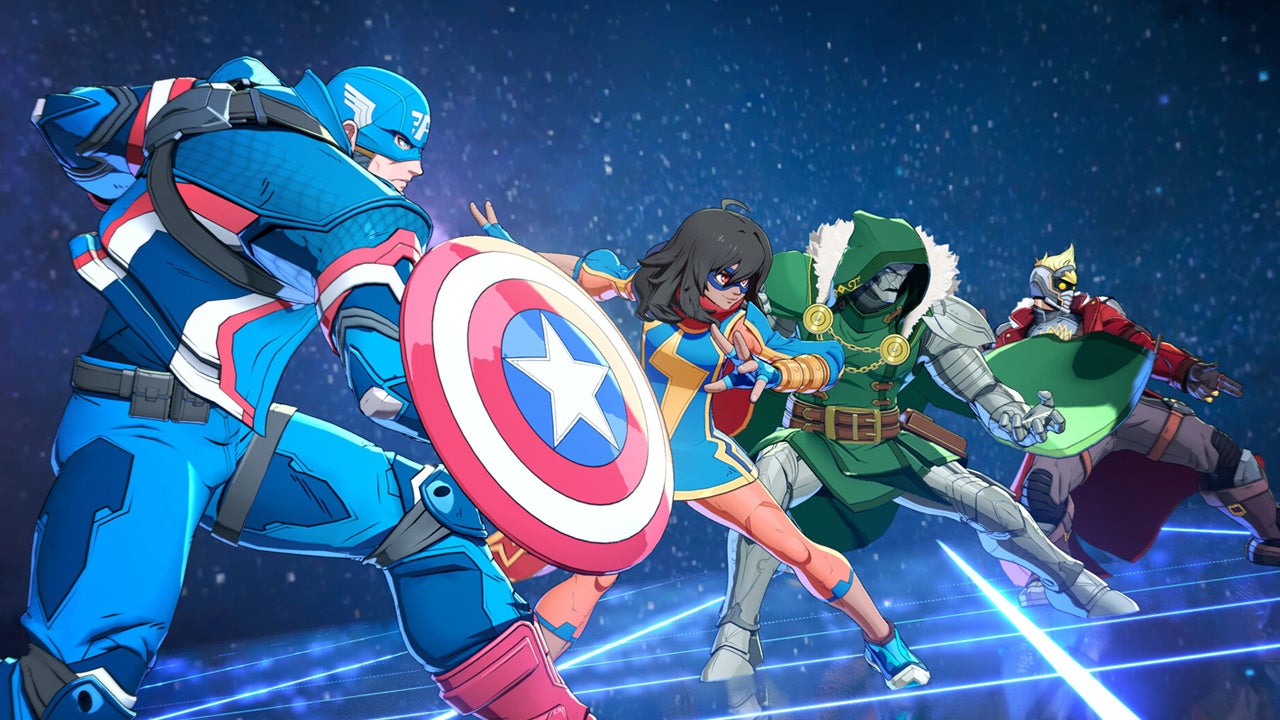
While we didn’t get pre-release access to the full version of Marvel Tokon: Fighting Souls, I did play many hours of online matches during its recent open beta, and can already confidently say that its fighting is a lot of fun. ArcSystem Works’ latest is a very mechanics-driven game that’s not always the most intuitive, so it took me some time to find my footing – but once I did, I got sucked right in. Its gorgeous action, its fantastic roster of characters, and especially its unique take on tag fighting allow for some flexibility in how many characters you actually need to learn to be competitive. I need to spend some more time in the arena and check out all the trimmings before my final review but Tokon seems primed to live up to the legacy of Marvel fighting games.
Let’s start with the fundamentals: Tokon is a 4v4 tag fighter with a bunch of unique rules that attempt to control the inherent chaos of having eight swappable characters in a single match. For example, all characters on a team share the same lifebar, removing one of the core elements of traditional tag fighting games, which typically let you swap in a fresh fighter and let the damaged one restore health while they sit on the sidelines. It’s a smart adjustment that allows for a much cleaner UI, avoids the pitfall of 4v4 matches that would otherwise run too long, and removes one of the big barriers of entry to any traditional tag fighter: the need to learn multiple characters in order to have a competitive team.
But what’s especially cool is that while you can be a very strong player by knowing how to play just one character, there’s still a ton of value in crafting a well-synergized team and swapping between them. For instance, if you know that your main struggles in a particular match up, like maybe your opponent plays Magneto and you would have trouble against his strong zoning, you could have a better option waiting in the wings. Or maybe you have a character that you really like but have trouble opening opponents up with, like in my case, Blade – you could lead with a more mix-up-heavy character, and once you land the hit, swap to continue the combo and get more damage than the mix-up character might have been able to get on their own.
What I really love about this system is that you can add new elements to your gameplan piece-by-piece rather than feeling like you need to have everything on lock right from the start. When I first started playing, all I needed to do was get competent with Spider-Man. I learned some high/low mix-up options, some bread and butter combos, got a basic understanding of how to use his web-zip to maneuver around the screen, and I felt ready to start playing against other people online. When I started to feel like I hit the ceiling of what I could do with just Spider-Man, I went back into training mode to learn more about Blade, and was able to add new layers to my gameplan. This process of being able to start with a small foundation and build upon it is the ideal way to learn a fighting game, and Tokon feels designed specifically for it.
You can be a strong player with just one character, but there's a ton of value to a well-synergized team.Where things start to get a little strange is when you add assists into the mix. You see, Tokon doesn’t begin as a 4v4 fighter. Instead, every match starts with just two of the characters on each team available, with the remaining fighters needing to be unlocked by either landing a light auto-combo, hitting the opponent with a move near the corner that causes a stage transition or wallsplat, connecting with a throw, or losing a round. Unlocking these characters is important, because each one adds another bar to your Assemble meter, which governs the ability to call assists during specific moments.
Tokon has a lot of hyper specific rules surrounding its assists, which leads to a system that can be fairly overwhelming for newcomers – it was certainly a lot to take in for me, even as someone who’s played lots of tag fighters like Marvel vs Capcom, Dragon Ball FighterZ, 2XKO, and many more. Before a match begins, you place your four characters into various positions: Leader, Shooter, Vertical, and Assault. These placements determine what kind of assist is used when you call them out in neutral (meaning when you’re just standing still or walking without pressing a button or blocking). Leader is whoever the current point character is, Shooters will use a projectile, Verticals predictably cover a vertical hit box, and the Assault spot is generally reserved for each character’s most powerful assist.
These neutral assists don’t cost any meter, but if you try to call an assist after landing an attack to pick up a combo or to cover your recovery after a blocked move, you’ll instead get a universal dash-attack assist that costs one bar of the Assemble meter. What’s finicky about this system is that you have to be very precise with your assist call, because if it happens too early (or too late) the assist won’t come out. This extends to the active tag system, which allows you to switch control to your assist character for a brief period while they’re on the screen. It’s very similar to 2XKO, but here it feels much more restrained. In 2XKO, you can basically swap to the assist character at any point, enabling some really tricky mix-up opportunities. Tokon, on the other hand, seems to be much more hesitant to allow these kinds of unrestrained mix-ups. While that’s understandable considering how crazy it could be with three assist characters, it does lead to an active tag system that feels awkward, unintuitive, and less fun on the offensive side of things.
However, the nerfed strength of active tag in no way means that Tokon doesn’t have depth or flair. Every character oozes style; Spidey is able to zip all across the stage, baiting anti-airs by hanging and then jumping off his webs; Storm can manipulate the weather to push and pull objects and enemies (or even snatch her opponent in a command grab from half-a-screen away with a gust of wind that pushes her forward); Magneto fills the screen with literal metallic garbage that he can utilize as a weapon. We’re no stranger to seeing a lot of these characters in fighting games before, but ArcSystem Works has gone above and beyond in terms of making them feel authentic to their comic book counterparts, while also ensuring they are each a blast to play in their own particular way.
There’s still a ton left to cover, from the story mode that promises a 10+ hour original story that follows the various teams that make up Tokon’s roster, to the teaching and training tools, to the gigantic online lobby that I only briefly got a glimpse of. I also plan to test the PC performance on live servers thoroughly given the issues that plagued the platform during the most recent open beta. Check back for all of that and more in my full review early next week.
Mitchell Saltzman is an editorial producer at IGN. You can find him on twitter @JurassicRabbit