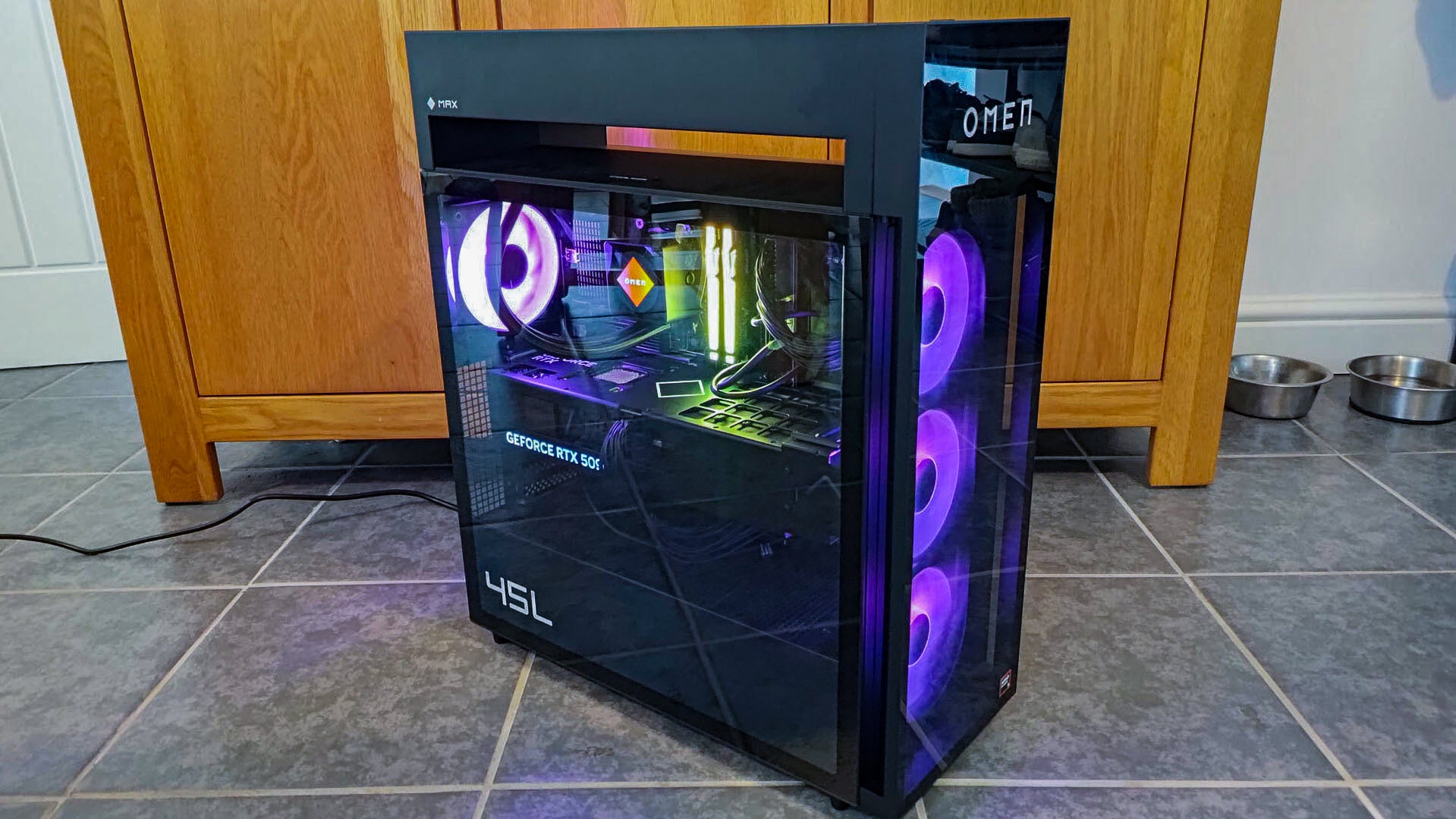
"Go big or go home" is the clear mantra behind the HP Omen Max 45L. This machine doesn't just sit on your desk; it dominates it. Featuring a massive Nvidia RTX 5090 equipped with an anti-sag bracket, a mountain of memory, and vast storage, this system is designed for those who refuse to compromise on raw power.
The standout design element is the unique chassis that completely silos off the CPU cooling, reminiscent of classic Vapochill phase change units. While the price tag is steep, the HP Omen Max 45L offers a high-end experience that prioritizes thermal efficiency and quiet operation in an era where premium hardware is increasingly expensive.
High-End Specs and Configuration Options
The pricing for this machine varies significantly depending on which components you select. While the flagship model reviewed here carries a premium, there are several entry points into the Omen ecosystem.
- Base Model: Starts at $3,199 (AMD Ryzen 7 9700X, RTX 5070, 32GB DDR5, 1TB PCIe 5 storage).
- Review Configuration: Priced at $6,500 (AMD Ryzen 9 9900X3D, RTX 5090, 64GB DDR5, 4TB storage).
- Alternative Options: Includes AMD RX 9070 XT GPUs and different CPU choices like the 9800X3D or 9950X3D.
It is worth noting that our flagship test unit utilizes the 12-core 9900X3D rather than the absolute top-tier 9950X3D, which might feel like a curious choice given the $6,500 price point.
Design and Thermal Innovation
The HP Omen Max 45L is aptly named; it is a bold, massive system. The LED lighting and glasswork are tastefully executed, though HP makes it clear that "unicorn vomit" levels of RGB customization are available if you prefer a more flamboyant look. Unlike the trend of wraparound glass panels seen in many modern builds, this case uses a segregated cooling unit on the top that sets it apart from the crowd.
Cooling Performance and Maintenance
The thermal architecture is arguably the most innovative part of this build. By isolating the CPU radiator in the roof with its own dedicated intake and exhaust, HP ensures that CPU heat does not bleed into the rest of the system. This prevents the GPU from inhaling warm air, resulting in slightly higher frame rates and quieter fans compared to traditional front-mounted radiators.
However, there are some practical trade-offs to consider:
- Limited Expansion: The bespoke HP 8E55 motherboard only offers one PCIe x16 port and one PCIe x4 slot. With the massive RTX 5090 installed, that x4 slot is essentially inaccessible.
- Storage Accessibility: The secondary M.2 SSD sits directly beneath the GPU, meaning you must remove the graphics card just to service that drive.
- Cable Management: While most cables are behind the tray, there is still a noticeable "spaghetti mess" in the front section, held together by single-use zip ties that make rerouting difficult.
Hardware and Connectivity
Despite the bespoke nature of the components, HP has used standard formats where it counts. The system features an HP-branded 1,200W Gold efficiency ATX 3.1 power supply, which can be swapped for other ATX units in the future. The rear I/O is functional, providing a decent selection of USB-A, USB-C, audio connectors, and a 2.5 Gigabit Ethernet port, though heavy users might find themselves wishing for more USB 2.0 ports for secondary peripherals.
Software and Optimization
The software experience is relatively clean. While you will encounter standard pre-installed apps like HP Smart printing or HP Support Assistant, the most useful tool is the Omen Gaming Hub. This interface allows you to monitor temperatures in real-time, customize the AIO CPU cooler’s LCD panel, and manage RGB lighting across all system fans.
The inclusion of the Omen AI helper provides an extra layer of optimization for component and in-game settings. While a machine with an RTX 5090 shouldn't struggle with any title, utilizing features like DLSS and Frame Generation remains highly recommended to smooth out frame rates in the most demanding ray-traced environments.