Motor City will be released in theaters on July 24.
There are fewer than a dozen lines of audible, functional dialogue in Motor City — Potsy Ponciroli’s ’70s-set Venice Film Festival premiere — resulting in a gruff, stripped-bare action film that highlights the genre’s worst and best. That it comes down on the side of “highly entertaining” is a minor miracle, if only because Ponciroli and his cast are completely locked in to the moods and movements that dominate the screen, allowing for an unfiltered (if musically overbearing) piece with its own brutal rhythms.
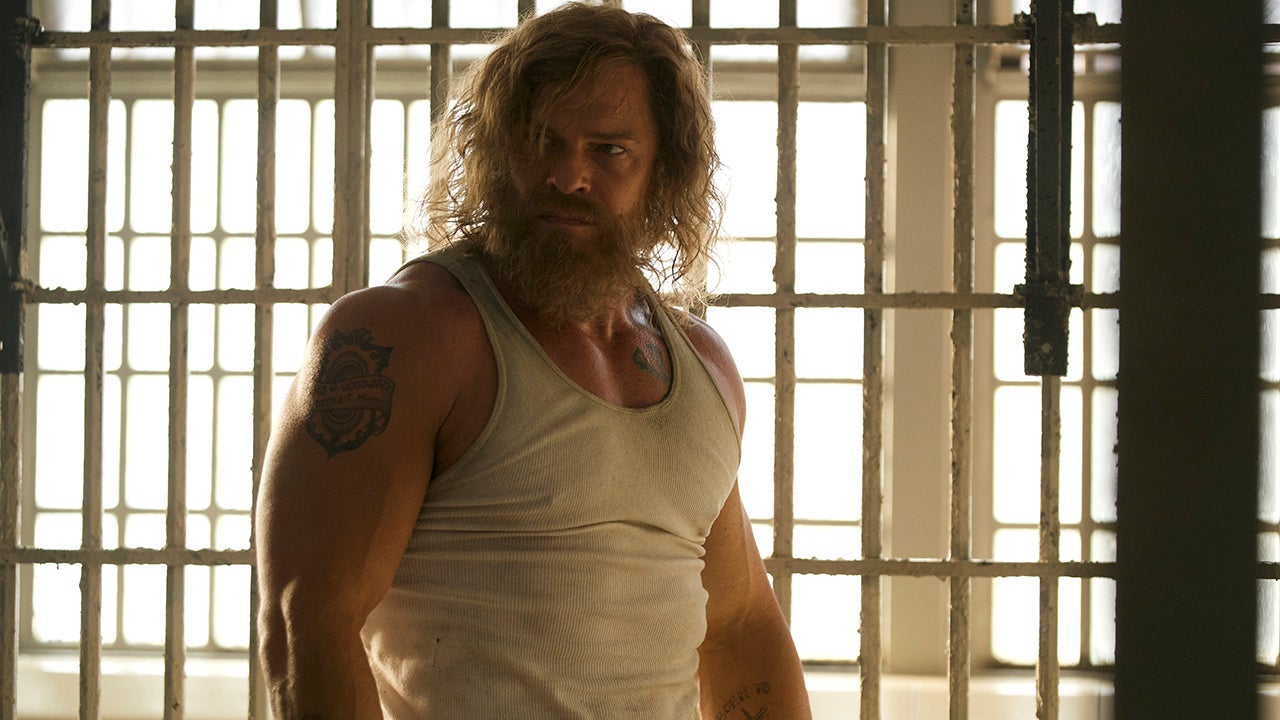
Granted, when you sacrifice words in a movie that’s this reliant on minor details, you end up either focusing on bits of paper, like modern silent intertitles — foreclosure notices, job applications, news articles, and so on — or you end up forgoing information entirely. This applies to Motor City’s protagonist, John Miller, a hulking former soldier with a nondescript job and close crew-cut. However, when you have an actor like Alan Ritchson in the part (think Schwarzenegger with more sensitivity), it’s a sacrifice you can afford. The movie opens in medias res with Miller wreaking vengeful havoc, dropping a body on a speeding car from a rooftop before firing a shotgun while getting flung through the air.
It’s a blast, no pun intended, and it builds just enough curiosity for you to get with the pseudo-silent program when Motor City flashes back to several months prior. Miller, a lion-maned hustler on probation — again, those are all the details we have — proposes to his waitress girlfriend Sophie (Shailene Woodley) before being framed in a major drug bust. Through flashbacks and silent stares, we learn that the mastermind behind his false imprisonment is slimy drug lord Reynolds (Ben Foster), who has numerous corrupt cops at his disposal, like the leather trenchcoat-sporting Savick (Pablo Schreiber). Meanwhile, more clean-cut detectives like Ben McKenzie’s Kent seem intent on unraveling this conspiracy.
It’s in establishing these characters and their motives that familiar stock types and obvious costume design come in handy. Reynolds especially benefits from this, as well as from Foster’s casting as a skeevy, potbellied, envious ex, whose ploy is all about winning Sophie back. In the meantime, Miller languishes in prison, his hair and beard growing ever longer, and prepares to escape and exact revenge with the help of two former comrades on the outside: Youngblood (Lionel Boyce) and Singh (Amar Chadha-Patel).
The trio, who eventually stage a blazing clockwork prison escape, are pretty cool, albeit in familiar ways, what with their straight-from-a-soup-can swagger with which they strut away from explosions. However, this being a bog-standard revenge flick in every way (except its sound), you already know which characters are more disposable than others, which is to say “anyone who isn’t a white man.”
Still, Motor City makes for an engaging experience, if only because it forces its author and audience alike into a somewhat non-traditional mode of filmmaking and viewing. It shouldn’t be this out of the ordinary for an American action flick to depend on visual cues, but in an increasingly homogenized action landscape, watching body language, blocking, and editing tell a story is a delight unto itself. It certainly helps that the movie taps into visceral sensations along the way, such as its vicious bloodshed and one particularly exciting no-holds-barred combat scene in the confines of an elevator. All of this is enhanced by Ritchson and Foster delivering fully-committed performances as admittedly retrograde archetypes in pursuit of their blood feud over a woman.
Ritchson and Foster deliver fully-committed performances as admittedly retrograde archetypes in pursuit of their blood feud over a woman.If there’s one place Motor City drops the ball, however, it’s in its music selection. Any film that muffles and circumvents the spoken word is bound to rely on other auditory means, and while its ambient sounds are just fine — they’re functional and unremarkable rather than absorbing — the movie’s wall-to-wall needle drops in the vein of the Guardians of the Galaxy movies feel a touch random. The artists in question are certainly era-appropriate — David Bowie, Donna Summer, Fleetwood Mac, and so on — and they prevent boredom during the initial setup before the movie finally lets Steve Jablonsky’s booming score do its work. But the title is Motor City, and there’s nothing particularly Detroit-esque about it, least of all its tracklist: The Bowie song in question isn’t even “Panic in Detroit!” This was the era of Alice Cooper and Iggy Pop, and the birth of techno; you couldn’t ask for a more appropriately propulsive in-built soundtrack, and the movie doesn’t take advantage of any of it.
Ultimately, this ends up indicative of how even Motor City ends up part of the aforementioned homogenized traditions of American action films, where time, place, and music have an increasing unimportance. You can transpose the story to any other setting or era without losing all that much, which is disappointing. But regardless of its missteps, that the movie works at all is almost worth applauding, even if only for the fact that Ponciroli gets enough audio-visual basics right to craft a coherent film of wanton violence. It’s pretty silly and pretty fun.