Earlier this week, it was reported that Microsoft has entered negotiations to shut down, or grant independence to, acclaimed action-game studio Ninja Theory just a mere eight days after the studio revealed its newest title, Senua, at this year’s Xbox Games Showcase. While the potential dismantling of a tenured studio is always tragic, Ninja Theory leaves behind a legacy that goes beyond video games, ultimately shaping Hollywood films that perhaps would not have been made without the studio's ambition.
Founded in 2000 under the name Just Add Monsters, Ninja Theory built itself upon a promise of delivering high-octane action games with unique aesthetics, such as Kung Fu Chaos and Heavenly Sword. The studio emphasized creativity and narrative as its core values and sought to deliver AAA-level experiences despite its smaller team and budgets.
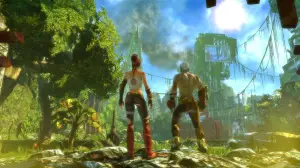
In 2009 after the studio delivered their first Sony exclusive with Heavenly Sword, this ambition led founder Tameem Antoniades and his team to visit numerous Hollywood studios to pitch their next project, Enslaved: Odyssey to the West, as a CGI film. The project would be a retelling of the classic Chinese novel Journey to the West, but set 150 years after mankind has been wiped out in an apocalyptic event. However, Ninja Theory found itself unable to convince a movie studio to fund it. Ninja Theory then began pitching it as a video game and, eventually, struck a deal with Bandai Namco to publish the title.
With development of the game fully underway, the studio then opted to bring on Hollywood screenwriter Alex Garland, who had just begun to make a name for himself for his work on films such as 28 Days Later and Sunshine. Eager to find a way to break into game development, Garland offered his services to help make Enslaved’s story more cinematic. He took an active role in the game’s design, stripping down the exposition in the script and allowing the gameplay and environments to convey information to the player. According to Antoniades, Garland was “intimidating” to work with, but the studio founder later praised Garland's gameplay design choices as the correct decisions in retrospect.
Enslaved: Odyssey to the WestUpon its release, it seemed as though the general public agreed. Enslaved: Odyssey to the West released in 2010 to critical acclaim, with GameSpot’s review calling it, “A great adventure that has just enough excitement and diversity in the gameplay to keep you engaged" and a game with "striking visuals."
For the studio’s next project, Ninja Theory would collaborate once again with Garland. After being impressed with the studio’s previous titles, Capcom reached out to Ninja Theory to reboot its Devil May Cry franchise. Antoniades would write the game’s script with Garland, while the latter would also serve as script and story supervisor. The reboot, DmC: Devil May Cry, marked a drastic departure from the previous, gothic-inspired games in the franchise. Instead, DmC offered a dark and gritty take on the world that was inspired by a grittiness similar to Christopher Nolan’s The Dark Knight and British punk-rock sensibilities. The game reworked the series' lore, and served as a refresh of the origin of protagonist Dante as he traversed the world between Heaven and Hell.
DmC: Devil May CryDmC released in 2013, and while praised for its gameplay mechanics, was largely reviled by fans of the series and seen as a commercial failure by Capcom. Its biggest criticisms were the disregard for series' lore and the characterization of Dante. However, Devil May Cry series producer Matt Walker praised the game, saying it had “an amazing world all its own that could only have been produced by the amazing artists and imaginations at Ninja Theory.”
Alex Garland would end his relationship with Ninja Theory with DmC: Devil May Cry, opting instead to return to the world of filmmaking. The following year, Garland made his directorial debut with the indie darling Ex Machina; he would then go on to make films such as Annihilation and Civil War, both of which were critically praised.
Interestingly, though perhaps unsurprisingly, Garland's style of filmmaking features the same storytelling elements that were present in his games, and it features cinematic action sequences that feel ripped straight from a video game.
Ex Machina (2014)In a full circle moment, it was announced in 2024 that Alex Garland would write and direct an adaptation of From Software’s Elden Ring for A24. The story goes that, after being impressed while playing through the game, Garland decided to write a 160-page spec script and fly all the way to Japan to directly pitch it to game director Hidetaka Miyazaki, ultimately earning the game studio’s approval.
Alex Garland took what he learned working with Ninja Theory and applied it to a whole different medium of entertainment. Without the ambition and collaborative nature cultivated at Ninja Theory--ideas that challenged what it means to be a AAA action game or a narrative-focused video game--this, presumably, wouldn't have taken place. Ninja Theory helped give filmmaking one of its most ambitious directors, among many other achievements. To see them close their doors would not only be a great loss to Microsoft and Xbox, but to gaming as a whole.