My wrists are sore from how much Splatoon Raiders I’ve been playing. If you’re a series veteran like I am, you know that can happen when you combine its signature twitchy motion aiming with marathon PvP sessions. But there’s no competitive multiplayer here. Instead, the first Splatoon spinoff is an incredibly well-designed action RPG that’s already drawn me in for more than 40 hours. It’s all about tinkering: I love crafting my build to get just a little bit stronger, putting it to the test in challenging, varied stages, and then sifting through the meaningful loot I earned to see what creative combination I can glue together next. When you stack that classic but expertly executed loop on top of Splatoon’s already awesome foundation, you get the strongest campaign this series has ever seen and one of the best Switch 2 games so far.
Raiders follows Splatoon 3’s idols, Shiver, Frye, and Big Man, as they head to the remote Spirhalite Islands to hunt for treasure. They’re trying to help pay off Splatsville’s enormous debt by battling waves of Salmonid enemies to uncover valuable relics. The story that unfolds is a swashbuckling ride that adds plenty of interesting details to Splatoon’s excellent world. Beyond the plot, though, I’m most impressed with how every element of this setting plays into the central theme of making the most of what’s already in front of you.
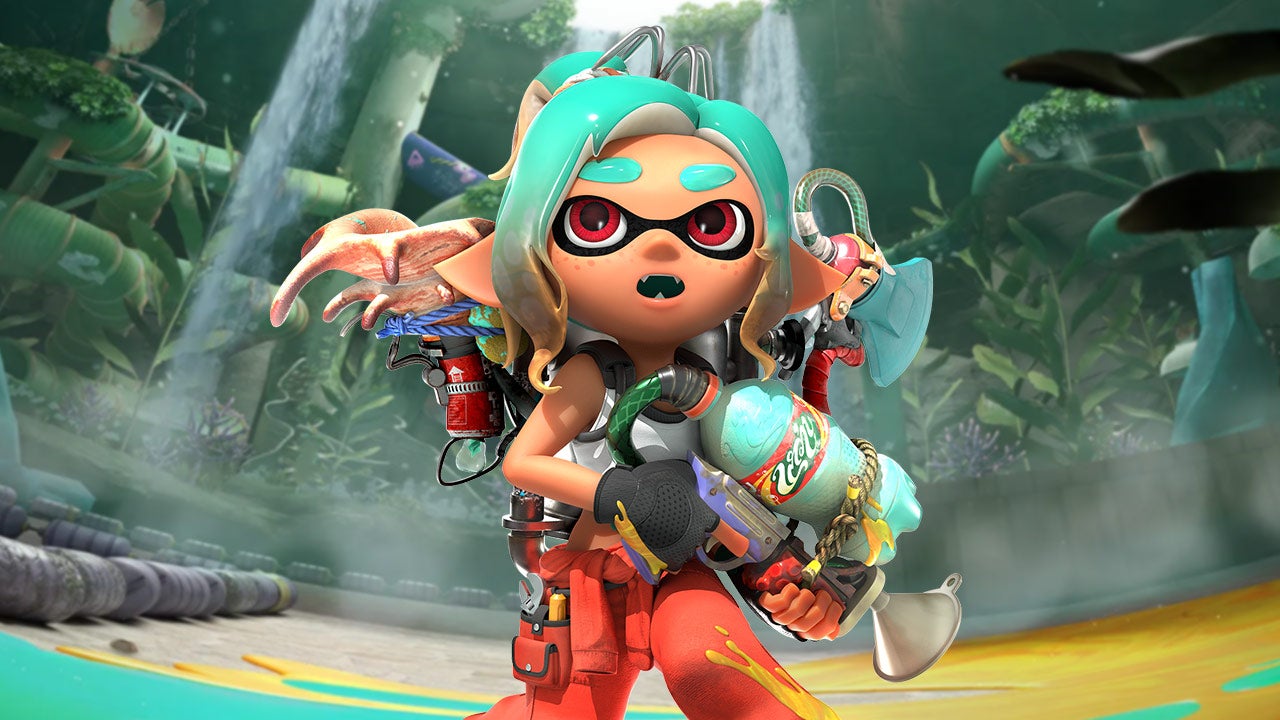
That resourcefulness starts with your character: the Mechanic, a blank slate Inkling or Octoling who has a knack for crafting. All 11 ink-dishing weapon types return, but the Mechanic has put their own spin on the designs. Instead of the polished, toy-like look of the mainline Splatoon games, weapons in Raiders are stitched together with duct tape and literal garbage, which gives it a scrappy, homemade visual identity that really stands out. The standard Splattershot’s ink tank can take the form of old bottles of soda or dish soap, while the bow-and-arrow-like Stringer can be made out of a broken tennis racket.
Attacking enemies, covering the ground with ink, and swimming through it feels better than ever no matter which weapon type you prefer, thanks in part to the improved HD Rumble of the Switch 2 pro controller. It was fun to experiment with different weapons across the 18-hour campaign and well beyond, even if I found myself falling back into using the dual-wielded pistol Dualies, which were hard to break away from after more than 150 hours spent with them in Splatoon 3.
Inkspector GadgetEven though I mostly stuck to the weapon I’m used to, Raiders still felt super fresh thanks to its standout new feature: Gadgets. These are special pieces of equipment separate from your main weapon, and a huge chunk of the RPG loop is built around them. The options are spread across three classes determined by which ink tank you equip – Speed, Power, and Tactical – and each one’s unique strengths are endlessly fun to experiment with. The Speed Tank’s Gadgets prioritize mobility and evasiveness, such as the Jump Bomb that lets you leap out of dangerous situations, or the Flywire grappling hook that can close the distance between you and your target in a flash. The Power Tank’s Gadgets let you charge in to deal heavy damage, like the Splatchet’s sweeping slash that can kill some Salmonids in a single blow. But my favorite has to be the Tactical Tank, with strategic Gadgets that focus on spacing. That includes the Bombloons: ink-filled explosives that link up with each other, causing a violent burst that scales with how many you have in the field.
Gadgets are deeply customizable tools that allow for tons of different builds.Each individual power is just the beginning, as these are deeply customizable tools that allow you to create tons of different builds, especially when you consider that you can have two Gadgets equipped at one time. You’ll constantly uncover new combinations that play off each other in smart ways – like how the Jump Bomb and Flywire can work together to make an acrobatic build where you never touch the ground. As you complete missions, you’ll unlock new skills for your Gadgets as well, and this is where the experimentation truly shines.
Take the Bombloons, for example. You could work on making them as explosive as possible, covering more area when they detonate and dealing more damage. Or, you could take advantage of the fact that the tether between the Bombloons also deals damage, and instead work to make them last as long as possible when deployed to maximize that tether. These are just two of hundreds of potential avenues you could take, and as your character levels up, you unlock room to slot even more skills into each Gadget, further expanding your potential. I will say, the crafting menu could really use a wishlist system so I can keep better track of all the materials I need to buy these upgrades – right now, I have to screenshot, write down, or just remember everything I’m hunting for.
You can swap your Tank type at any time, and you are actively encouraged to do so, with specific missions that yield unique rewards depending on which one you use. That means you always want to rotate between them and keep each Gadget lineup up to speed with your current level. I have at least one strategy centered around each tank, like my favorite Tactical build where I literally never fire my main weapon because I stay submerged in the ink 100% of the time, cooling down my gadgets faster and causing thousands of points of passive damage. The way Gadgets interact with each other inspires creativity, and new build ideas constantly spark in my head as I try to figure out more ways to break Raiders open. And it never stops giving you new toys to play with or ways to upgrade your gear. Every time I thought, “wouldn’t it be cool if I could do this?”, I eventually unlocked that possibility.
Raiders of the Lost InkThis campaign forces you to use every tool to the fullest, because the Salmonid army is not messing around. It’s one of the more challenging first-party Nintendo games in the last several years. Relentless hordes will overwhelm you if you don’t head in with a solid strategy, and your base weapon just won’t cut it on its own. If that sounds unappealing to you, there are three difficulty levels to choose from, and all they change is how much damage you take – not the level design, rewards, or experience given. As an S+ rank player in Splatoon 3, I immediately turned the difficulty to the hardest setting, Survivalist. This led to tense firefights and a thin margin between victory and defeat, and I love the stakes that created. I also tested the standard mode, and while I didn’t die nearly as much, the smart encounter design and identical number of enemies still provided a satisfying learning curve. Failure is an important part of Raiders. When you lose, you have to head back to base, rethink your build, and maybe complete a couple of side missions before trying again. The deep customization wouldn’t be nearly as interesting if the missions were a breeze, and Raiders completely nails that important balance.
It also doesn’t hold your hand at all. Each stage has a threat level it warns you of ahead of time, but it doesn’t stop you from tackling something way above your paygrade. You may get crushed, but it’s so fulfilling when you find a way to topple a mission you had no business clearing yet, made even better when you’re rewarded with a rare weapon or material drop for doing so. Missions only take a few minutes each, so it wasn’t frustrating or a huge setback when I lost. There were several times I could tell I was inching closer and closer to the finish line until I finally broke through. Not just from the numbers going up, which you do visually see, but from a tangible feeling that I was taking enemies down a split second faster, my health was lasting a little bit longer, and I had better Gadgets ready to go.
Relentless hordes of Salmonids will overwhelm you if you don’t head in with a solid strategy.Raiders stands out even further with its nearly perfect pacing. Across its campaign, I grew incrementally stronger with each success, but the Salmonid army always stayed one step ahead, with increasingly challenging stages that asked me to find new ways to keep up. But I never felt like I was unnecessarily grinding or replaying levels over and over, because there were always new stages to play.
There are five main level types, each with a different objective and unique rewards for clearing them. The standard levels are linear paths with some fun platforming challenges as you make your way to the next intense wave of Salmonids, grabbing optional collectibles as you go. You’ll also dive into multi-level dungeons where you need to clear each floor in a limited amount of time, placing an emphasis on efficiency and raw damage output over pure survival. Alternatively, Salmonid Dens star a specific enemy type and often require a degree of lateral thinking where picking the right tool in your toolbox is the only way to clear the room in time, like a race to the top of a mountain where the Speed Tank is the best choice to get the job done. And then there are levels about mining a giant crystal for resources, where you only need to fill the meter halfway to clear the stage, but can risk it all to fill it further for bonus rewards, as long as you’re confident you can still extract before losing all of your lives.
Finally, the Sampler Dungeons are a standout, as they are Splatoon’s take on shrines from Breath of the Wild. Each one takes you through a set of puzzles where you’re limited to a specific loadout. What’s smart is that there’s a Sampler Dungeon for each Gadget, and it equips you with one of the strongest possible versions of that tool. Then, through the puzzles, Raiders essentially teaches you why this Gadget is good, and gives you different ideas for how you could use it. They are great tutorials for new powers, and I learned things about multiple gadgets I’d previously underestimated. These are motivating, too: seeing some of the craziest combos you can pull off with a souped up version of a Gadget made me want to go and upgrade my own so I could do it all the time.
I really enjoy every level type for different reasons, and enemy variety shines across the board. The Salmonids will be familiar to anyone who played a lot of Salmon Run in Splatoon 2 or 3, but a key difference is that Raiders focuses on handcrafted levels rather than random waves, and the way they’re used leads to clever encounters that often feel like puzzles. Every enemy type poses a unique problem, like the Smoker‘s giant bubble that protects enemy Salmonids, or the bouncing Big Shot‘s damaging shock wave that pressures you out of the ink. Different combinations of these foes means there’s always a lot to consider as you weave through the chaos and make split-second decisions about who to take out first – maybe you surround yourself with protection by way of the orbiting Splatellite Gadget, or you could use updrafts nearby to get airborne. There are always multiple ways to win.
I really enjoy every level type, each for different reasons.And when you do win, each of these mission types gives you something different as a reward, whether it’s money, a new buff, certain crafting materials to improve your Gadgets, or skill points to upgrade your character. So when you need something specific, there’s always a level type waiting for you, and you’re constantly bouncing between them. When you add in the endless build shuffling and a few excellent boss battles sprinkled throughout, Raiders always feels fresh.
There are also Spicy versions of every level that dramatically up the difficulty and number of enemies. These are extremely fun to tackle and require even more creativity and strategy to clear. I was initially unimpressed by Raiders’ graphics – it doesn’t look all that different from a Switch 1 game – but when I saw the sheer amount of enemies crammed on screen in a Spicy level while it stayed locked at 60fps, I understood how this game was taking advantage of the Switch 2’s additional power. My main complaint is that these levels aren’t that visually interesting. You’ll see a lot of repeat biomes with a fairly bland, muted color palette, which is an odd thing to say about this generally very stylish series. Compared to the bright, neon stages of the main series’ multiplayer levels, the underground subway look of the Octo Expansion, and the Side Order DLC’s monochrome style, this is definitely my least favorite Splatoon aesthetic.
Inked TogetherRaiders is playable entirely in online co-op, and I’m so impressed with how it gets pretty much every decision right. This series has come a long way considering Splatoon 1 and 2 didn't even have a competent friends lobby system. In fact, Splatoon has shed a lot of its bad habits here, as there is no lengthy newscast rigamarole to mash through when you boot it up – you just jump right in.
Multiplayer supports up to four raiders, and while the host has to pick the levels, everyone earns their own separate loot and gets credit for completing that stage, so you can feasibly play the whole campaign together. The smartest thing it does is level scaling based on the individual player. If I’m level 30 playing in my friend’s level eight mission, enemies appear as level 30 on my screen and level eight on theirs. I also earn rewards appropriate for my level, which makes it worth it for me to play through lower-tiered stages I’ve already cleared before. That meant I both had to put up a real fight and I wouldn’t ruin my friends' game by just streamrolling everything with endgame gear. And because difficulty settings only impact the amount of damage you take, I can play on Survivalist while my friend plays on an easier difficulty with no issue.
If you’re a solo player and need help, you can call for assistance from other players around the world, who will earn bonus rewards for helping someone in need. There’s even an arcade game to play back at your base while you wait for everyone to finish their prep, which is a nice throwback to Splatoon 1’s Squid Jump on the Wii U GamePad. It really feels like they thought of everything.
That said, I do think Raiders is actually slightly better as a single-player game, only because its clever level designs can be trivialized when you throw more firepower into the mix, which turns it into a bit more of a generic multiplayer shooter. Don’t get me wrong, it’s still totally fun to blast through levels with your friends if that’s what you want to do, it’s just a very different vibe to the puzzle-like nature of going it alone. I might recommend you play the campaign on your own first, and then group up with others when you go back for the endgame.
Speaking of which, the endgame opens up even more difficult challenges to tackle and more powerful customization to gear you up for it. I’ve already put in 20 hours since the credits rolled. It’s totally reasonable to feel satisfied and walk away after the awesome campaign, but if you’re like me and play Monster Hunter or similar games for hundreds of hours and love the grind, there’s plenty of really cool stuff left to do. I initially thought the balance wasn’t quite as finely-tuned in the endgame – it seemed much easier to craft a pretty broken build fairly fast – but Raiders eventually rebutted with tests that sent me right back to the workbench. Raiders is unlikely to be a forever game for me, but I’m sure I’ll get a couple dozen more hours out of it as I play with friends, help strangers, and continue to improve my loadouts.