Steam Machine review
It's finally here. The much-anticipated Steam Machine, a mini gaming PC designed for your living room, is in my possession—and it's a lovely device to behold. It's sleek, futuristic, and very, very Valve. I've been testing it thoroughly over the past week, and I'm sure you're anxious to know the results. Have all my mini gaming PC Christmases come at once? Well, not quite. Because while Valve's attempt to bring PC gaming to your TV—and thereby the masses—has plenty of admirable qualities, it's got one giant caveat hanging over it: the price.
The 2 TB, Steam Controller-included Steam Machine bundle in my possession costs $1,428 (£1,208). The controller-less 2 TB variant is $1,349 (£1,149), while the 512 GB version, again without controller, is $1,049 (£879). Add a controller to the 512 GB variant, and you're looking at $1,128 (£938). Much has been made over the Steam Machine's delayed launch and increased price tag, brought on by the ongoing memory crisis crippling the consumer electronics market right now. But holy moly, that's a lot of money for a mini gaming PC. Especially one with internals that, in 2026, feel underpowered before it's even officially released.
The RDNA 3-based GPU inside the Steam Machine has left me feeling, if I'm honest, rather deflated. It's certainly possible to drop the settings, bump up the upscaling, and squeak some smooth gaming performance out of the little black box. But the drawbacks feel like a step too far when you're paying this sort of cash. The idea might be to bring the PC gaming experience to your living room, but if that experience includes smooth frame rates in demanding games, you're going to have to make some major compromises. And, because of its Linux origins, it hasn't been a flawless experience getting some of those games to run properly to begin with, either.
I want to get excited about the Steam Machine, I really do. It's a fascinating piece of design, and an admirable attempt to bring PC gaming from your desktop to your couch in one bite of the cherry. But like so much hardware these days, it's been hampered with a price tag that, given what you actually receive, feels like far too much to pay.
When to Buy the Steam Machine
✅ You're well-heeled and curious: If the price tag above made you shrug your shoulders, and you want a fascinating little under-TV PC gaming box to mess around with, the Steam Machine starts to make sense.
✅ You're not planning on playing anything too demanding: The Steam Machine requires a ton of upscaling and frame generation help to deliver smooth frames in demanding games, with all the compromises that entails. If you're more of an indie gamer, though, it's got enough grunt to get by with little issue.
When to Avoid the Steam Machine
❌ You want high performance: You can get much better performance for your money from a regular gaming PC hooked up to your telly box for similar cash. It won't be anywhere near as small, or as cute, but your games will look and run better. And that counts for a lot.
❌ You're on a budget: Yes, you've probably spotted a theme already. The Steam Machine would make sense if it was affordably priced—but as things stand, the value proposition just doesn't add up.
Steam Machine Features
Here are some key specs of the Steam Machine:
- CPU: Semi-custom AMD Zen 4 6C / 12T
- CPU Max. clockspeed: 4.8 GHz
- GPU: Semi-custom AMD RDNA 3
- Max. sustained GPU clockspeed: 2.45 GHz
- RAM: 16 GB DDR5
- Dedicated VRAM: 8 GB GDDR6
- Storage: 512 GB / 2 TB
- Connectivity: 2x2 Wi-Fi 6E, Bluetooth 5.2, integrated 2.4 GHz Steam Controller wireless adapter
- I/O: 2x USB Type-A 3.2 (front), 2x USB Type-A 2.0, 1x USB Type-C 3.2, 1x DisplayPort 1.4, 1x HDMI 2.0 (rear)
- Extras: Optional Steam Controller, customisable face plates, HDMI 2.0 cable
- Price: 512 GB model w/out controller: $1,049/£879. With controller: $1,128/£938. 2 TB model w/out controller: $1,349/ £1,149. With controller (as reviewed): $1,428/£1,208.
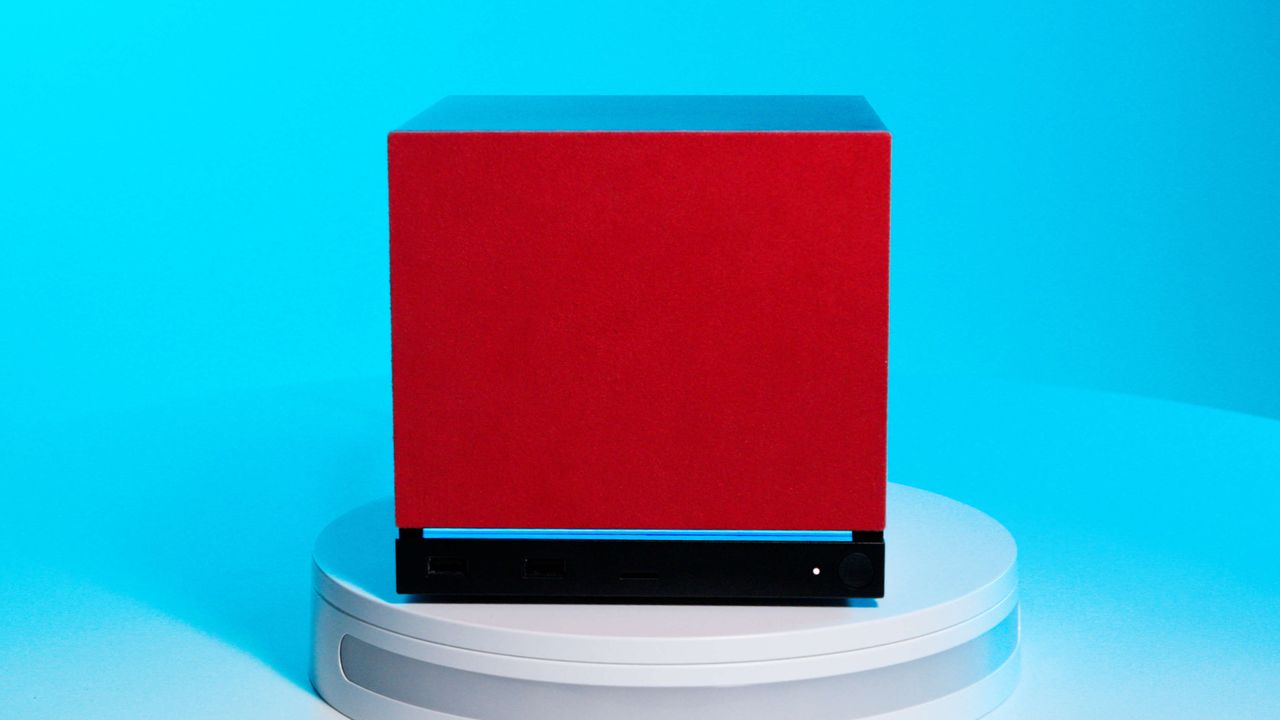
The Steam Machine is, by default, a black cube. Measuring 15.2 x 15.6 x 16.2 cm, its top is a touch smaller than a handspan. Or mine, at the very least. Underneath the removable magnetic front face plate (two extras are included in the box with the 2 TB bundle) is a small panel consisting of a power button on the right hand side, two USB 3.0 Type-A ports, and a microSD card slot.
Above them lies an RGB strip, which by default lights up in blue while you're gaming or downloading, and turns off at idle. Around the back are two USB 2.0 Type-A ports, a single USB 3.2 Gen 2 Type-C port rated to 10 Gbps, and a 1 Gbps ethernet connection. For display options, you've got a choice of a DisplayPort 1.4 connection, or an HDMI 2.0 port.
And of course, it can be bundled with a Steam Controller, which is a sizable symmetrical-style unit with twin TMR thumbsticks, eight face buttons, four rear grip buttons, two trackpads, haptic rumble, gyro controls, and a 35+ hour battery life. It's perhaps not the prettiest of objects, but as our Jacob found in his review, it sure is comfortable. Useful, too.
On the outside, the Steam Machine is a very unassuming little device, which is certainly by design. It's the internals, however, where things get really interesting. Under the hood lies a semi-custom AMD Zen 4 CPU with six cores and 12 threads, alongside 16 GB of system RAM. The GPU is also a semi-custom AMD RDNA 3 job, with 8 GB of dedicated GDDR6 VRAM, 28 compute units, a sustained max clock speed of 2.45 GHz, and a 110 W TGP. Being a semi-custom GPU, it's difficult to make a direct comparison with existing RDNA 3 graphics cards—although the budget RX 7600 XT from the same generation features 32 compute units and a similar game clock speed.
The Steam Machine comes in two different storage flavours: 512 GB and 2 TB. I've got the 2 TB model, which provides plenty of storage for many, many games. Should you opt for the 512 GB variant, you'll want to keep an eye on install sizes. Speaking of games, the Steam Machine makes use of SteamOS 3, an Arch-based operating system that's tailored for gaming.