Steam Machine Review
The Steam Machine is finally here after looming on the horizon for the last eight months or so. And while Valve has been adamant that the Steam Machine is an entry-level gaming PC, rather than a new, fourth player in the console space, this little box has captured the attention of console and PC gamers alike. At $1,049, the Steam Machine is unlikely to win over the hearts and minds of PlayStation and Xbox faithfuls, but it is easily the best living room PC I’ve ever used, despite being a bit weaker than either of the base consoles. But what’s truly impressive is that it’s able to do that while also being one of the best ways to just get into PC gaming in the first place. PC gaming has always been expensive, and the Steam Machine is certainly no different, but Valve was able to cut away most of the tinkering and just get new players into the game.
Purchasing Guide
The Steam Machine is available to reserve now, starting at $1049. That price will get you the base 512GB model with no controller. If you do want to add a controller, the price will go up to $1128, which is actually cheaper than buying the two separately. Or, if you want to maximise storage, you can get the 2TB model for $1349 without a controller, or $1428 with the Steam Controller. No matter which 2TB version you get, though, you'll get two additional faceplates.
Expensive, Or Is It?
The Steam Machine’s price has been a constant topic of conversation ever since it was announced back in November 2025. Back then, Valve made it very clear that the Machine would be priced competitively with a comparable gaming PC, and at that point, I assumed it’d land at around $800. But gaming PCs, and the components they’re made of, have become much more expensive since then. Thanks to the ongoing RAM crisis, fueled by seemingly every company needing to build a hyperscale datacenter, the 16GB of RAM in the Steam Machine alone would cost nearly $250 by itself.
With that in mind, it makes it a little easier to understand how Valve landed on a $1049 price point for the 512GB version and $1349 for the 2TB model, even if it makes it a bit harder to recommend. That makes the Steam Machine around $400-450 more expensive than the Xbox Series X or the PlayStation 5 to start. That price probably disqualifies Valve’s new mini gaming PC in the eyes of many console faithfuls, but it makes a lot more sense for its intended purpose as an entry-level gaming PC.
Because as much as that $1049 price tag is shocking at first glance, Valve is still keeping its word about keeping the price competitive. I took a moment to price out a similarly-specced gaming PC on PCPartPicker, and it ended up being around $1050, and that’s with a full-sized ATX PC case, rather than the Steam Machine’s tiny little cube. Whether you’re just getting into PC gaming and need a low-effort starting point, or if you already have a huge Steam library and you need a mini gaming PC for your living room, the Steam Machine is arguably a pretty good deal. Especially because unlike most gaming PCs, the Steam Machine is ready to play games as soon as it boots up for the first time. And, well, time is money.
Design and Features
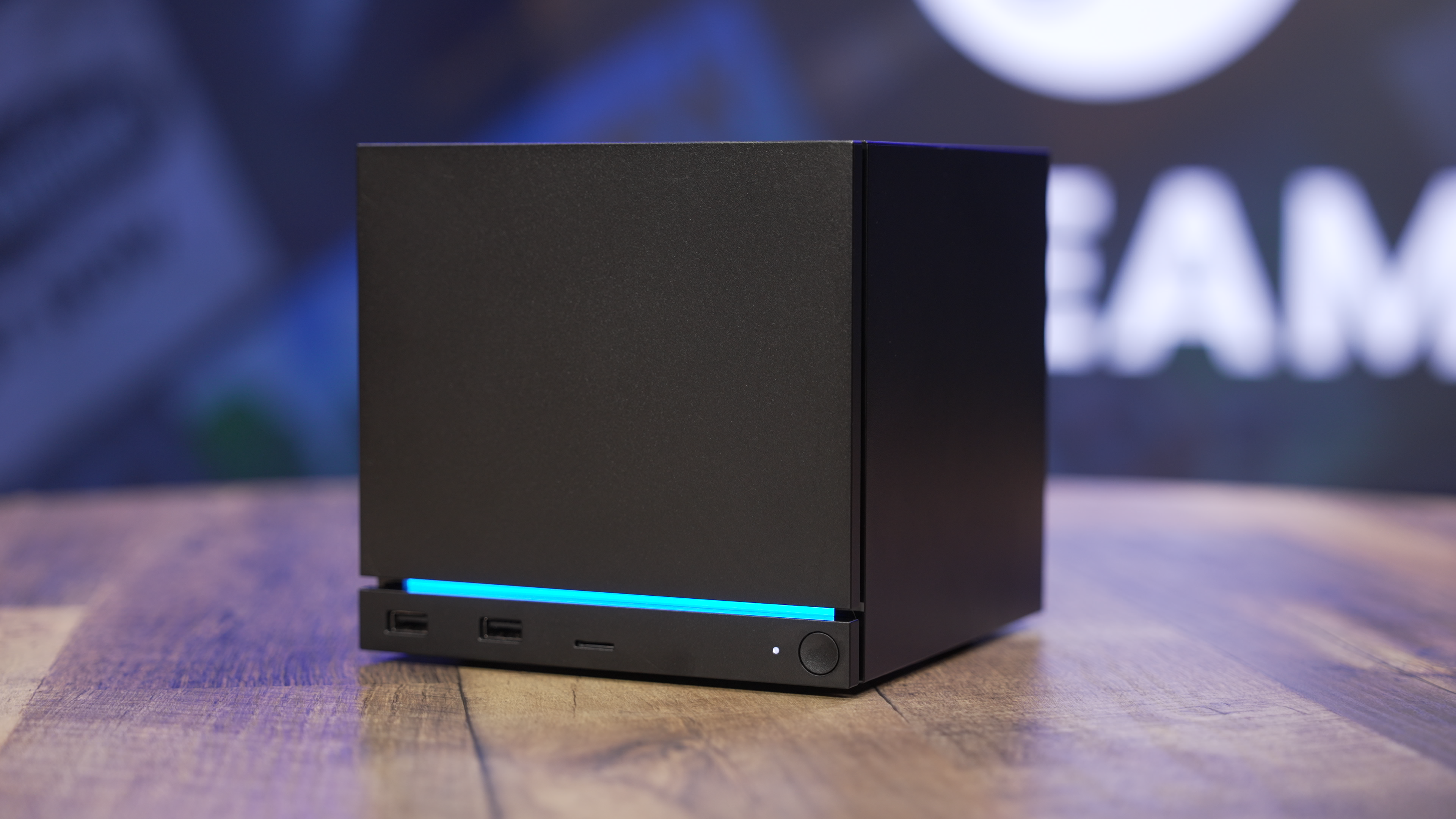
Right out of the box, the Steam Machine doesn’t look like much. It’s a little cube, about 6-inches on each side, with an RGB light bar across the bottom. And that’s one of the main appeals about this little PC. At the beginning of this console generation, the PS5 and the Xbox Series X both had out-of-this-world designs. The PS5 looked like some fancy space-age building in a gentrified neighborhood, while the Xbox Series X looked like a mini-fridge with green accents in the vents. Depending on your sensibilities, the Steam Machine is so small and unassuming that it might be the first console-that’s-not-a-console that actually blends in with the rest of your entertainment center.
Everything about the Steam Machine’s design seems purpose-built to blend into your living room, down to the cooling. There’s only a single fan on this thing, located in the rear of the device. That doesn’t sound like enough, but most of this cube is a giant heatsink that takes cold air from the front of the device and passes it directly out of the back. Just take off the magnetic faceplate and peek inside, and you’ll see just a block of aluminum fins to that effect. This is such a simple cooling solution in theory, but it immediately solves the overheating problems of anyone that just wants to shove their console on a shelf and forget about it. You don’t have to worry about keeping the sides of the Steam Machine free to ‘let it breathe’ because the only air intake is in the front of the console, which then spits hot air out of the back. And, you’re going to want both the front and the back of the device clear anyway to access the ports.
There are three ports on the front of the Steam Machine, two USB-A ports to connect controllers or other peripherals and a MicroSD card reader. I love that the card reader is in the front here, because if you already have a Steam Deck, you can easily swap the SD card carrying your game library between the two, and have immediate access to whatever you’re playing. Just like any desktop PC, there are way more ports ‘round the back. There’s an HDMI and a DisplayPort for displays, along with a power connector, an ethernet port, two USB-A ports and a USB-C port. That’s admittedly less than a lot of full-sized PCs, but with the size of the Steam Machine, it’s hard to expect anything more. It’s important to note, though, that the power connector is the same as what’s found on other game consoles like the PS5 and the Xbox Series X.