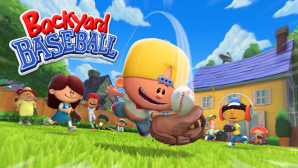
Growing up in the '90s and early aughts, Backyard Baseball was the game of my generation. What was once found in cereal boxes as a free pack-in became a brand that decorated millennial childhoods across many sequels and different sports. I was so excited when it was announced that someone had gotten the gears turning on bringing the beloved but, until recently, hard-to-find series back to modern platforms. The revival has included re-listings of several of the original games, plus a brand-new entry for Backyard Baseball. It's that one that maybe had the most riding on it, and for the most part, it delivers.
Let's start with what works. Backyard Baseball, not to be confused with Backyard Ball '97, the new name for the original game's re-release, is essentially a complete remake. It stays very faithful to that original game, offering the same colorful roster of kid athletes playing on the same neighborhood fields, spouting off many of the same whimsical one-liners mid-game, and chasing championships.
It adds some new touches, like additional unlockable team logos and a customizable player option that didn't make it into the series for a few years back in the day, but overall, it's purposely just as millennials left the game, only with an updated aesthetic that ditches the 2D artwork for 3D characters and environments.
Though I wasn't sure about the new 3D style when it was first revealed, it's grown on me, and I've come to like it now. It's extremely vibrant but also adheres to the general stylings of the past games, including things like UI elements that look just like they always did. It's not the first 3D game in the series I've enjoyed anyway; those two GameCube entries were awesome.
The backyard is just as you left it, for the most part.In most every way, the new Backyard Baseball is a hit. The kids' personalities still shine brightly at every opportunity, be it their walk-up music (which has just been patched to offer the original tracks alongside the reimagined versions), their player cards in the roster-selection screen, or the way the announcers--Sunny Day and Vinnie the Gooch--speak of them, informing you of who each of these kids are.
Gameplay-wise, That's actually one of the things I've been most heartened by with this revival project: It's difficult if you want it to be. This is a game that needs to be approachable to children, but the remaster of the original proved adults like me had aged out of the game's comfort zone. We'd become too comfy, because the game's hardest difficulty was still much too easy.
But this new version will kick your butt if you ask it to, and I love it for that. It would be boring to trounce every opponent on my way to hoisting the league championship. Instead, I'm fighting for wins and staying locked in with every at-bat. Hitting and pitching demand precision, especially on higher difficulties. The original games were always personality- and vibes-first, with gameplay feeling secondary. Today, it feels harder to get away with that, and the team behind the series' return seems to understand this, and offers up a game with a bit more depth if you want it.
If you don't want it, you can still play on lower difficulties and even switch the rules to tee ball. Backyard Sports were once meant as a teaching tool for kids learning new sports. This new one still operates well in that way, thankfully.
In baseball, you hear about "five-tool players," meaning players who are the complete package: They can hit for average and for power, they have great speed, a great arm, and they can field with the best of them. Though a few quick patches have already fixed some of what ailed the game in its first few days on Steam, it remains--for now, at least--more like a four-tool player. That would still be impressive if it were a singular athlete, but as a baseball video game, its poor fielding mechanics are holding it back right now.
Every kid is fully developed as a character, and you'll inevitably have favorites.The problem is two-fold. Less common but still happening too much is an issue where would-be outfield singles are becoming outs, sometimes even double plays. There's a disconnect between how fast the ball moves on contact and how quickly the outfielders can get the ball back into the infield. It's been frustrating, though not as bad as the other fielding issue.
When a ball is hit into the outfield and does find space between the fielders, the game does a bad job of automatically switching you to the nearest defender, which is what the old games did and what most baseball games have always done. As a result, you'll waste seconds or even just crucial half-seconds trying to switch to the right fielder before you can chase down the ball, often leading to extra bases and even some hits that never should've occurred.
It's a glaring issue that this isn't where it needs to be, and I expect this is why, in the months leading up to the release of the game, the team's demo only included the Home Run Derby mode. Pitching and hitting feel great. The game is full of personality, which is of the utmost importance in this series. It's fielding that is keeping Backyard Baseball from contending for glory.
The first two patches have quickly addressed a lot of other parts of the game, both in fixing up gameplay issues to the point that I need not mention them at this point, as well as buffing some of the off-field stuff, like deeper stat breakdowns--with even more on the way.
I'm hoping the team can figure out how to solve this fielding deficiency, because if or when it's fixed, the new Backyard Baseball feels primed to be a memory-making machine for a new generation of kids (and their nostalgic parents).