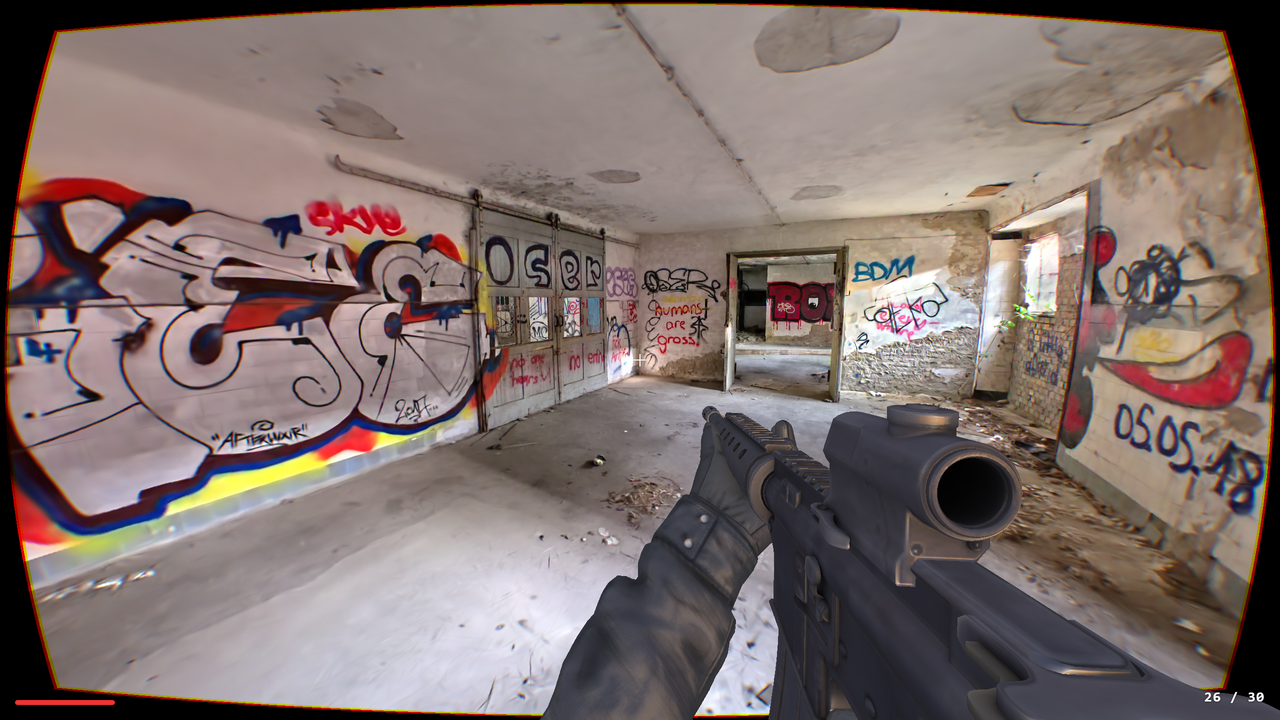
You can actually play a photorealistic FPS directly in your web browser right now, even if you aren't rocking a high-end gaming rig. While this specific project might not deliver heart-pounding combat, its ability to conjure hyper-realistic environments without devouring system resources is nothing short of impressive.
The project was developed by Iakov Sumygin, a software engineer at Snap Inc., using the browser-based game engine PlayCanvas. The secret sauce behind this visual fidelity is a technique known as Gaussian Splatting.
How Gaussian Splatting Creates Photorealistic Environments
Unlike traditional 3D modeling, which relies on rigid polygons to build worlds, Gaussian Splatting takes a completely different approach. According to reports from Tom's Hardware, the process involves combining multiple images of a real-world location with specific camera position data. This creates a virtual rendering of a space that can be navigated from various angles.
To understand why this is such a breakthrough for a photorealistic FPS, you have to look at how it differs from standard geometry:
- Polygons: Typically consist of triangles with defined, sharp edges.
- Gaussians: Function more like "fuzzy" blobs or voxels.
- The Splatting Process: By "splatting" millions of these tiny Gaussians together, the engine creates a 3D scene that looks like a hybrid between an interactive photograph and an impressionistic painting.
Overcoming the Physics Problem
Currently, Gaussian Splatting isn't a standard in game development because it only captures how a space looks, not how it functions. A "splat" is essentially just a cloud of oriented blobs that lacks the physical properties required for traditional gaming.
Sumygin points out the inherent limitation: "Gaussian Splatting gives you photorealistic environments for free. The catch: a splat is just a cloud of oriented blobs—no triangles, no colliders, no navmesh, no lights. Drop a character in and they'll float through walls looking like they belong in a different universe."
To turn this visual data into a playable photorealistic FPS, Sumygin had to implement several workarounds:
- Collision Meshes: He used specialized scripts to generate geometry from the visual scan so players wouldn't walk through walls.
- Navmeshes: He created navigation meshes to allow AI-controlled enemies to move through the space.
- Custom Scripting: These additions bridged the gap between a static visual scan and an interactive game world.
While the project serves more as a fascinating proof of concept than a polished AAA title, it highlights a massive shift in potential rendering techniques. For developers who can't afford resource-intensive traditional methods, Gaussian Splatting offers a path toward high-fidelity visuals that remain accessible to players with older hardware.