Warhammer: Age of Sigmar Spearhead City of Ash Review
If you're familiar with Warhammer: Age of Sigmar, Games Workshop's flagship fantasy battle game, you're likely aware of its presence on high streets around the world. However, you might be less familiar with its counterpart, Spearhead, which offers a simplified version of the rules and fixed army lists to enable quicker, more intense gameplay that's also beginner-friendly. Spearhead has gained a strong following, and now, with the release of Spearhead: City of Ash, the format has received a fresh injection of excitement.
What’s in the Box
Like most Games Workshop products, the initial reveal of Spearhead: City of Ash might leave you feeling underwhelmed — the box is filled with grey plastic sprues. However, once you start working with sprue cutters, hobby knives, and plastic glue, the disappointment fades as you uncover battalions of intricately detailed and dynamically posed miniatures. These models bring a fantasy battlefield to life in a way few other publishers can match.
Almost all of the miniatures in the set are brand new, making this release a must-have for fans of the Cities of Sigmar and the Skaven’s Clan Eshin. Whether you're drawn to the steadfast human warriors or the cunning rat-men assassins, you'll find plenty of incentive to add these figures to your collection. The set also includes some beautifully detailed ruined building scenery, which will enhance any fantasy battle game.
However, if you're new to the Games Workshop hobby, be warned: some of the figures, particularly the Skaven, can be quite challenging to assemble. They are flexibly posed and fragile, making it easy to damage parts while cutting them off the sprue or trimming flash. Additionally, some of the models may be confusing to assemble, with unclear instructions and difficult-to-reach surfaces.
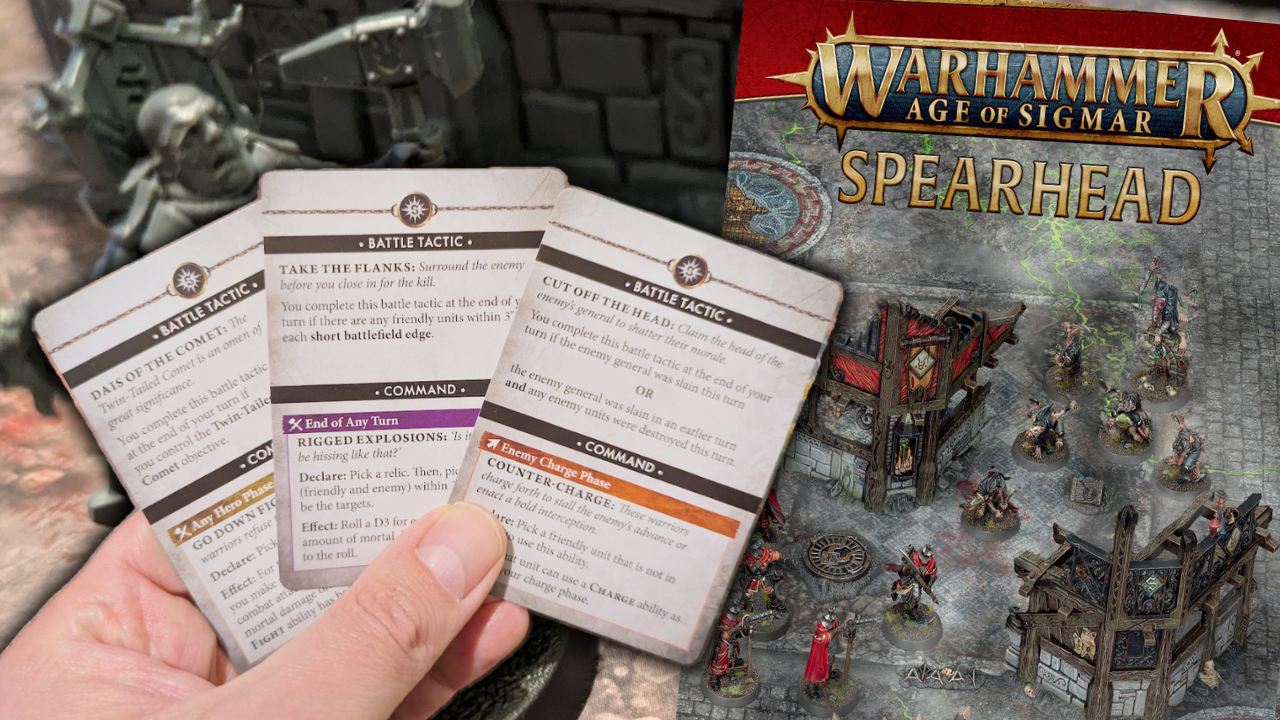
Beneath the sprues, you'll find the core components of the game: two rulebooks, decks of cards, and a double-sided base board. The rulebooks are well-produced, glossy, and filled with inspirational photos of fully painted armies. However, the build guide for the miniatures is included in one of the books, which won't lie flat for easy reference. The cards are functional but unremarkable, and while the board is aesthetically pleasing, it's unmounted and requires some effort to lay flat.
Notably absent from the box is a full rulebook. While the included books provide a solid starting point, serious players will need to download the complete rules from Games Workshop's website.
Rules and How It Plays
If you've played any of Games Workshop's core games before, you'll be familiar with the basic structure of the turns, which follow an I-go, you-go format. Players move through phases such as movement, shooting, charge, and melee. Each model has a range of stats, including movement distance in inches, number of attacks, and target values for hitting, wounding, and armor saves. In combat, players roll dice equal to the total number of attacks for all models of the same type, attempting to match or exceed the hit value. Those that succeed roll again to match or exceed the wound value. The target unit then attempts to match or exceed its armor save value to negate some of the hits. Anything that gets through this process inflicts a wound, which is enough to kill a standard trooper model, though elite units and heroes can withstand more damage.
This dice-heavy system can be both exciting and frustratingly random. Charging, for example, grants a two-dice bonus to movement in an attempt to reach an enemy unit, but can leave you stuck if you roll poorly or misjudge the distance. The high level of randomness can lead to dramatic and unpredictable outcomes, but it can also be frustrating.
Spearhead, however, aims to encourage strategic thinking in different ways. Victory isn't solely determined by eliminating all enemy units. Instead, each side of the game board — a quarter of the size of a full Age of Sigmar battlefield — has a number of objectives. Models that touch an objective can contest it by adding up their "control" value. If you have a higher control value on an objective than your opponent, you control it. The more objectives you control, the more points you earn in each of the game's four rounds, which are then totaled to determine the winner.
Although the board is relatively small and it's tempting to charge toward every objective from the start, this system encourages planning and foresight. Both generals have special abilities that allow other units to make surprise moves, adding an element of unpredictability. As in other Games Workshop games, there's also a strong element of rock-paper-scissors in terms of unit matchups, which is crucial when deciding which objectives to contest with which units at different points in the battle.
Spearhead thrives on introducing unexpected elements that alter the dynamics of play and the strategies required. Relics scattered across the battlefield grant powerful abilities to nearby units, such as barricades that protect against shooting or caltrops that pose a significant risk to maneuvering units. These relics can be just as valuable as the objectives themselves. Each turn also reveals a new "twist" card from a small deck, with effects such as increasing the value of specific objectives or allowing units to move and charge simultaneously — but only if they stay on the roads.