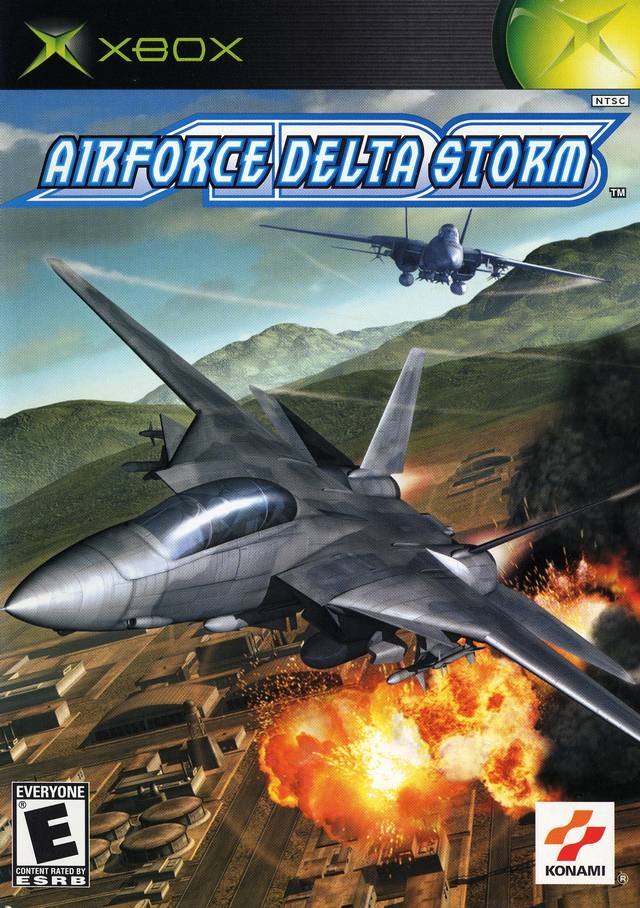
Released in late 2001, AirForce Delta II: Storm (known as Airforce Delta II in Japan and Deadly Skies in Europe) is an intense fighter jet combat simulator that brings high-stakes aerial warfare to the Xbox. Developed by Konami Computer Entertainment Studios, this title serves as the successor to the Sega Dreamcast original, expanding the franchise with new strategic layers and a much larger scale of conflict.
A World Divided: The Story of AirForce Delta II: Storm
The narrative of AirForce Delta II: Storm is set in a near-future era spanning from 20X1 to 20X7. In this timeline, scientific advancements have conquered most human diseases, but at a heavy cost: extreme overpopulation and the resulting scarcity of basic necessities. This global crisis has triggered a geopolitical schism.
Industrialized nations with insufficient food resources have formed the "United Forces," utilizing their military superiority to seize agricultural territories. In response, nations threatened by these invasions have pooled their resources to establish the "Allied Forces." Players find themselves thrust into the center of this escalating conflict, piloting advanced aircraft to defend territory and navigate the shifting tides of war.
Gameplay Mechanics and Flight Control
As an action-simulation hybrid, the game focuses on controlling various aircraft to execute both air-to-air and air-to-ground missions. While the core combat loop remains true to its predecessor, AirForce Delta II: Storm introduces a strategic "World Map" feature. This system allows players to move their aircraft across a map via specific checkpoints to reach mission objectives like ships or land-based structures.
Strategic management is vital in this mode; players must manage their "Range" carefully, as some checkpoints can be recaptured by enemy forces, potentially cutting off progress. To accommodate different levels of player skill, the game offers three distinct control configurations:
- Novice: A simplified bank-to-turn setting designed for players who want to jump straight into the action without mastering complex maneuvers like pitch, yaw, or corkscrewing backflips.
- Expert: A traditional flight shooter setup that grants the pilot all six degrees of freedom for maximum maneuverability.
- Ace: The most realistic configuration, featuring separate function buttons for airbrakes and dedicated throttle inputs mimicking a traditional aircraft thrust lever.
Features and Presentation
The Xbox iteration of the game is noted for its impressive visual fidelity for its era, featuring detailed aircraft models and expansive, photorealistic maps that provide a sense of scale during large-scale engagements. The gameplay offers significant variety through various mission types, ranging from intercepting enemy fleets to striking ground targets.
Notable features include:
- Extensive Aircraft Roster: A wide selection of fighter jets to suit different combat needs.
- Strategic Movement: The World Map system adds a layer of tactical planning to mission progression.
- Multiple Mission Types: Engaging in diverse objectives across air, sea, and land environments.
Who is this game for?
AirForce Delta II: Storm appeals strongly to fans of the aerial combat genre, particularly those looking for a robust alternative to the Ace Combat series. It is ideal for players who enjoy flight simulators with a heavy emphasis on mission variety and strategic movement. While the "hot spot" mini-missions can be repetitive, the sheer volume of content and the depth of the control settings make it a compelling choice for fans of high-octane, jet-based action.
Platform Availability
The primary experience was released for the Xbox in November 2001. Additionally, a separate title also titled Airforce Delta Storm was released for the Game Boy Advance in 2002, featuring a plot based on the original Airforce Delta.