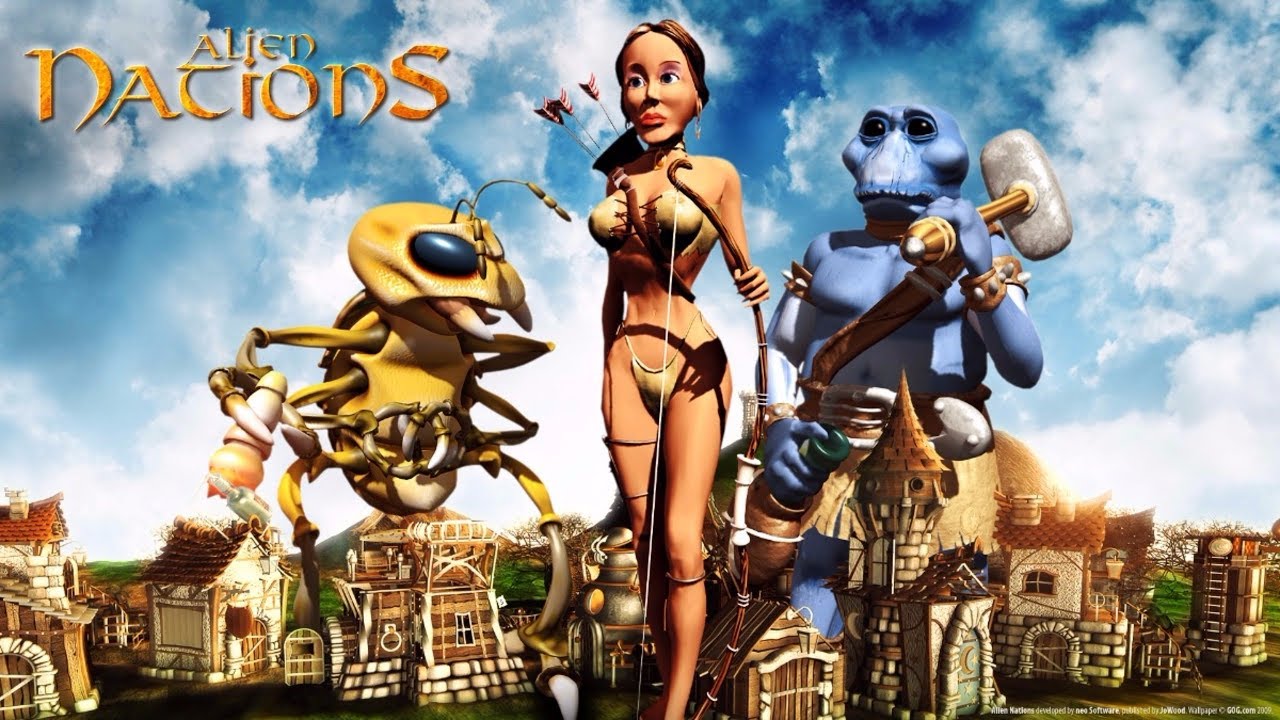
Alien Nations represents a distinctive niche within the strategy genre, offering a blend of economic simulation and real-time tactics set against a whimsical space-fantasy backdrop. Originally developed by neo Software Produktions GmbH and released in 1999, the game challenges players to manage the rise of three distinct civilizations on the planet Lukkat. Available on PC and Mac, this classic title has found a second life through modern digital distribution, inviting a new generation of strategy enthusiasts to explore its humorous yet demanding mechanics.
The Premise of Alien Nations
The narrative of Alien Nations begins with a cosmic administrative error. Three races—the blue Pimmons, the wild anthropomorphic Amazons, and the insectoid Sajiki—were intended to be delivered to separate planets by celestial storks. However, due to a lapse in judgment, the storks deposited all three nations on the same celestial body, Lukkat. Now, players must guide one of these factions to establish a kingdom, ensure prosperity, and ultimately dominate the planet. The scenario sets the stage for a conflict born of necessity, where diplomatic maneuvering and military preparedness are both essential for survival.
Gameplay Mechanics and Strategic Depth
Alien Nations is an isometric economic real-time strategy game designed to be mouse-heavy, allowing for complete control without keyboard dependency. The core loop revolves around resource management, building construction, and research. Citizens spawn from Dwellings as Transporters at timed intervals. These Transporters serve as the workforce, carrying raw materials to build functional structures. As the city expands, the game introduces a complex labor system where Schools can retrain Transporters into specialized roles such as Masons, Professors, or soldiers, though this process requires both time and monetary investment.
Economic stability relies on taxation and upkeep. While basic Dwellings generate income through taxes, more advanced structures yield greater profits but demand higher maintenance. Player satisfaction is a critical mechanic; nations require entertainment to maintain morale. To keep citizens happy, players must construct amenities including pubs, theatres, circuses, and orgy dens. Neglecting these needs can lead to unrest, forcing a balance between infrastructure development and civic welfare.
Platform Availability and System Requirements
Alien Nations is playable on PC and Mac platforms. Originally launched in 1999 in Germany, Australia, and the UK, with subsequent releases in the US, Russia, and France in 2000, the game is now accessible via GOG.com. The GOG release provides a DRM-free experience, ensuring compatibility with modern operating systems including Windows XP, Vista, 7, 8, and 10. The minimum system requirements specify a 1 GHz processor, 256 MB of RAM, and a 3D graphics card compatible with DirectX 7.
Notable Features and Target Audience
The game is characterized by its colorful, cartoonish graphics and a pervasive sense of humor that underlies every gameplay element. The presentation is tongue-in-cheek, offering a relaxed yet complex strategy experience compared to more militaristic RTS titles. Key features include:
- Three Unique Factions: Choose between the Pimmons, Amazons, or Sajiki, each offering different strategic approaches.
- Economic Focus: Prioritize research, trade, and efficient resource management over constant combat.
- Versatile Modes: Engage in Campaign missions, Never-Ending Games, or Multiplayer matches.
- Humorous Tone: Enjoy a lighthearted narrative and visual style that contrasts with traditional war sims.
Alien Nations appeals to fans of classic economic strategy games, players who enjoy the depth of titles like The Settlers, and those seeking a unique RTS experience that emphasizes diplomacy, city management, and resource allocation. Its "easy to learn but hard to master" design philosophy makes it an enduring favorite for strategy gamers looking for a blast from the past with substantial depth.