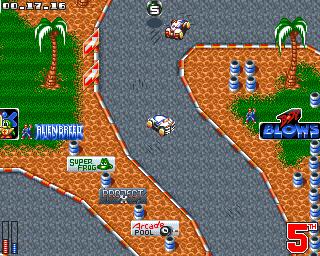
Overview of ATR: All Terrain Racing
Released in 1995 by the renowned developer and publisher Team17, ATR: All Terrain Racing stands as a distinct cult classic in the history of computer entertainment. Unlike the polished, tarmac-based simulations that dominated the mid-90s, this title embraces a "dirtier" aesthetic, focusing on the rough and tumble of dust tracks and off-road environments. Developed by the team behind future hits like Worms, ATR: All Terrain Racing was designed for the Commodore Amiga and Amiga CD32 platforms, offering a gameplay experience that prioritized chaotic fun and challenging mechanics over pure realism.
Genre and Gameplay Mechanics
ATR: All Terrain Racing is a racing game that subverts the industry trend of the time. While many contemporaries moved toward cockpit views to simulate the sight of the track, Team17 opted for a return to the overhead style. This isometric perspective allows players to survey the track ahead, a mechanic that proves essential due to the game's punishing difficulty. The developers anticipated the bends, meaning players must look ahead rather than reacting to the car immediately in front. If a player misjudges a turn, they will find themselves ploughing off into the cones.
The game is notorious for being "tricky," requiring a cool head under pressure and anticipation to master. While the difficulty curve is steep at the outset, players who learn from their mistakes can eventually master the tracks. The game draws comparisons to the acclaimed Skidmarks II and Roadkill, sharing a philosophy of making up for a lack of on-the-track realism with quirky features and demanding gameplay.
Battle Mode Features
A standout feature of ATR: All Terrain Racing is its unique battle mode. Designed for head-to-head duels, the game eschews split-screen technology. Instead, both players must remain on screen simultaneously. This introduces a strategic layer regarding positioning: if a chasing player lags too far behind and is about to disappear off-screen, the computer automatically forces them to catch up to the leader. This mechanic ensures that the leading player can score points by forcing opponents to close the gap. To aid in this struggle, the battle mode includes exclusive power-ups unavailable in the standard arcade mode, such as missiles and mines, allowing players to "annihilate rivals" and take the wind out of their opponent's sails.
Story and Setting
While ATR: All Terrain Racing does not feature a narrative-driven plot, the setting is defined by its hostile environment. The game is set on dusty, unwholesome tracks designed for destruction and competition. The objective is not just to finish first, but to dominate the opposition through aggressive driving and the strategic use of power-ups. The atmosphere is one of adrenaline-fueled competition, where the thrill of the track is derived from the chaos of the battle rather than the fidelity of the graphics.
Platform Availability and Historical Context
ATR: All Terrain Racing was originally released for the Commodore Amiga and Amiga CD32 in 1995. The game holds a unique place in gaming history, not just for its mechanics, but for the controversy surrounding its initial review. During a protracted dispute between Team17 and the magazine Amiga Power, the publication's reviewer, Jonathan Nash, awarded the game an abysmal rating of 38%. This review prompted the developer to pursue a lawsuit for defamation, cementing the game's legacy as a title that sparked significant industry debate.
Who It Appeals To
This title is ideal for retro gaming enthusiasts and fans of challenging arcade racers. It appeals specifically to players who enjoyed the quirky, destructive nature of Skidmarks II and Roadkill, as well as those interested in the history of the Amiga CD32 and Team17's early development work. It is a must-play for those who appreciate a game that demands high skill levels and strategic foresight over simple button-mashing.