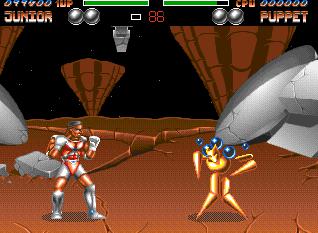
Released in 1993 by Team17, Body Blows Galactic stands as a vibrant entry in the golden age of Amiga versus fighting games. Serving as the direct sequel to the 1992 original, this title expands the franchise's scope by taking the local martial arts rivalry and catapulting it into the cosmos. For fans of the Commodore Amiga, the game offers a fast-paced combat experience that captures the spirit of the era's popular beat 'em up and fighting titles, delivering intense one-on-one action with a unique sci-fi twist.
Interplanetary Story and Roster
The narrative continues the saga of Danny and Junior, who, after winning the global martial arts tournament, decide to test their skills on a larger stage. The plot follows the duo as they challenge the meanest and toughest fighters from across the stars in an interplanetary competition to determine the ultimate galactic warrior. Body Blows Galactic features a roster of 12 distinct playable fighters hailing from six different worlds. Unlike its predecessor, this installment removes boss characters entirely, focusing instead on a pure tournament structure where every opponent is a peer competitor.
Gameplay Mechanics and Controls
The core gameplay loop mirrors the structure of contemporary fighting giants, relying on best-of-three matches to decide each bout. Fighters utilize a variety of standard attacks and special moves, including projectiles, rising uppercuts, and spinning kicks. The game adapts to the hardware constraints of the time by simplifying controls for the common single-fire-button joysticks found on Amiga systems. Players execute special moves by holding the fire button while stationary or by moving in specific directions while pressing the fire button. Blocking is achieved by holding the fire button while retreating from the opponent. Notably, the game lacks combos and throws, emphasizing spacing and timing over complex inputs. A distinctive feature is the "mercy" mechanic, where the fire button locks during the recovery animation of a knocked-down opponent, preventing immediate follow-up attacks until they rise.
Platforms and Enhanced Versions
Initially developed for the Amiga computers, the game saw the creation of a slightly enhanced AGA version specifically for the Amiga 1200. This upgrade introduced more colorful backdrops and refined sound effects and music composition. The game supports various modes of play, including single-player arcade-style progression, two-player head-to-head battles, and a massive eight-player tournament mode, making it a staple for local multiplayer sessions.
Notable Features
- 12 playable fighters from six distinct worlds.
- Eight-player tournament mode for local multiplayer.
- Enhanced AGA version with improved visuals and audio.
- Simplified controls optimized for single-fire-button joysticks.
- Unique "mercy" mechanic during knockdown recovery.
Reception and Notable Characters
Upon release, Body Blows Galactic garnered mostly favorable reviews from the press. Critics praised the atmosphere and the quality of the two-player experience, with some publications hailing it as a top contender in the genre. The character Kai-Ti received specific acclaim for her design, being highlighted as one of the most attractive fighting game characters of the period. However, reception was not universally unanimous; some reviews pointed out balance issues, noting that certain characters like Warra, Lazer, and Dino could be ineffective compared to the dominance of fast fighters like Kai-Ti.
Who It Appeals To
Body Blows Galactic appeals primarily to retro gaming enthusiasts and collectors of Commodore Amiga software. Players who appreciate the simplified yet strategic depth of early 90s fighting games will find its mechanics accessible and rewarding. The game is also of interest to fans of Team17's early development history and those who enjoy competitive multiplayer setups where a single joystick is the primary input method. Its legacy is further cemented by the inclusion of its characters and backgrounds in the compilation release Ultimate Body Blows, ensuring its fighters remain part of the series' canon.