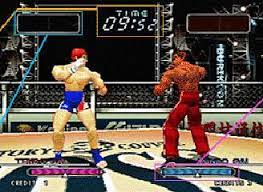
Buriki One: World Grapple Tournament '99 in Tokyo, widely recognized simply as Buriki One, is a 3D competitive fighting game developed and published by SNK. Released on May 21, 1999, the title serves as the seventh and final game developed for SNK's short-lived Hyper Neo Geo 64 arcade hardware. It distinguishes itself from other arcade fighters of the era by focusing on realistic combat simulation and a unique control scheme that challenges traditional gameplay paradigms.
Buriki One: A Unique Fighting Experience
The game was primarily designed by Hiroaki Hashimoto, who worked extensively as a motion capture artist. This approach resulted in a visual style and character movement that prioritized realism over the exaggerated animations common in other fighting titles of the time. The game features 12 martial artists, all released exclusively for the game with the exception of Ryo Sakazaki, a guest character from SNK's Art of Fighting franchise.Gameplay Mechanics and Controls
Buriki One is defined by its unconventional control system, which swaps the traditional roles of buttons and joysticks. The control system utilizes two buttons exclusively for movement and defense. Pressing the left button moves the character backward, while pressing the right button moves them forward. Double-tapping either button allows for a dash, which is crucial for evasion and closing distance. Holding both buttons simultaneously allows the player to block incoming attacks. Offensive actions are performed using the joystick. Players can execute attacks of varying damage levels by pushing the stick in different directions. Pushing forward executes a medium attack, up-forward delivers a stronger blow, and down-forward produces the weakest but fastest strike. By combining various joystick movements, players can perform special attacks for increased damage. The gameplay draws heavy inspiration from Mixed Martial Arts (MMA), featuring struggles, grabs, and submission holds similar to wrestling games. The game lacks projectiles and super moves, favoring close-quarters combat. The objective is to knock out the opponent, force a submission, or win a 3-point judgment.Story and Setting
The narrative centers on a tournament held in 1999 at the Tokyo Dome. Twelve fighters compete to determine which martial art is superior. The roster represents disciplines such as Karate, Boxing, Professional Wrestling, Greco-Roman Wrestling, Tai Chi Chuan, and Muay Thai. Each fighter brings a unique style, contributing to the theme of global martial arts supremacy.- Karate: Represented by Gai Tendo, the older Ryo Sakazaki, and Silber.
- Boxing: Featured by Rob Python and Seo Yongsong.
- Professional Wrestling: Represented by Patrick Van Heyting.
- Greco-Roman Wrestling: Represented by Ivan Sokolov.
- Tai Chi Chuan: Represented by Song Xuandao.
- Muay Thai: Represented by Payak Sitipitak.