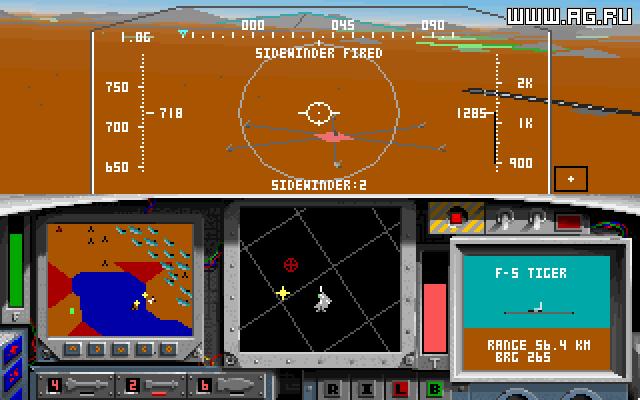
F-15 Strike Eagle stands as a seminal entry in the combat flight simulation genre, developed by the legendary Sid Meier and published by Microprose in 1985. This title thrust players into the cockpit of the titular fighter jet, blending authentic military simulation with arcade-style action. Recognized as Computer Gaming World's "Action Game of the Year" in 1985, the game earned its reputation as a "mega hit" and "blockbuster" by delivering a sophisticated aerial experience that prioritized technical accuracy and strategic depth.
F-15 Strike Eagle: Gameplay and Mechanics
Upon selecting a mission, players are immediately transported into a high-speed descent into enemy airspace. The gameplay centers on managing the aircraft's sophisticated arsenal, which includes air-to-air missiles, cannon fire, and high-explosive bombs. Survival requires mastering defensive systems such as electronic countermeasures (ECM), chaff, and flares to evade incoming threats. A comprehensive Heads Up Display (HUD), airborne radar, and ground tracking target display provide essential situational awareness, allowing pilots to engage both air-to-air and ground targets effectively.
The experience offers four distinct skill levels, ranging from "Airman" to "Ace," catering to a wide range of abilities. Less-experienced pilots can utilize an arcade mode that simplifies controls, while advanced players must navigate complex flight dynamics and tactical challenges. The campaign features seven authentic missions, with performance-based progression unlocking secret scenarios. Additionally, the game supports infinite scenarios, ensuring varied and replayable combat encounters.
Story and Setting Overview
F-15 Strike Eagle is grounded in reality, drawing inspiration from real-life missions flown by F-15 pilots during the 1970s and 1980s. Sid Meier collaborated extensively with Air Force pilot John W. "Bill" Stealy to ensure the game's authenticity and technical precision. The narrative framework spans significant geopolitical conflicts, taking players to combat zones in Libya, Egypt, Iran, and above the Persian Gulf. Missions also extend to strikes in Haiphong and Hanoi, Vietnam, providing a historically informed backdrop for aerial combat.
Platform Availability
Originally released for PC in 1985, F-15 Strike Eagle expanded across a diverse array of hardware, cementing its legacy as a multi-platform classic. The game was ported to the Apple II, Commodore 64, and Amiga, where it was praised for its graphics and playability on those systems. It also found a home on handheld and console formats, including releases for the Game Boy and NES. Later iterations, such as F-15 Strike Eagle 2, brought the combat simulator experience to the Megadrive/Genesis, adapting the controls for console gameplay.
- PC: Original platform for the 1985 release.
- Apple II / Commodore / Amiga: Key home computer platforms with distinct visual adaptations.
- Game Boy / NES: Handheld and console adaptations offering accessible arcade-style combat.
- Megadrive / Genesis: Platform for the sequel title with enhanced 3D graphics.
Notable Features
The title is celebrated for its pioneering design and commitment to realism. Key features include:
- Collaboration with military experts to ensure authentic flight dynamics.
- Seven distinct missions that unlock further secret scenarios based on performance.
- Dynamic difficulty scaling to accommodate all pilot skill levels.
- Comprehensive weaponry and defensive countermeasure management.
- Recognition as a foundational title in strategy and simulation gaming.
Who It Appeals To
F-15 Strike Eagle appeals to fans of military history, aviation enthusiasts, and simulation gamers. The game bridges the gap between hardcore simulation and accessible arcade action, making it suitable for both dedicated flight sim veterans and players seeking a challenging tactical experience. While later ports like the NES version simplified the interface into a forward-scrolling shoot-'em-up, the core game remains a rewarding challenge for those who enjoy mastering complex systems and tactical decision-making. It stands as a nostalgic classic for retro gaming aficionados and a historical reference point for the evolution of combat simulation.