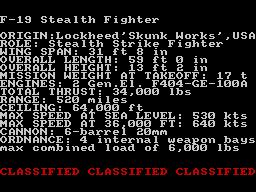
F-19 Stealth Fighter: A Classic of Combat Flight Simulation
F-19 Stealth Fighter stands as a seminal title in the history of combat flight simulation, developed by the legendary MicroProse. Originally released in 1988 for PC DOS, with subsequent ports to Amiga and Atari ST in 1990, this game offers players a deep dive into aerial warfare using a fictional United States military aircraft. The design of the titular jet was created before the public unveiling of the real-world F-117 Nighthawk, relying instead on a 1986 Testors model kit, which gives the aircraft a distinct, angular profile that predates the stealth bomber's actual appearance. As the 16-bit remake of Project Stealth Fighter for the Commodore 64 and ZX Spectrum, this entry in the series refined the experience with advanced graphics and expanded gameplay systems.
Gameplay Mechanics and Stealth Management
At its core, F-19 Stealth Fighter is a rigorous simulation that challenges players to master the delicate art of staying undetected. The game features a sophisticated radar detection system where the player must constantly compare their aircraft's varying radar signature against the energy of incoming enemy radar pulses at different ranges and powers. Mastering these stealth techniques takes significant practice, as the F-19's invisibility attributes are its primary defense against hostile forces.
Before every sortie, players must configure the four weapons bays with a vast array of realistic armaments. The ground crew can recommend loadouts, but pilots can customize their arsenal, selecting everything from Maverick thermal imaging missiles for anti-ship duties to Harpoon sea-skimming missiles. The game presents over 4,000 missions across four distinct theatres of operation:
- Gaddafi's Libya
- The Persian Gulf
- The North Cape
- Central Europe
Players can select the intensity of the conflict, ranging from conventional warfare to limited warfare, or the high-stakes Cold War mode, where even being detected by the enemy can trigger a major diplomatic incident. The simulation features convincing AI behavior from enemy aircraft, SAM sites, and radar stations, which will initially patrol calmly but launch into highly aggressive searches the moment the player is detected.
Immersive Scenarios and Consequences
The simulation extends beyond flying; it immerses the player in a dynamic geopolitical environment. The narrative depth is enhanced by a variety of mission endings that reflect the real-world consequences of aerial combat. Depending on the outcome, a pilot might be rescued by a Sikorsky SH-3 Sea King, face newspaper headlines announcing capture, or trigger protests from outraged allied or neutral nations. These endings ensure that every decision carries weight, reinforcing the simulation's focus on tactical awareness and strategic planning.
Platform Availability and Notable Features
F-19 Stealth Fighter is available across a wide range of hardware, ensuring accessibility for retro computing enthusiasts and modern gamers alike. The game launched on PC DOS in 1988, followed by the Amiga and Atari ST versions in 1990. A Japanese-exclusive port was released for the NEC PC-9801 in 1992. For contemporary audiences, the DOS version was re-released on the Steam distribution platform in 2015, allowing players to experience this classic title on modern systems.
The package is renowned for its extensive documentation; users receive a thick, glossy manual filled with detailed information on weapons systems and aerodynamics, along with maps and a keyboard overlay to assist with the complex control schemes. The game remains accessible to newcomers with training missions that allow players to learn the basics without the pressure of enemy fire, though experienced pilots can immediately engage in full combat scenarios.
Who Should Play F-19 Stealth Fighter?
This title is essential for fans of air combat simulation and players interested in the evolution of stealth technology in gaming. It appeals to those who enjoy complex mechanics that are easy to learn but satisfyingly difficult to master. While the fictional F-19 was eventually replaced by the accurate F-117 in the sequel Night Hawk: F-117A Stealth Fighter 2.0, this game remains a critically acclaimed milestone for its authentic scenarios, dazzling graphics for its era, and rigorous approach to radar warfare. It is a must-play for enthusiasts of MicroProse's golden age of simulation.