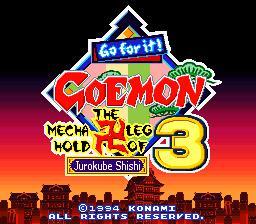
Ganbare Goemon 3: Shishijyuurokubei no Karakuri Manji Katame stands as a standout entry in Konami's beloved franchise, originally released for the Super Famicom in Japan on December 16, 1994. As the third installment of the series on this classic console, the game delivers a robust blend of platforming and exploration that has earned it a cult following. The title, which translates roughly to "The Mecha Leg Hold of Jurokube Shishi," offers a unique experience that has garnered praise for its depth and charm. Thanks to a dedicated fan translation, this adventure is accessible to a global audience, allowing players to step into the shoes of Goemon and his eccentric team.
Gameplay Mechanics and Genre
The title is an action-adventure platformer that shifts the balance toward exploration compared to its predecessors. Reviewers have highlighted the fusion of platform-style action with Zelda-style adventure elements, creating a gameplay loop that rewards curiosity and combat skills. Players navigate diverse worlds using a control scheme that facilitates fluid switching between characters and weapons. By pressing L and R, players can swap weapons, while the Select button allows for instant character changes. The roster includes Goemon, Ebisumaru, and Yae, each offering slightly different control responses. The game also features distinct challenges, such as navigating precarious peg-to-peg jumps with a hula hoop, which require precision and patience. A standout technical achievement is the use of Mode 7 for battles fought with Goemon Impact, creating dynamic and visually impressive confrontations that utilize the hardware's capabilities.
Story and Setting Overview
The narrative revolves around a chaotic time-travel mishap. The Wise Old Man, Goemon's scientific helper, constructs a time machine with the intention of chasing women across different eras. However, the plot takes a darker turn when Ebisumaru's evil twin sister, Bismaru, plots to hijack the machine for her own devious schemes. Goemon and his friends must intervene to stop her. The story unfolds through amusing and bizarre cutscenes that provide entertainment and context for the varied levels. The dialogue-heavy progression ensures that the world feels alive, though the translation is essential for non-Japanese speakers to fully grasp the humorous exchanges.
Notable Features and Visuals of Ganbare Goemon 3
Ganbare Goemon 3 is celebrated for its graphical fidelity. Characters are rendered large and detailed, featuring charming idle poses; for instance, Ebisumaru can be seen wiping his face with a handkerchief while Yae brushes hair from her face. These little touches make the characters visually appealing and distinct. The backgrounds offer a wide variety of distinct environments, preventing the journey from feeling repetitive. The audio design complements the visuals with a soundtrack that blends traditional and modern Japanese musical styles, fitting the game's cultural setting. While the sound effects are generally praised, some players note that the impact noises for the male characters can be jarring compared to Yae's more natural vocalizations.
Platform Availability and Audience
Originally launched on the Super Famicom, this game remains a definitive experience for retro gaming enthusiasts. The availability of a fan translation ensures that the game's humor and depth are accessible to non-Japanese speakers. It appeals to players who appreciate classic platformers, adventure games, and the unique charm of Konami's action series. The combination of tight controls, memorable music, and the distinct art style makes it a must-play for collectors and fans of the SNES era.