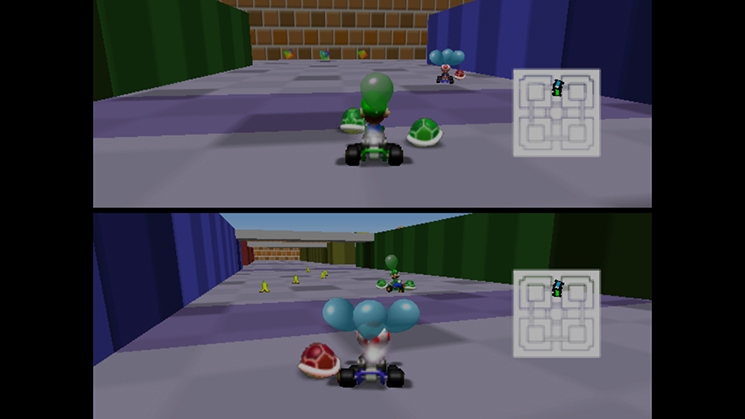
Mario Kart 64 is a landmark racing title developed and published by Nintendo for the Nintendo 64 console. Originally released in Japan on December 14, 1996, and subsequently in North America and Europe in 1997, this game served as the successor to Super Mario Kart on the Super Nintendo Entertainment System. As the second main entry in the series, it introduced a significant evolution in gameplay, transitioning the franchise into a new era of graphical capabilities and multiplayer dynamics.
Genre and Gameplay Mechanics
At its core, the game is a high-speed racing title where players take control of characters from the Mario franchise to compete on a variety of tracks. The gameplay relies on a weapon-based item system designed to either benefit the user or hinder opponents. A major mechanical upgrade from its predecessor is the introduction of Mini-Turbo boosts, which players can activate through drifting. The game also introduced unique racer weight classifications, which influenced how characters handled the track.
Players can choose from a roster of cast members, including new additions to the playable cast such as Wario and Donkey Kong. The game features four distinct game modes:
- Grand Prix: The standard cup-based racing mode.
- Time Trial: Players attempt to set the fastest lap times.
- Versus: Customizable race rules.
- Battle: A combat-focused mode where players aim to knock each other off the arena.
Story and Setting
While the game does not feature a traditional narrative, the setting is deeply rooted in the colorful world of the Mario franchise. The gameplay takes place across a variety of distinct tracks that showcase the expanded capabilities of the Nintendo 64 hardware. These environments are unique designs rather than just variants of the same courses. The tracks feature complex layouts that utilize the full scope of the 3D engine, including elevated paths and hazardous drops.
Notable Features of Mario Kart 64
The transition to the Nintendo 64 allowed for polygon-based true 3D computer graphics for track design. This shift enabled track features that were previously impossible with the Mode 7 graphics of the original game, such as changes in elevation, bridges, walls, and pits. However, the characters, items, and some track obstacles remained as two-dimensional, pre-rendered sprites for game optimization.
- 3D Environments: The game was the first in the Mario Kart series to use true 3D graphics for the environment.
- Multiplayer Support: It was the first game in the Super Mario franchise to allow more than two people to play simultaneously, supporting up to four players.
- Advanced Physics: The game introduced advanced collision physics and expanded camera controls.
- Real Walls: The 3D environment allowed for real walls that can obscure views, adding a layer of strategy to the racing.
- New Items: The roster of items expanded to include the Spiny Shell and triple variants of shells.
Platform Availability
Originally released for the Nintendo 64, the game has since become widely accessible through various digital platforms. It was released as a Virtual Console game for the Wii in 2007 and for the Wii U in 2016. Additionally, the game is available on the iQue Player and the Nintendo 64 - Nintendo Classics platform.
Who it Appeals To
This game appeals to racing enthusiasts and fans of competitive multiplayer gaming. Its accessible yet deep mechanics make it suitable for a wide audience, ranging from young children to adults. The ability to play with up to four players simultaneously makes it a prime choice for party gaming and local multiplayer sessions.