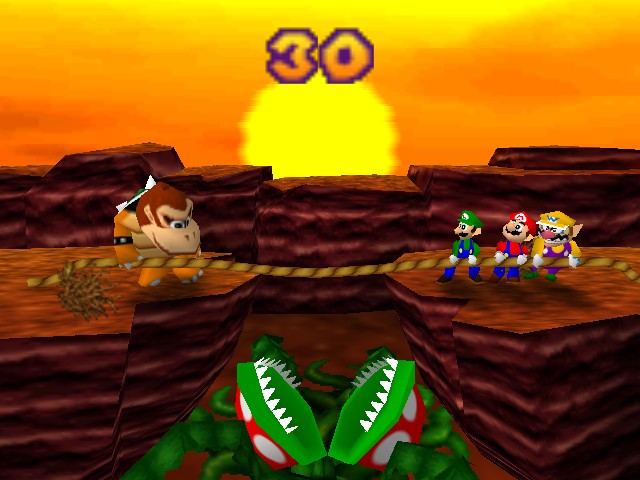
Mario Party: The Pioneering Party Board Game
Released on December 18, 1998, Mario Party established a new standard for console party gaming by blending traditional board game mechanics with fast-paced digital competition. Designed for the Nintendo 64 and later adapted for the Game Boy Advance, this title transformed the way players interact with the beloved Mario franchise. Rather than focusing on platforming or racing, the game centers on strategic dice rolling, item management, and rapid-fire challenges that test both luck and skill. It holds a Metacritic score of 79.00, reflecting its strong critical reception and enduring legacy within Nintendo's catalog. The experience remains a foundational entry in the long-running series that would eventually hold the record for the longest-running minigame series in gaming history.
Core Gameplay and Mechanics
At its heart, Mario Party is a multiplayer board game where up to four human or computer-controlled characters navigate a shared board. Players roll dice to move independently across the map, encountering various events that can boost or hinder their progress. After a set number of turns, the game transitions into a series of minigames that serve as the primary method of earning coins and stars. The competitive nature of these encounters is often unpredictable, allowing underdogs to catch up to leaders through clever item usage or minigame mastery. Collecting stars to reach a target score remains the ultimate victory condition, encouraging players to balance risk-taking with steady progression.
Setting and Narrative Framework
While the game does not rely on a traditional campaign or heavy storyline, it immerses players in a vibrant, themed board game world where every space tells a story. The boards are designed with distinct visual themes that reflect the expansive Mario universe, complete with hazards, hidden paths, and interactive elements that keep the environment feeling dynamic. The lack of a rigid narrative allows the focus to remain entirely on the social and competitive aspects of the experience, making each session uniquely tailored to the group's playstyle. The central hub areas serve as a functional lobby where players select modes and prepare for the next match, ensuring the pacing never drags.
Platform Availability and Notable Features
Originally launching on the Nintendo 64, Mario Party brought a revolutionary multiplayer experience to home consoles, with a subsequent Game Boy Advance port making the game accessible on handheld systems. The title introduced a formula that would define the franchise for years, emphasizing local multiplayer over solitary play. Key features include its seamless integration of board strategy with arcade-style minigames, flexible player configurations, and a robust item shop that allows strategic coin spending. The franchise currently holds the record for the longest-running minigame series, with Nintendo reporting cumulative worldwide sales of 39.6 million game copies as of December 2014.
Who Mario Party Appeals To
- Players seeking high-energy local multiplayer experiences with friends and family
- Fans of the Mario franchise who prefer strategy and competition over platforming
- Groups looking for accessible, pick-up-and-play party games with variable outcomes
- Collectors and enthusiasts of late-1990s Nintendo hardware and gaming history