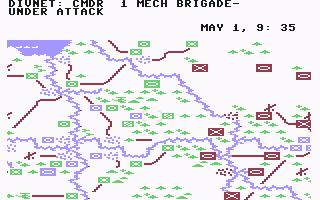
Step into the high-stakes theater of Cold War conflict with NATO Commander, a seminal real-time strategy title designed by the legendary Sid Meier. Released in 1983 by MicroProso, this early wargame offers players a harrowing simulation of a hypothetical Warsaw Pact invasion of West Germany. As the Supreme Allied Commander, you are tasked with managing a desperate defense against overwhelming Soviet-led forces, balancing tactical battlefield decisions with the terrifying political consequences of total escalation.
Strategic Warfare and Gameplay Mechanics
Unlike many traditional turn-based wargames of the era, NATO Commander serves as one of the first real-time strategy games at the theater level. The gameplay focuses on managing a massive defensive operation across a map covering central Europe. Players must deploy a diverse array of NATO units—including mechanized and armored divisions, infantry, reconnaissance brigades, SAM batteries, and air wings—to intercept and slow the advancing Eastern Bloc forces.
The mechanics emphasize resource management and tactical positioning. While the Warsaw Pact enjoys constant reinforcements, NATO forces operate under much tighter constraints. Players must utilize terrain modifiers, such as hills and rivers, to gain defensive advantages. Beyond simple combat, the game incorporates high-stakes political elements: while players have the option to deploy chemical or nuclear weapons to halt the enemy, doing so carries significant victory point penalties and risks triggering a broader, catastrophic conflict.
A Foundation for Strategy Classics
Though it was one of Sid Meier's earliest projects, the engine developed for NATO Commander proved incredibly robust. The underlying technology served as the functional basis for several other influential MicroProse titles, including Conflict in Vietnam, Crusade in Europe, and Decision in the Desert. This lineage connects this title directly to the evolution of the modern strategy genre.
Key Features
- Real-Time Tactical Command: Experience a theater-level simulation that moves in real-time, requiring quick thinking under pressure.
- Diverse Unit Management: Command an international coalition including forces from West Germany, the UK, France, the USA, Belgium, and the Netherlands.
- High-Stakes Escalation: Navigate the "nuclear dilemma" by deciding when to use extreme weapons at the cost of political stability.
- Dynamic Reinforcements: Manage limited NATO reserves against a relentless and constant Warsaw Pact advance.
Platform Availability and Appeal
Originally released for the Atari 8-bit family in late 1983, the game later saw ports to the Apple II and Commodore 64 in 1984. This title appeals strongly to fans of historical military simulations and enthusiasts of early Sid Meier works. It is a must-play for those interested in the origins of real-time strategy and players who enjoy the tension of managing both tactical combat and geopolitical consequences.