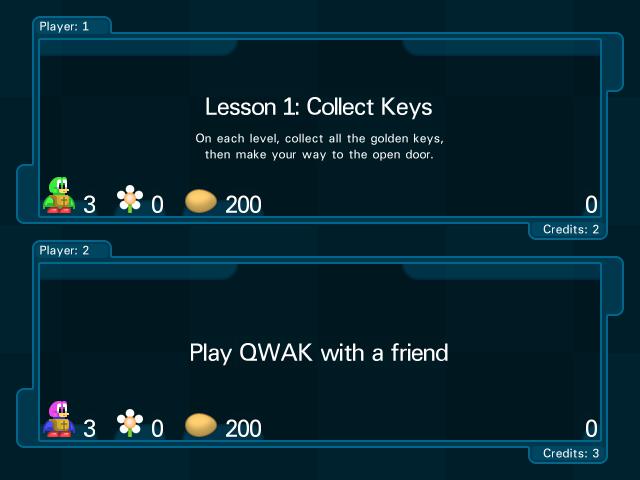
Qwak (1989) is a charming 2D platformer and puzzle game originally crafted by developer Jamie Woodhouse. First introduced to players in 1989 as part of Superior/Acornsoft's Play It Again Sam 10 compilation, the title quickly established itself as a standout entry in the retro gaming landscape. At its core, Qwak challenges players to navigate a cute green duck across a series of single-screen stages, combining precise movement with logical puzzle-solving. The game’s straightforward premise is bolstered by tight controls and a distinct visual style that has kept it relevant across multiple decades and hardware generations.
Gameplay and Mechanics
Qwak operates firmly within the platformer and puzzle genres, requiring players to carefully traverse each level while avoiding hazards and collecting scattered keys. Every stage is designed as a self-contained puzzle board where all required keys must be gathered before the exit door unlocks. This loop encourages methodical exploration and spatial reasoning, as players must plan their routes efficiently to progress. The original BBC Micro and Acorn Electron releases are notably more challenging than later iterations due to a tighter stage count and less forgiving design. As players advance through the twenty-odd single-screen stages, the increasing complexity of key placement and environmental obstacles provides a consistent sense of progression and reward.
Story and Setting Overview
While Qwak does not feature an elaborate narrative, it establishes a clear and lighthearted setting that supports its gameplay loop. The entire experience revolves around the journey of a determined green duck tasked with collecting keys to unlock new areas. There is no heavy exposition or cutscene-driven storytelling; instead, the game relies on environmental design and objective-driven progression to maintain player engagement. The colorful, cartoonish aesthetic creates a playful atmosphere that aligns perfectly with the duck protagonist and the lighthearted challenge of the puzzle-platforming format.
Platform Availability and the Legacy of Qwak
Qwak has enjoyed a remarkably long lifecycle across numerous computing platforms. It debuted in 1989 on the BBC Micro and Acorn Electron before receiving a significant upgrade in 1993 when Team17 released an enhanced version for the Commodore / Amiga. This later port introduced a two-player mode, additional levels, and a polished presentation that expanded the game’s reach. Team17 also included the title in a double-pack with the science fiction shooter Alien Breed for the Amiga CD32 later that same year. Decades later, Jamie Woodhouse completed a Game Boy Advance port in 2006, followed by modern digital releases on Windows PC, Classic Macintosh, and iOS, ensuring accessibility for contemporary audiences.
Notable Features
Several aspects distinguish Qwak from its contemporaries. The addition of cooperative two-player gameplay in the 1993 Amiga update transformed a solitary puzzle experience into a shared challenge, encouraging players to work together to collect keys and unlock exits. The game’s compact stage design fosters intense focus and quick repetition, making it highly addictive. Furthermore, the seamless transition from its original 8-bit origins to modern mobile and desktop platforms demonstrates the title’s enduring structural strength. The colorful visuals, tight puzzle mechanics, and consistent difficulty curve remain its defining characteristics.
Who It Appeals To
Qwak (1989) is best suited for retro gaming enthusiasts, puzzle-platformer fans, and collectors interested in the early works of Jamie Woodhouse and Team17. Players who appreciate methodical progression, precise platforming, and clever level design will find the game’s key-collecting loop deeply satisfying. Its availability across classic hardware and modern digital storefronts makes it an accessible entry point for those looking to explore foundational British indie development. Whether experienced on original BBC Micro systems or contemporary mobile devices, Qwak remains a timeless test of spatial reasoning and platforming skill.