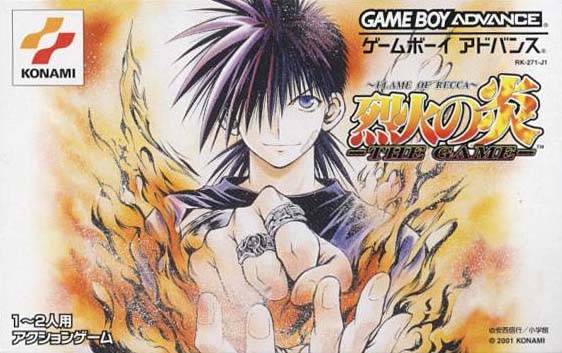
Recca no Honoo: Flame of Recca
Released on December 20, 2001, Recca no Honoo: Flame of Recca stands as a distinct entry in the action and fighting genre, developed and published by Konami exclusively for the Game Boy Advance. Adapting the vibrant manga and anime series of the same name, this title offers a unique twist on the classic one-on-one combat formula. Rather than confining players to a traditional flat plane, the game expands the battlefield vertically, creating a dynamic experience that differentiates it from its handheld peers.
Story and Setting
The narrative draws directly from Nobuyuki Anzai’s acclaimed series, placing players in a world where feudal ninja traditions clash with modern urban life. The plot follows Recca Hanabishi, a high school student who awakens ancestral pyrokinetic abilities tied to the legendary Flame Dragons. After rescuing his classmate Yanagi Sakoshita, who possesses rare healing powers, Recca pledges to protect her. This commitment draws the attention of the Uruha organization, which seeks to exploit Yanagi’s abilities for immortality experiments. Alongside friends like Domon Ishijima and Fūko Kirisawa, Recca forms the Hokage ninja team to battle rival clans and confront Mori Kouran and his SODOM syndicate. The story emphasizes destiny, friendship, and the enduring legacy of ancient ninja lore.
Gameplay Mechanics of Recca no Honoo: Flame of Recca
Breaking away from standard conventions, the game utilizes a three-screen-high vertical playfield. Characters can freely run and double-jump across this expansive stage, adding strategic positioning to combat. The control scheme relies on three buttons: R for blocking and activating techniques, B for close-range attacks to initiate combos, and A for a tracking long-range strike. Special moves are executed by combining R with directional inputs and the B button. Notably, these techniques are not unlocked instantly; players must earn them through gameplay, encouraging mastery. Boss encounters against Siguma, Mokuren, and Mori shift the dynamic entirely. These encounters feature larger adversaries with multiple life bars, requiring players to chip away at defenses and exploit specific timing windows, creating a hybrid experience reminiscent of classic platform-action games.
Notable Features and Visuals
Visually, the game delivers bright, highly animated character sprites that remain instantly recognizable despite handheld limitations. The dynamic animations capture the energetic spirit of the source material. Stage design, while functional and expansive, leans toward a generic aesthetic, focusing on vertical traversal rather than intricate environmental storytelling. On the audio front, the presentation is serviceable but unremarkable. Key technical and design elements include:
- A three-screen-high vertical playfield that replaces traditional flat arenas
- A unique earned-move progression system that rewards gameplay mastery
- Hybrid boss encounters requiring multi-phase defense breaking
- Limited localization requiring basic Japanese proficiency for full navigation
Character voice lines primarily announce special attacks, though the audio quality is somewhat tinny and occasionally difficult to distinguish during intense exchanges.
Who Is This Game For?
This title is best suited for dedicated fighting game enthusiasts and fans of the Recca no Honoo: Flame of Recca manga and anime franchise. Its unconventional vertical stage mechanics and earned-move progression system offer a refreshing departure from traditional arena fighters, appealing to players who enjoy experimentation and tactical depth. While the generic stages and audio presentation may not satisfy audiophiles, the core combat remains highly rewarding for those willing to invest time in learning its unique systems. Ultimately, it serves as a faithful and mechanically ambitious adaptation that captures the essence of its source material while carving out its own identity in the handheld landscape.