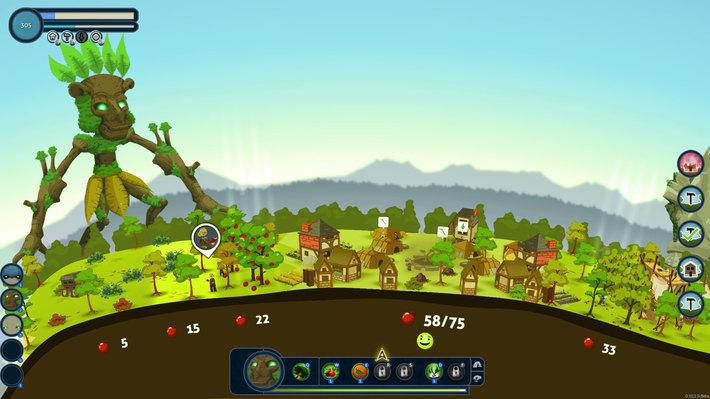
Reus: A Modern Revival of the God Game Genre
In an era dominated by high-fidelity 3D graphics and complex narrative-driven adventures, Reus stands out as a refreshing and artistic return to the roots of simulation gaming. Released in May 2013 by Abbey Games, this title invites players to step into the shoes of an omnipotent force responsible for nurturing life on a barren planet. As a strategy, indie, and simulation title, Reus successfully revives the "god game" genre, a style largely forgotten since the classics of the early 2000s, offering a unique blend of terraforming, resource management, and ecological experimentation.
Gameplay Mechanics and Core Loop
The central premise of Reus is deceptively simple yet mechanically deep. Players do not control the planet directly; instead, they command four colossal giants—representing the Swamp, Forest, Rock, and Ocean biomes. These giants roam the perimeter of a two-dimensional, cross-section view of the world. Their primary role is to seed the planet with resources, including flora, fauna, and minerals. The gameplay loop revolves around terraforming the environment to create suitable habitats, which in turn allows for the introduction of life and the eventual settlement of humans.
Unlike traditional city-builders where the player places buildings, in Reus, the environment must be prepared first. The player must strategically place oceans, forests, swamps, and deserts to unlock different tiers of resources. For instance, certain plants and animals only appear if specific biome conditions are met. Once the stage is set, the giants summon resources that generate four key currencies: Food, Wealth, Technology, and Awe. These resources are essential for guiding human development.
Story, Setting, and the Symbiosis System
Reus does not offer a traditional narrative with cutscenes and dialogue. Instead, the story is emergent, told through the evolution of the planet and the progression of human civilization. The setting is a vibrant, side-scrolling slice of a globe, where the player acts as a meta-god. The objective is to help humans progress from primitive settlements to advanced civilizations by fulfilling their needs for resources and awe.
A defining feature of Reus is its symbiosis system. Resources generate more power when placed in specific combinations. For example, placing a quartz mine next to another quartz mine boosts wealth generation, while certain plant pairings can increase food yields. This mechanic encourages experimentation and strategic planning, as players must unlock higher-tier resources and develop more complex resource chains to meet the escalating demands of human developments. The humans themselves are not directly controllable; their behavior and structure construction are influenced by the resources available and the "awe" provided by the giants, who can praise or punish the inhabitants based on player actions.
Platform Availability and Technical Presentation
Reus is available on a wide range of platforms, ensuring accessibility for both PC enthusiasts and console players. The game launched on PC in 2013 and has since been released on macOS, Linux, Xbox One, and PlayStation 4. This cross-platform support allows a diverse audience to experience Abbey Games’ vision.
Visually, Reus is often cited for its exceptional art style. The game utilizes a crisp, 2D aesthetic that scales beautifully, maintaining clarity and charm regardless of the resolution. The side-view perspective allows players to see the cross-section of the planet, from the hot core to the surface where giants roam. The soundtrack complements this serene atmosphere, providing a relaxing backdrop to the strategic depth of the gameplay. The game also features a smooth interface that facilitates efficient management of resources and upgrades.
Who is Reus For?
Reus is an ideal choice for fans of strategy and simulation games who appreciate minimalist design and deep mechanical systems. It appeals to players who enjoyed the indirect control and ecological management of classic god games like the Black & White series. The game is also suitable for those who enjoy sandbox modes, as it offers an achievement-free sandbox experience alongside its campaign-driven "time-based" modes. With a Metacritic score of 75.00, Reus is recognized for its unique approach to world-building and its successful resurrection of a beloved gaming genre.