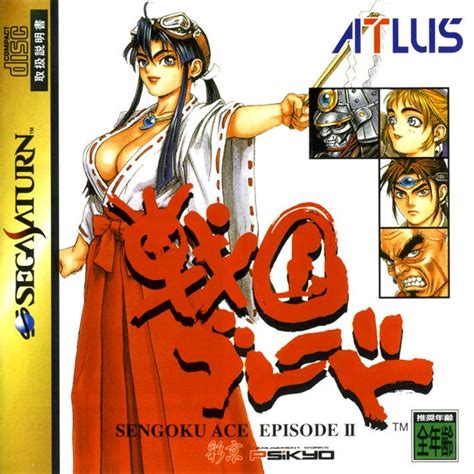
Sengoku Blade, known as Tengai outside of Japan, is a horizontally scrolling shoot 'em up developed by Psikyo and originally released for arcade machines in 1996. Serving as the sequel to the 1993 title Sengoku Ace, this entry marks a significant departure from Psikyo's usual vertical format. The game immerses players in a unique historical fantasy world where the Sengoku period of Japan collides with demons, ancient magic, and steam-powered robotics. Featuring a roster of distinct playable characters who fly independently rather than piloting aircraft, Sengoku Blade offers a chaotic and visually rich experience that has endured through numerous ports over the decades.
Gameplay and Mechanics
The gameplay revolves around fast-paced action as players navigate through stages filled with dense projectile patterns and massive transforming bosses. A defining feature of Sengoku Blade is its character selection system. Each fighter utilizes a unique weapon and summons a "sogami" or familiar to assist in combat, altering the playstyle significantly. Players can charge their shots to unleash more potent effects and deploy powerful bomb attacks for screen-clearing relief. The game supports cooperative play, making it a classic choice for local multiplayer sessions.
Playable Characters and Familiars
- Koyori (Miko): A shrine maiden who fires ofuda and summons a water monkey for homing bubbles and charged electric projectiles.
- Shoumaru (Sho): A ninja driven by love for a kidnapped princess, throwing blades and using magic mirrors that can be placed to fire continuous beams.
- Tengai: The brutish protagonist in the international release, wielding Shinto beads and a hawk that transforms into a phoenix for charged attacks.
- Junis: A kunoichi accompanied by a smoking lemur named Socrates, utilizing a spread of kunai and shuriken with a fiery breath attack from her pet.
- Hagane (Katana): A slow-moving but powerful robot samurai capable of unleashing devastating laser attacks.
Story and Setting Overview
Set in a reimagined Sengoku era, the narrative blends historical aesthetics with supernatural elements. The plot centers on a kidnapped princess, motivating the ninja Sho and the other warriors to battle through hordes of enemies. The environment is a striking mix of traditional Japanese architecture and fantastical steampunk designs, complete with steam-powered robotics and demonic foes. The game is also noted for its eccentric humor, featuring ridiculous cutscenes and unique character interactions that add personality to the chaotic action.
Platform Availability
Sengoku Blade has reached a wide audience through multiple releases. The original arcade version was followed by a home port for the Sega Saturn in 1996, which included a "fan" disc with exclusive artwork. Years later, Psikyo's work was preserved on the PlayStation 2, and the game was subsequently remastered for modern mobile and handheld devices.
- Arcade
- Sega Saturn
- PlayStation 2
- iOS
- Android
- Nintendo Switch
Who Should Play Sengoku Blade?
This title appeals primarily to fans of classic arcade shooters who appreciate variety in their gameplay. While the core mechanics adhere to the traditional shmup formula, the diverse cast of characters and their unique familiars encourage players to experiment with different strategies. It is an ideal choice for those who enjoy challenging bullet-hell patterns, giant boss battles, and games with a distinct sense of style and humor. Collectors of Psikyo's catalog and players seeking a nostalgic trip to the golden age of arcade gaming will find Sengoku Blade to be a vibrant and entertaining experience.