Starship Titanic stands as a distinctive anomaly in the landscape of classic adventure gaming, blending science fiction spectacle with the absurdist comedy of Douglas Adams. Originally released in 1998 by The Digital Village, the game invites players to step aboard the titular vessel—a technological marvel that has suffered a catastrophic malfunction during its maiden voyage. As a unique entry in the adventure genre, it combines the exploration of traditional point-and-click mechanics with a proprietary natural language engine, offering a gameplay experience that is as dialogue-heavy as it is visually striking.
The Starship Titanic Narrative and Setting
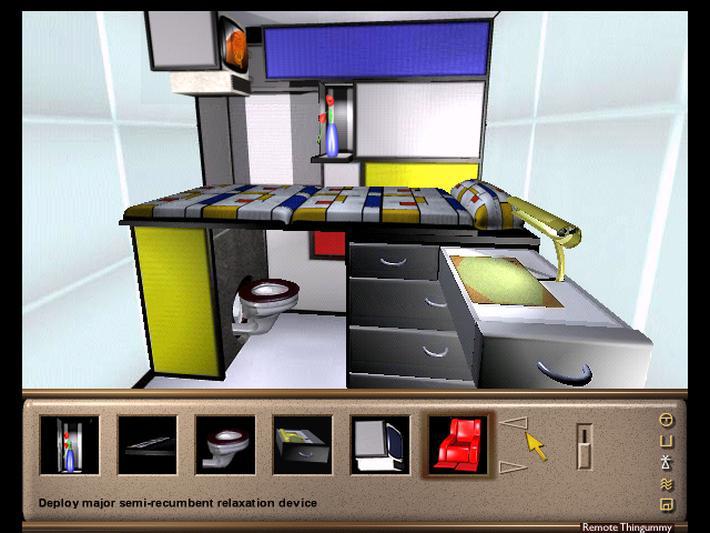
The premise begins with a literal bang: the Starship Titanic, described as the biggest and most beautiful starship ever built, vanishes from hyperspace and crashes directly into the player's home. You find yourself aboard the vessel as a "Super Galactic Class Traveller," a status that humorously affords you sleeping quarters in a multifunctional closet and a single greasy chicken per passenger. Your mission is twofold: locate the missing parts of the ship's control system to repair the AI, and secure a free upgrade to First Class.
The setting is a majestic Art Deco interior that resembles a mix of the Ritz, the Chrysler Building, and Tutankhamen's tomb. The ship is inhabited by a crew of malfunctioning robots, including the distinguished Doorbot Fentible, the hypochondriac Liftbot Nobby, and the convivial Barbot Fortilian Bantoburn O'Perfluous. As you navigate the ship, you will encounter a semi-deranged parrot and the mystery of Titania, whose brooding statues dominate the corridors.
Gameplay Mechanics and SpookiTalk
Starship Titanic is played from a first-person perspective, utilizing a cursor-based interface where players click to move between locations and interact with objects. The game introduces the Personal Electronic Thingy (PET), a toolbar located at the bottom of the screen that serves as the player's primary interface.
The game's defining feature is its interactive language engine, known as SpookiTalk (also referred to as the Chat-O-Mat). Unlike standard text parsers, this system allows players to converse naturally with the ship's robotic inhabitants. You can interrogate characters, give them orders, and receive contextual responses. The game features over 16 hours of recorded dialogue, allowing the AI to interpret player input and generate appropriate reactions based on the character's specific personality traits.
Key Features
- Douglas Adams' Legacy: The game was written and designed by the creator of The Hitchhiker's Guide to the Galaxy, ensuring a tone of surreal British humor throughout.
- Iconic Voice Cast: The game features voice acting from Monty Python legends Terry Jones and John Cleese.
- Art Deco Visuals: Production designers Oscar Chichoni and Isabel Molina created the ship's distinct visual style, moving away from standard sci-fi tropes.
- Interactive Dialogue: The SpookiTalk engine allows for complex interactions with non-player characters, making conversation a core gameplay loop.
Platforms and Availability
The game was originally released for Microsoft Windows in April 1998, followed by a version for Apple Macintosh in March 1999. While the original release faced mixed reviews regarding its difficulty and interface, it remains a cult classic for its writing and ambition. For modern players, Starship Titanic has been re-released for contemporary systems, ensuring that its unique blend of adventure and comedy remains accessible to new audiences via digital distribution platforms like GOG.com.
Who It Appeals To
This title is specifically tailored for fans of Douglas Adams, science fiction comedy, and classic interactive fiction. It appeals to players who enjoy deep narrative immersion and character-driven gameplay over action-oriented mechanics. The unique focus on dialogue and the absurdity of the "Super Galactic Class" travel experience makes it a compelling choice for those interested in the intersection of literature and gaming.