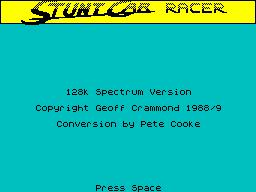
A High-Octane Roller Coaster: Stunt Car Racer
Released in 1989, Stunt Car Racer (also known as Stunt Track Racer) is a seminal racing title developed by Geoff Crammond. Published under the MicroPlay label of MicroProse, this game departed from the traditional, flat circuit racing of the era to deliver something far more vertical and perilous. Eschewing the polished world of Formula One, players take control of reinforced dragster conversions equipped with nitro-engines and "sticky" tyres, hurtling through massive, towering tracks that feel more like a high-speed roller coaster than a standard racecourse.
Thrilling Gameplay and Physics
What sets Stunt Car Racer apart from its contemporaries is its focus on gravity, momentum, and simulated physics. Unlike the predictable paths of Grand Prix racing, these elevated tracks are filled with jumps, twists, turns, and banking curves that demand absolute precision. The game is famous for providing an early taste of real-time physical interaction; players can feel the car rattling, shaking, and creaking as it pushes across ramps and through tortuous bends.
The gameplay loop involves progressing through various racing divisions, starting from the relatively simple "The Little Ramp" in division four and climbing toward the elite top flights. As you ascend, the tracks become increasingly treacherous:
- The Stepping Stones: A track riddled with holes that requires pinpoint accuracy to navigate. The Big Ramp: A daunting jump that can only be successfully cleared if the driver is travelling at full speed.
- The Drawbridge: A high-stakes circuit where timing is everything—crossing the bridge while it is moving can launch your vehicle into the air.
- The Ski Jump: A literal ski jump integrated directly into the middle of the racing circuit.
The tension is heightened by a unique damage mechanic. While minor stress cracks in the roll cage can be repaired after every race, significant holes appearing in the chassis from bad falls are much more punishing, as they can only be fixed at the end of a season. One wrong move on these barrier-free tracks doesn't just mean losing a race; it means plummeting into a yawning chasm.
Immersive Atmosphere and Visuals
Despite the technical limitations of platforms like the Commodore 64, the game utilizes filled 3D vectors to create a sense of scale and speed. The perspective is claustrophobic and immersive, viewing the world through a small opening at the front of the car, with the massive engine and tyres dominating the bottom of the screen. This "cockpit" view, combined with the distinct red, white, and black polygons, creates a highly distinctive aesthetic.
The auditory experience is equally vital to the immersion. The engine note undergoes a transformation based on velocity: at low speeds, it emits a powerful, rumbling roar, but as the nitro-boost is engaged, it shifts into a high-pitched scream and whine. When the boost hits, flames burst from the engine, providing a sensory payoff that makes every high-speed maneuver feel incredibly visceral.
Who Is This Game For?
Stunt Car Racer appeals to fans of high-risk, high-reward racing. It is perfect for players who prefer the chaos of crashing and jumping over the technicalities of engine tuning or tire tread maintenance. If you enjoy games that prioritize momentum, physics-based tension, and the sheer adrenaline of navigating "threadlike" tracks hundreds of feet above the ground, this classic remains an essential experience.
Technical Specifications
- Genre: Racing
- Developer: Geoff Crammond
- Publisher: MicroPlay (MicroProse)
- Release Date: 1989
- Platforms: PC, Commodore 64, Amiga, Atari ST