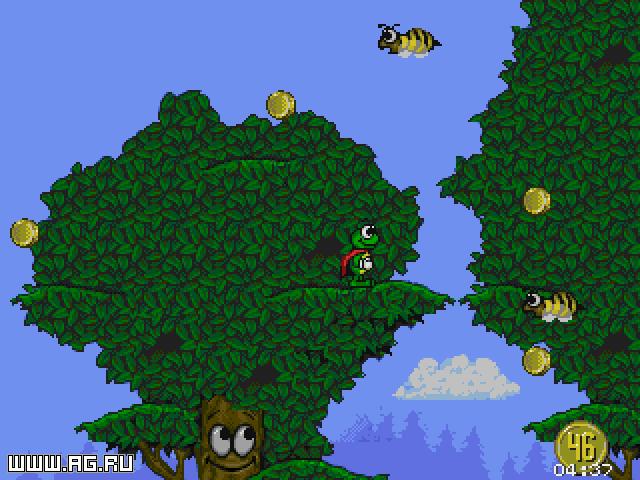
Superfrog represents a significant entry in the history of 2D platforming, developed by the renowned British studio Team 17. Originally released on December 31, 1993, the game emerged during a period when Team 17 was rapidly establishing a reputation for quality over quantity. Following successful releases such as the shoot-'em-up Project X and the beat-'em-up Body Blows, the Wakefield-based developers sought to create a "classic" platformer that would leverage the superior graphical and audio capabilities of the Commodore Amiga. Today, it is recognized as a classic mascot platformer that bridges the gap between the studio's earlier arcade-style successes and the mascot-driven genre that would later define their legacy.
The Story of the Frog Prince
While the narrative of Superfrog is straightforward, it provides the essential framework for the action. The game introduces players to a magic Prince who is transformed into a frog by an evil witch. To reclaim his human form, the protagonist must embark on a quest to defeat the witch and rescue his bride-to-be.
The game opens with a witty and highly detailed animation sequence crafted by Eric Schwartz, a talent known for his work in the shareware scene. This introduction sets the tone for the game's visual style, which combines a cartoony aesthetic with the high-fidelity graphics that the Amiga was famous for. Although the plot is simple, it serves as a clear motivation for the gameplay: traverse dangerous lands, overcome obstacles, and locate the villain to restore peace.
Gameplay Mechanics and Features
At its core, Superfrog is a side-scrolling arcade platformer. Players control the amphibious hero as he navigates through a variety of levels filled with secrets, traps, and a host of evil creatures designed to stop his progress. The gameplay relies heavily on precise jumping mechanics and exploration.
Key gameplay elements include:
- Coin Collection: Levels are populated with coins that must be collected to unlock exits and progress to the next stage.
- Exploration: Many levels feature pseudo-open-world designs where players must bounce around to find hidden paths and the correct direction to the exit, often guided by misleading arrows.
- Mini-Games: Upon completing specific segments, players are treated to fruit machine mini-games that offer various prizes.
- Boss Battles: The culmination of a series of levels typically involves a confrontation with the evil witch, which requires button-mashing to defeat.
While the original Amiga release was praised for its "super-playable" nature and fluid controls, later iterations—such as the Superfrog HD version released for the PlayStation 3 and PlayStation Vita—attempted to bring the game to modern audiences. However, the core mechanics remain rooted in the classic style of the early 90s, requiring patience and persistence.
Platform Availability
The original Superfrog was a flagship title for the Commodore Amiga, released in late 1993. Its success and the popularity of the character led to its availability on several other platforms over the years.
- Commodore Amiga: The original home of the game, showcasing its best graphics and sound.
- PC: Available for personal computers, allowing Windows users to experience the classic platformer.
- PlayStation 3 and PlayStation Vita: A "HD" remake was released for Sony's handheld and home consoles, bringing the 2D platformer to a new generation of gamers, albeit with some graphical updates.
Who Should Play Superfrog?
This title appeals primarily to fans of retro gaming, platformer enthusiasts, and those interested in the history of Team 17. Players who appreciate the "classic style" of platforming—where high scores, coin collecting, and navigating complex level geometry are paramount—will find the game engaging. It is also a must-play for gamers interested in the works of Eric Schwartz and the specific era of Amiga software development where developers were pushing the boundaries of what was possible on 16-bit hardware.