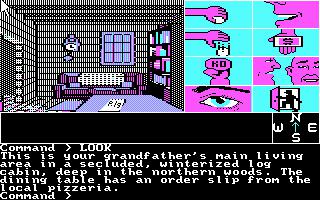
Released in 1986 by Activision, Tass Times in Tonetown stands as a quirky and groundbreaking entry in computer gaming history. Designed by veteran Infocom writer Michael Berlyn and Muffy McClung Berlyn, with programming by Rebecca Heineman of Interplay in collaboration with Brainwave Creations, this title defied conventional boundaries. Rather than adhering to traditional fantasy or science fiction templates, the game crafted a surreal, alternate reality heavily influenced by 1980s pop culture, punk aesthetics, and new wave fashion. Its unique blend of narrative ambition and experimental interface design has cemented its status as a cult classic among retro gaming enthusiasts.
The World of Tass Times in Tonetown
The narrative begins in the cabin of the player’s inventor grandfather, who has mysteriously vanished. While searching the premises, the protagonist discovers a strange, electronically powered hoop. When a pet dog named Spot jumps through it, the player follows him into Tonetown, a bizarre parallel universe. Here, reality is flipped: dogs are sentient newspaper reporters, with Spot transforming into the celebrity journalist Ennio the Legend. The town distills 1980s counterculture, filled with garish new wave clothing, wild haircuts, and radical slang. The word “tass” in the title means “cool” or “hip,” invented by the developers while teaching at Harvard. Despite its playful surface, the town faces a genuine threat from Franklin Snarl, a sinister real estate tycoon and monstrous animal hybrid systematically destroying the community with uncool housing developments.
Gameplay Mechanics and Interface
Tass Times in Tonetown occupies a fascinating transitional space in adventure game design. It functions as a graphical text adventure, marrying traditional parser-based command input with an early visual interface. The screen is divided into distinct zones: an upper-left quadrant displays scene artwork featuring simple animations, a central strip tracks inventory and provides a navigation compass, and the bottom quarter houses the text parser. To the right of the artwork sits a row of clickable command icons representing actions like look, talk, and pick up. This hybrid system allowed players to type commands or use icons as shortcuts, though the small text area often required scrolling through lengthy descriptions. While innovative, the limited functional icons and parser constraints sometimes made exploration cumbersome.
Platform Availability and Historical Significance
Upon its 1986 release, the game launched across multiple 8-bit and 16-bit home computers, including the Atari ST, Commodore Amiga, Commodore 64, Apple II, Apple IIGS, Macintosh, and IBM PC compatibles. Notably, it holds the distinction of being the very first commercial software released for Apple’s groundbreaking IIgs computer. Apple selected this title to showcase the IIgs’s advanced graphics and sound capabilities, making it a pivotal launch title. Many retro gaming historians consider the Amiga version the most polished due to its superior color palette and smooth rendering, though each port faithfully adapted the core experience to its hardware limitations.
Notable Features and Target Audience
- Experimental Interface: An early example of clickable action icons paired with a traditional text parser, bridging the gap to fully mouse-driven adventures.
- Distinctive Cultural Aesthetic: A deeply immersive 1980s punk and new wave atmosphere with invented slang and satirical commentary.
- Cult Classic Status: Valued by historians for its ambitious world-building and historical importance in early graphical interface design.
- Historical Hardware Showcase: Essential for collectors interested in the Apple IIgs launch library and mid-1980s cross-platform gaming.
Players who appreciate the evolution of interactive fiction and the rich experimentation of the 1980s gaming scene will find this title to be a fascinating historical artifact. Its blend of surreal storytelling, pioneering UI design, and cult appeal ensures it remains a noteworthy experience for anyone exploring the roots of the adventure genre.