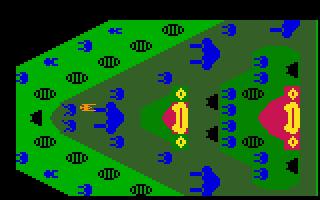
The Dreadnaught Factor stands as a tense, atmospheric shooter that captures the Cold War anxieties of the early 1980s. Originally conceived by Tom Loughry for the Mattel Intellivision and published by Activision in 1983, the title expanded to other hardware, with dedicated Atari 5200 and Atari 8-bit versions arriving in 1984. It challenges players to defend Earth from a relentless alien invasion by piloting a nimble fighter craft against colossal, descending warships that hover menacingly over the planet. With its stark visuals and high-stakes survival mechanics, The Dreadnaught Factor remains a significant entry in Activision’s early catalog of home gaming titles.
Story and Setting
Set against the backdrop of Reagan-era geopolitics, the game channels the period’s pervasive fear of nuclear annihilation into its central premise. Players witness a massive alien vessel, known as a Dreadnaught, enter orbit and begin a slow, inexorable descent toward Earth. An opening map screen establishes the tension, showing the leviathan’s trajectory as it inches closer to the surface. If the ship reaches low orbit, the defense fails and the planet is laid waste. This constant countdown creates a palpable sense of urgency, transforming each playthrough into a race against time. The narrative relies on environmental storytelling and the oppressive visual of the warship’s approach, reflecting how pop culture processed global tensions through interactive media.
Gameplay Mechanics and Controls
Players take control of a highly maneuverable fighter aircraft, strafing through a starfield to intercept the incoming Dreadnaught. The primary objective is to disable the ship’s offensive weapons and ultimately destroy it before it crashes into the atmosphere. Laser fire serves as the main tool for neutralizing the Dreadnaught’s cannons and missile systems, but bombs are essential for targeting the vessel’s massive engines and ventilation ports. Striking these vents requires precise timing, as players must slow their approach to avoid defensive fire. Each pass over the Dreadnaught causes it to drop slightly lower, increasing the difficulty and the intensity of incoming flurries. As players progress, the enemy ships change shape and deploy more aggressive defenses, ensuring that no two runs follow the exact same pattern.
The Dreadnaught Factor: Notable Features and Platform Availability
While the Intellivision version altered the perspective by flipping the screen sideways for a vertical strafing experience, the Atari 5200 and Atari 8-bit releases maintain the original top-down, forward-scrolling approach. These platforms showcased Activision’s attention to packaging, with collectors noting the publisher’s exceptional box art and manual design. The Atari 5200 version relies on precise controller inputs to navigate the intense dogfighting sequences. The game’s design philosophy emphasizes persistence over raw firepower, rewarding players who can survive multiple attempts to breach the Dreadnaught’s defenses. The developers provided extra lives to accommodate the steep learning curve inherent in the game’s later stages.
Who It Appeals To
- Retro gaming enthusiasts and collectors of early Activision titles.
- Players who appreciate atmospheric, high-difficulty shooters with strategic depth.
- Fans of classic arcade-style survival challenges and period-specific sci-fi themes.
- Historians of interactive entertainment interested in the evolution of home gaming.