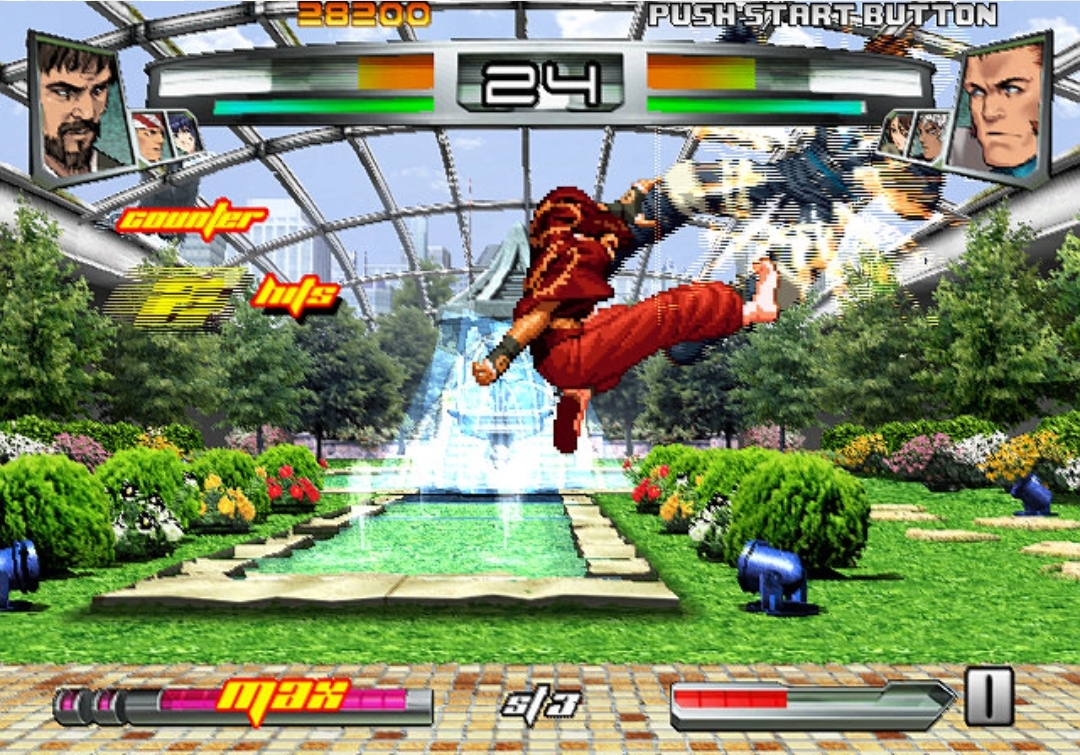
The King of Fighters Neowave stands as a pivotal entry in the legendary fighting game franchise, marking SNK Playmore's significant transition from the classic Neo Geo hardware to the modern Atomiswave arcade platform. Released first in arcades in 2004, this title serves as the eleventh installment in the series and is categorized as a Dream Match, offering a roster filled with fan-favorite combatants from various SNK universes rather than following a strict numerical progression. The game brings the intense 2D arena combat to a wider audience through subsequent console ports, solidifying its place in the history of beat-'em-ups.**.
Gameplay Mechanics and Combat Systems
Designed as a traditional fighting game, The King of Fighters Neowave retains the series' core identity of fast-paced, three-character team battles. Unlike its predecessor which experimented with new tag mechanics, Neowave strips the gameplay back to the classic scheme, focusing on refined execution and strategic depth. Players select teams comprising fighters from iconic rosters. The game features the following official team configurations:
- Japan Team (Kyo Team)
- K' Team
- Fatal Fury Team
- Art of Fighting Team
- Ikari Warriors Team
- Korea Justice Team
The roster features 43 distinct combatants. SNK made notable changes to the lineup by dropping characters such as May Lee, Angel, and K9999, while introducing Jhun Hoon to the Korea Justice Team. The game also welcomes back a hidden boss, Young Geese Howard, originally the antagonist from Art of Fighting 2.
Neowave introduces meaningful customization to the gameplay loop. During character selection, players can choose specific options that alter their team's capabilities, enabling either Super Cancels, Guard Breaks, or MAX2/HSDM attacks. Additionally, a new Heat mode is accessible via the fifth button, allowing players to temporarily power up a character at the cost of health. While the game removes the narrative elements found in recent entries, the focus remains squarely on competitive play and mastering these enhanced mechanics.
Presentation and Visual Style
As the first fighting game developed by SNK Playmore on Atomiswave hardware, Neowave showcases the technical capabilities of the new system. The game features high-resolution backgrounds that add depth to the arena, though the character sprites remain largely identical to previous entries, merely receiving some filtering. The artwork is handled by Tomokazu Nakano, resulting in a visual style that draws comparisons to the work of Range Murata.
While the audio engine offers technical superiority over the older Neo Geo synthesizers, the soundtrack is often described as functional but lacking in memorability. The console ports for PlayStation 2 and Xbox retain the 3D background elements, though players on these platforms may encounter technical quirks, such as music restarting frequently due to rapid load times between character changes.
Platform Availability and Console Ports
Following its arcade debut, The King of Fighters Neowave expanded its reach across multiple home systems. The game was released on the PlayStation 2 in Japan and Europe, while the Xbox version launched in Japan, North America, and PAL regions. The Xbox release is particularly notable for including full Xbox Live support, allowing for online matchmaking.
Availability varied by region due to publishing policies; for instance, straight ports of 2D games to North America were restricted by Sony, leading to the PS2 release being limited to Japan and Europe. Despite these regional constraints, fans could access the game via the Atomiswave arcade hardware, PS2, and Xbox, ensuring the fighting experience remained accessible to the community.
Who Should Play The King of Fighters Neowave?
This title appeals primarily to dedicated fans of the King of Fighters series and enthusiasts of classic 2D fighting games. It is ideal for players who appreciate Dream Match styles of gameplay where iconic characters clash outside of standard continuity. The game offers a refined, traditional experience for veterans looking for the classic team-based combat without experimental mechanics, while also serving as a historical bridge for those interested in the evolution of SNK's hardware and the franchise's transition into the mid-2000s.