Master the Art of Cooperation in The Lost Vikings
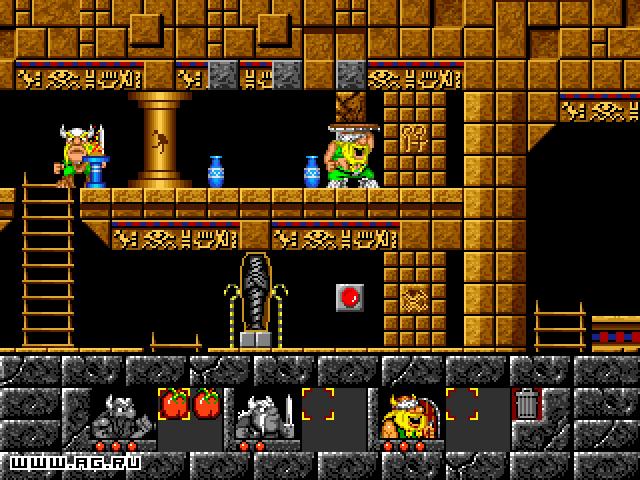
A true classic from the golden era of 16-bit gaming, The Lost Vikings is a highly clever action-puzzle platformer that demands precision, strategy, and teamwork. Originally developed by Silicon & Synapse—the studio that would later evolve into the legendary Blizzard Entertainment—this title stands as a landmark achievement in puzzle design. Instead of controlling a single hero, players must command three distinct Vikings, each possessing unique abilities, to navigate treacherous environments and overcome ingenious obstacles.
A Story of Intergalactic Abduction
The premise of The Lost Vikings is as charming as it is high-stakes. The adventure begins when the peaceful Norwegian village is disrupted by an alien named Tomator, who kidnaps our heroes to serve as attractions in his intergalactic zoo. To escape this cosmic captivity and find their way back home, Erik, Baleog, and Olaf must traverse a series of challenging worlds. The journey spans multiple levels (including up to 37 stages in certain versions) across six different worlds, all while evading enemies and environmental hazards.
Three Heroes, One Goal
The core gameplay mechanic revolves around the synergy between three playable characters. Success is only achieved if all three Vikings reach the exit of a level alive; if even one member of the trio falls to an enemy or a deadly trap, the entire mission fails and the player must restart. This creates a high-stakes environment where every move must be calculated.
Each Viking brings a specific skill set to the table:
- Erik the Swift: The agile member of the group, Erik is the only Viking capable of jumping. He can also use his horned helm to charge at high speeds, allowing him to smash through certain walls or strike enemies.
- Baleog the Fierce: A master of weaponry, Baleog provides the necessary firepower. He can utilize a massive claymore for close-quarters combat or a bow to strike enemies and hit distant switches from afar.
- Olaf the Stout: The heavy hitter of the group, Olaf uses his large shield to block incoming projectiles. By holding his shield above his head, he can glide safely across gaps. Furthermore, his strength allows Erik and Baleog to stand on his shield, providing them with much-needed height to reach higher platforms.
Challenging Puzzle-Platformer Gameplay
While The Lost Vikings features platforming elements, it is fundamentally a puzzle game. The levels are laid out linearly, requiring players to manipulate the environment—such as pressing buttons, pulling levers, or utilizing elevators—to progress. You might find yourself using Baleog to hit a switch that opens a door for Erik, only to then swap to Olaf to bridge a gap for the whole group. This constant switching and coordinated movement is what makes the game's design so enduringly difficult and rewarding.
Notable Features and Availability
Originally released for the Super Nintendo Entertainment System (SNES) in 1993, the game has enjoyed a long legacy across various platforms. Players can encounter this classic on a wide range of systems, including:
- PC (MS-DOS / Battle.net)
- Game Boy Advance
- Sega Genesis / Mega Drive (featuring exclusive stages)
- Commodore / Amiga
- Amiga CD32
Whether you are revisiting the 16-bit original or exploring the mechanics through modern emulated releases, The Lost Vikings remains a must-play for fans of intelligent design and challenging retro gameplay. It is the perfect title for players who enjoy the satisfaction of solving complex spatial puzzles through character-driven strategy.