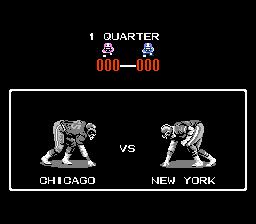
Overview of Touch Down Fever
Touch Down Fever is a sports video game originally developed and published by SNK in 1987. Designed as an early attempt to bring American football to the arcade, the title quickly transitioned to home consoles, with its Nintendo Entertainment System port launching in Japan on November 11, 1988, and reaching North American shelves in February 1991. As a dedicated entry in the sports genre, the game captures the essence of gridiron action through a uniquely condensed arcade lens, prioritizing rapid rounds over complex statistical simulation.
Gameplay and Mechanics
Operating from a close-up overhead perspective, Touch Down Fever emphasizes fast-paced action. Players navigate their squads using an eight-way joystick paired with two buttons dedicated to running and passing. This control layout, drawing inspiration from SNK's earlier mechanical innovations, allows for precise directional aiming without cluttering the interface. Matches are designed to be brief, arcade-style contests that focus on immediate tactical decisions rather than long-term management. The game supports up to four simultaneous players, offering configurations for both competitive head-to-head matches and cooperative play against the computer. Despite its straightforward mechanics, retrospective analysis has highlighted mixed reactions regarding field proportions, player scaling, and repetitive gameplay loops.
Control Scheme and Pacing
The arcade version featured an eight-way joystick equipped with an optical rotary encoder, enabling smooth directional control during passes and runs. This design choice was intended to enhance pacing for arcade cabinets, where quick turnover and continuous coin insertion were essential. The game includes dipswitch settings that allow operators to customize difficulty levels and coinage parameters, ensuring the experience could be tailored to different arcade environments.
Story and Setting
Rather than focusing on real-world franchises or detailed narratives, Touch Down Fever embraces a generic, arcade-driven approach to the sport. Players choose from basic U.S. city-based teams, each distinguished by unique uniform colors. The setting is purely functional, serving as a backdrop for exhibition games and tournament modes. The game intentionally avoids licensed rosters and complex storylines, instead focusing on the raw, simplified intensity of gridiron action. Celebrations and crowd reactions are stylized but remain secondary to the core objective: advancing down the field to score points.
Platform Availability
Originally conceived for arcade cabinets, Touch Down Fever supports both upright two-player setups and stand-up cocktail table configurations. It was later ported to the NES, where it retained its core mechanics while adapting to home console play with single-player and two-player options. Beyond its original arcade and 8-bit console run, the title has seen modern re-releases on the PlayStation 3 and PlayStation Portable through digital distribution channels. These ports allow newer generations to experience this early SNK football simulation on contemporary hardware.
Notable Features and Legacy
The arcade version ran on custom SNK hardware compatible with JAMMA standards, utilizing dual Zilog Z80 processors for smooth animation and a dedicated mono audio channel. A direct sequel, Touchdown Fever II, followed in 1988 as an enhanced version rather than a narrative continuation. While the game's visual presentation and pacing have been critiqued in retrospective reviews, its historical significance as an early attempt to bring arcade football to homes remains notable. The original arcade machines and circuit boards are now considered rare collectibles.
Who Should Play Touch Down Fever?
- Retro gaming enthusiasts interested in early 1980s arcade sports titles.
- SNK collectors tracking the developer's early ventures beyond fighting games.
- Arcade history buffs who appreciate unique control schemes and cabinet configurations.
- Classic console players looking for straightforward, short-duration matches.