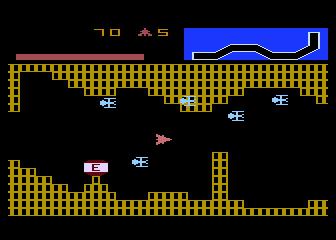
Vanguard (1981)
Vanguard stands as a foundational title in the history of arcade shooters, originally developed by TOSE and published by SNK across Japan, Germany, and North America. As one of the earliest color arcade releases from SNK, it quickly established the company’s reputation in the Western market through licensing deals with publishers like Centuri and Zaccaria. The game introduced a groundbreaking dual-control system, utilizing four directional buttons instead of a second joystick, a design philosophy that would later influence classics like Robotron: 2084.
Genre and Gameplay Mechanics
Vanguard is a scrolling shoot 'em up that challenges players to navigate a heavily guarded tunnel while managing both combat and resource survival. The gameplay revolves around piloting a spaceship equipped with multi-directional lasers. Players can fire in four directions simultaneously, though doing so temporarily reduces movement speed. A critical mechanic involves a rapidly depleting fuel gauge; destroying enemy ships grants fuel, while running out results in an immediate crash. The tunnel is divided into distinct scrolling zones, including the mountain, rainbow, stick, stripe, and bleak zones. Navigating these areas requires constant vigilance against deadly cave walls and swarms of enemy vessels. Players can also locate energy pods marked with an 'E', which grant temporary invincibility to both enemy fire and environmental hazards.
Story and Setting Overview
Set in a sci-fi future, the narrative follows a pilot’s mission to navigate a complex, multi-layered tunnel system and reach the City of Mystery. Once the final zone is breached, the pilot must confront and destroy a powerful creature known as Gond. The journey is broken into several thematic zones, each featuring unique enemy layouts and scrolling directions. Upon defeating Gond, the game loops back to the beginning at a higher difficulty level, emphasizing the title’s arcade roots and relentless pacing.
Platform Availability and Legacy
While Vanguard debuted in arcades in 1981, its reach expanded significantly through various home console ports and modern re-releases. The title was licensed to Cinematronics for cocktail cabinet conversions and later adapted for legacy hardware. Key platform releases include:
- Atari 2600
- Atari 5200
- PlayStation 3
- PSP
Decades later, SNK preserved this historical artifact in the SNK 40th Anniversary Collection, making it available on modern platforms. Notably, the Atari 2600 version features cover artwork by Ralph Angus McQuarrie. Historians also credit the game with potentially being one of the earliest titles to implement a player continue feature, a standard now ubiquitous in gaming.
Who Vanguard Appeals To
Vanguard primarily targets retro gaming enthusiasts, shoot 'em up historians, and collectors interested in the foundational era of arcade development. Its pioneering use of multi-directional scrolling and early resource management mechanics make it a valuable educational piece for developers studying the evolution of game design. While the straightforward arcade loops and dated control schemes may not appeal to modern casual players, those with an appreciation for gaming preservation and the golden age of arcade history will find Vanguard to be a fascinating and historically significant experience.