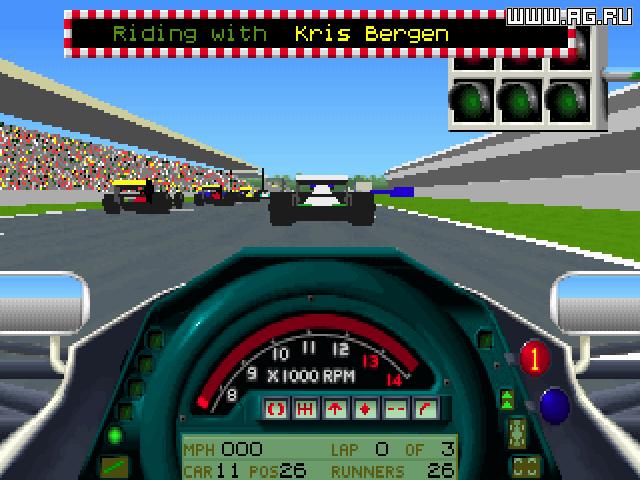
World Circuit: A Pioneering Formula One Racing Simulator
World Circuit stands as a landmark title in the history of computer gaming, originally developed by British designer Geoff Crammond and released under the name Formula One Grand Prix in Europe before arriving in the United States on October 1st, 1992. This title established a new benchmark for vehicular simulation by combining cutting-edge polygonal graphics with deeply technical driving mechanics. It transformed how players experienced motorsport on a personal computer and remains a crucial piece of interactive entertainment history.
Genre and Gameplay Mechanics
Positioned firmly within the racing and simulation genres, World Circuit diverges sharply from the arcade-style competitors of its era. Rather than focusing on chaotic speed and power-ups, the game demands strategic precision and mechanical mastery. Players must navigate a complete championship season, managing tire wear, fuel consumption, and brake temperature across 16 meticulously designed circuits. The title introduces a granular car setup system that allows competitors to adjust gearing, braking force, and aerodynamic wing angles. These adjustments directly impact handling characteristics, rewarding players who dedicate time to practice laps and technical fine-tuning. The simulation also features dynamic weather conditions, requiring players to adapt their driving style and tire strategy when tracks transition to wet surfaces.
Story and Setting
While World Circuit does not follow a traditional narrative structure, its setting is deeply rooted in the authentic atmosphere of the 1991 Formula One championship. The game recreates the entire racing season, transporting players through iconic Grand Prix locations that defined the era. Although the official FIA license was not secured, the developers maintained a high level of realism by accurately replicating team liveries and driver helmet designs, replacing real-world names with fictional alternatives to avoid licensing issues. This dedication to period-accurate presentation allows players to experience the tension, strategy, and prestige of top-tier motorsport without breaking the simulation's immersive foundation.
Platform Availability
World Circuit was originally developed for the PC (DOS), Amiga, and Atari ST platforms, taking full advantage of the hardware capabilities available in the early 1990s. The PC version specifically expanded visual fidelity by incorporating textured scenery polygons alongside the wireframe vehicles. For modern audiences interested in experiencing this historic release, a contemporary digital restoration titled Geoff Crammond Racing is scheduled for release on Steam in 2026, ensuring that new generations of players can access this foundational simulation on current systems.
Notable Features
- Advanced Car Setup: Minute control over gear ratios, brake bias, and aerodynamic wing angles directly alters vehicle physics and handling.
- Dynamic Weather System: Wet track conditions realistically impact grip levels and force strategic tire changes during races and qualifying.
- Polygon-Based Graphics: Utilizes early 3D polygon rendering at a remarkably high framerate, delivering smooth motion for its time.
- Comprehensive Season Mode: Players compete through a full 16-race calendar, managing team strategy and driver development across the championship.
- Realistic Damage Model: Impacts affect vehicle performance, particularly on aerodynamic components, requiring careful driving and pit adjustments.
Who It Appeals To
This title is specifically crafted for players who appreciate deep mechanical simulation and strategic planning over fast-paced arcade action. Motorsport enthusiasts, particularly those fascinated by Formula One history and engineering, will find the attention to detail highly rewarding. Retro gaming collectors and simulation veterans will appreciate its historical significance and technical ambition. However, players seeking casual, pick-up-and-play entertainment may find the steep learning curve and requirement for methodical practice less accessible. It remains a definitive experience for those who value precision, strategy, and authentic vehicular physics.