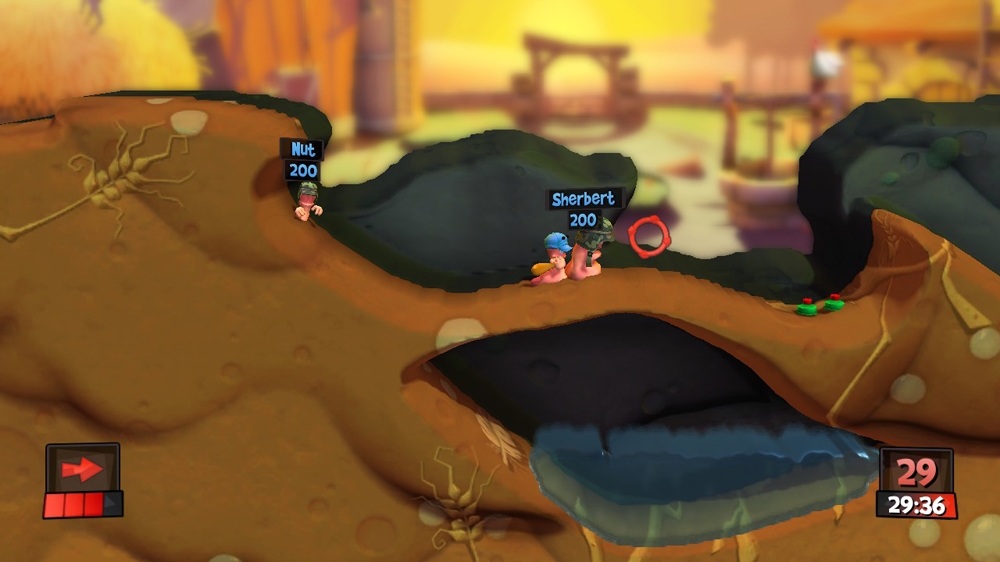
Worms Revolution stands as the 18th entry in Team17’s long-running artillery franchise, delivering a refined turn-based strategy and simulation experience. Released on October 9, 2012, for PC, Xbox 360, and PlayStation 3, this title marks a deliberate return to the series' 2D roots after previous three-dimensional experiments. With a Metacritic score of 73.00, the game successfully revitalizes its core loop by introducing a new engine, robust customization options, and a class-based progression system. At its heart, Worms Revolution remains exactly what players expect: a chaotic, weapon-slinging tactical battle where teams of invertebrates compete for survival on destructible landscapes.
Core Gameplay & Class System
The primary objective is straightforward yet deeply engaging: eliminate the opposing team using an arsenal of absurd and explosive weaponry. Players control squads of worms in a strict turn-based format, managing a limited time budget to move, aim, and deploy weapons like dynamite, bazookas, flying sheep, concrete donkeys, and the iconic Holy Hand Grenade. A major mechanical shift in this installment is the introduction of a class system. Teams can now select from four distinct roles:
- Soldier: The balanced, classic worm that serves as the foundation of any squad.
- Heavy: Capable of taking and dealing out extra damage during engagements.
- Scout: Can navigate small tunnels and leap large distances across the map.
- Scientist: Features a distinct large head design and slowly heals the team at the start of each turn.
This addition adds strategic depth to squad composition, allowing players to tailor their approach to their preferred playstyle rather than relying on a uniform team.
Destructible Environments & Physics
The battlefield in Worms Revolution is far from static. The new engine implements a comprehensive physics system that allows objects to interact, move, and break realistically. Players can utilize telekinesis to reposition items like gas lighters or UFOs, triggering chain reactions that engulf zones in fire or poison. Water also plays a pivotal role, flowing dynamically across sloped terrain when bottles or flasks are destroyed. While submerged worms sustain minor damage over time, the water primarily serves as a tactical tool to sweep opponents across the map or block movement paths. The wind mechanics further complicate long-range shots, requiring players to account for environmental variables before firing.
Atmosphere & Presentation
True to the franchise's legacy, the game does not lean into a complex narrative. Instead, it embraces its absurd premise of color-coded worms engaged in an eternal, lighthearted conflict. The experience is framed as a wildlife documentary, narrated by British actor Matt Berry, whose distinctive voice and scripted one-liners add a layer of dry humor to the on-screen mayhem. Visually, the game employs a 2D environment rendered with modern 3D-style graphics, allowing players to zoom in and out to survey the terrain and plan their artillery trajectories. The cartoonish aesthetic and humorous tone keep the focus firmly on chaotic fun rather than serious storytelling.
Who Worms Revolution Appeals To
This title is primarily aimed at veteran fans of the Worms franchise and enthusiasts of turn-based tactical strategy. The class system and physics-driven environments provide enough novelty to keep long-time players engaged, while the accessible controls and humorous presentation lower the barrier for newcomers. It is also an excellent choice for groups seeking local multiplayer experiences, as the hotseat and multiplayer modes thrive on shared, screen-passing battles. For those who enjoy unpredictable, weapon-heavy strategy games where terrain manipulation and wind physics dictate victory, Worms Revolution delivers a polished and entertaining tactical experience.