A Retrospective on Sid Meier's Railroads!
Twenty years ago, the gaming landscape was vastly different. Yet, in the quiet corners of PC strategy, a title emerged that redefined how we view economic competition: Sid Meier's Railroads!. Though it may have faded from the mainstream spotlight, the game’s legacy remains undeniable. It stands as a testament to the genius of its creator, Sid Meier, whose other works like Civilization and Gettysburg are already canon.
Meier is widely recognized not just as a designer, but as a master of distilling complex human behavior into elegant mechanics. He has a rare ability to find humor and fun in subjects that are often dark or dry. While Civilization deals with heavy themes like genocide and religious hatred, it does so with a lightness of touch that makes it accessible to families. Sid Meier's Railroads! carries that same spirit, offering a competitive, real-time board game experience disguised as a simulation.
The Misunderstood Middle Ground
Upon its release, Railroads! was cruelly ignored. It suffered from a fatal identity crisis among critics and players. It was neither a rigorous simulation of railroad logistics, complete with signal management and junction engineering, nor was it a hard-nosed business simulator requiring you to balance freight costs and ticket prices.
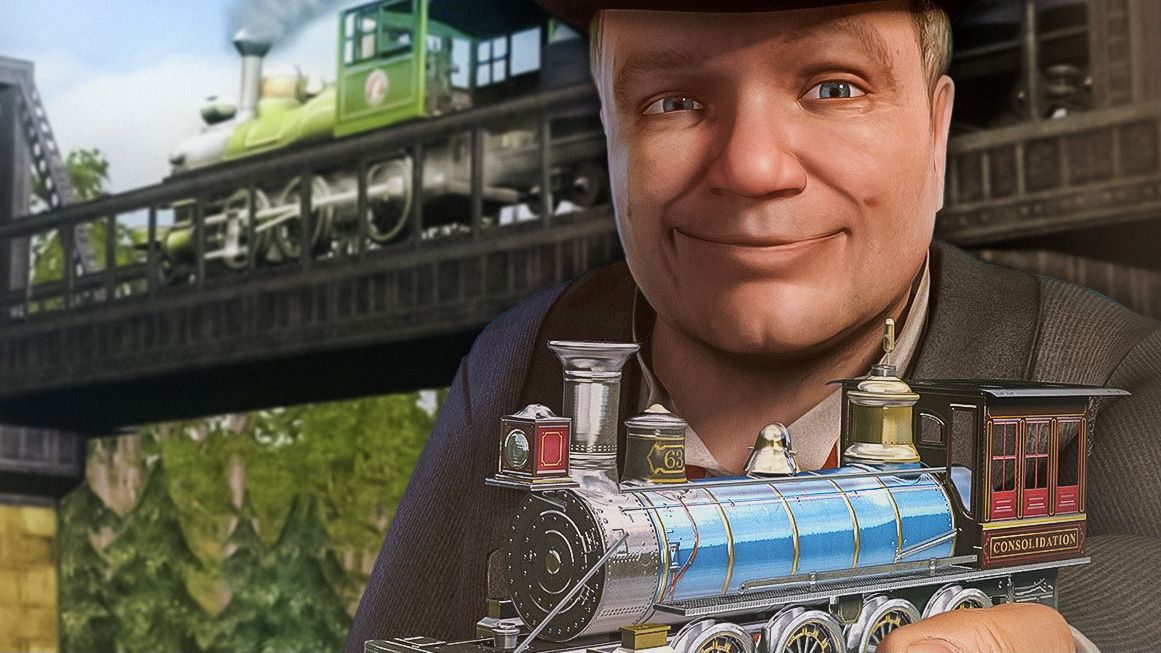
Instead, it occupies a unique niche. It is a game about train sets, toys, and the raw, visceral competition of commerce. It is, in essence, a competitive real-time board game that deserves to be played with friends.
A LAN Party Revival
The game features around ten scenarios set in distinct periods of rail technology, each playable in about two hours. While you can play alone, the true essence of Railroads! is revealed in multiplayer.
Given that the original game used the now-defunct GameSpy server browser and didn't sell particularly well, finding opponents online is a challenge. However, this is an opportunity for nostalgia. You should consider running a Railroads! LAN party. Hooking up over an office network allows you to experience the game exactly as it was designed to be played: with direct, competitive interaction.
Financial Engineering and Hostile Takeovers
The gameplay loop is deceptively simple. You link towns and industries by painting tracks across a bright, airy landscape. The initial goal is to build a war chest by carrying passengers between major cities. This is not about massive profits, but about establishing a foothold.
Once you secure your first $100,000, you face a critical decision: extend, secure, or invest. This is where Railroads! gets dirty.
The Three Pillars of Strategy
- Extending Your Network: You can lay lines to more cities and industries. Dropping a depot on a lumbermill or factory is called "annexing" in the game, and for good reason. It is a hostile act. You are declaring, "This is my territory. Keep off." By controlling the source of goods, you take a stake in their production.
- Securing Your Position: You can buy up industries you plan to exploit. This grants you income not just from transportation, but from every item sold. Raw materials are poor investments; transporting iron ore is for suckers. The real money is in finished products. Buying a weapons factory in Leicester allows you to monopolize the mid-game. Monopolies are fun.
- Investing via Shares: You can buy shares in yourself or competitors in 10% increments. The cost is determined by the company’s value, assets, and profits. If you gather more than a 50% aggregate stake, you take over the company completely. You can add their railroad to your network or sell the entire company off.
The Genius of Interaction
The brilliance of Sid Meier's Railroads! lies in the interaction between these three systems. They are not isolated choices but a tangled web of risk and reward.
- Need money? Sell shares. This is a risk, as it dilutes your control.
- Want to take a controlling interest? Hoard cash and hope your rivals' value doesn't outpace your savings.
- Want to bankrupt an opponent? Make a play to buy the industries at the heart of their network.
If you win the auction for a rival's industry, you are in the black. If you lose, they double their operating profits, but they may be forced to sell stocks to raise the cash they need. You can drive opponents to the brink by forcing them into auctions they cannot afford, triggering a cascade of forced stock sales.
A Modern Relevance
It is horrifying to realize a rival has a 30% stake in your company. It is even more horrifying to realize that to raise capital for a major network upgrade, you must sell some of your own shares. This mechanic creates a dynamic where economic warfare is just as important as physical infrastructure.
In single-player, the AI does an extraordinary job of exploiting these interactions, triggering auctions you cannot afford or annexing your most critical nodes. This depth was present in 2009, and it remains potent today.
Twenty years later, the world deserves another look at Sid Meier's Railroads!. It is not just a game about trains; it is a game about power, competition, and the ruthless elegance of market forces. It is a game that understands that business is competition, and competition is a game. And games, as we know, are awesome.