3D Printing Performance Boosted by 1000% with Nintendo Switch and Klipper
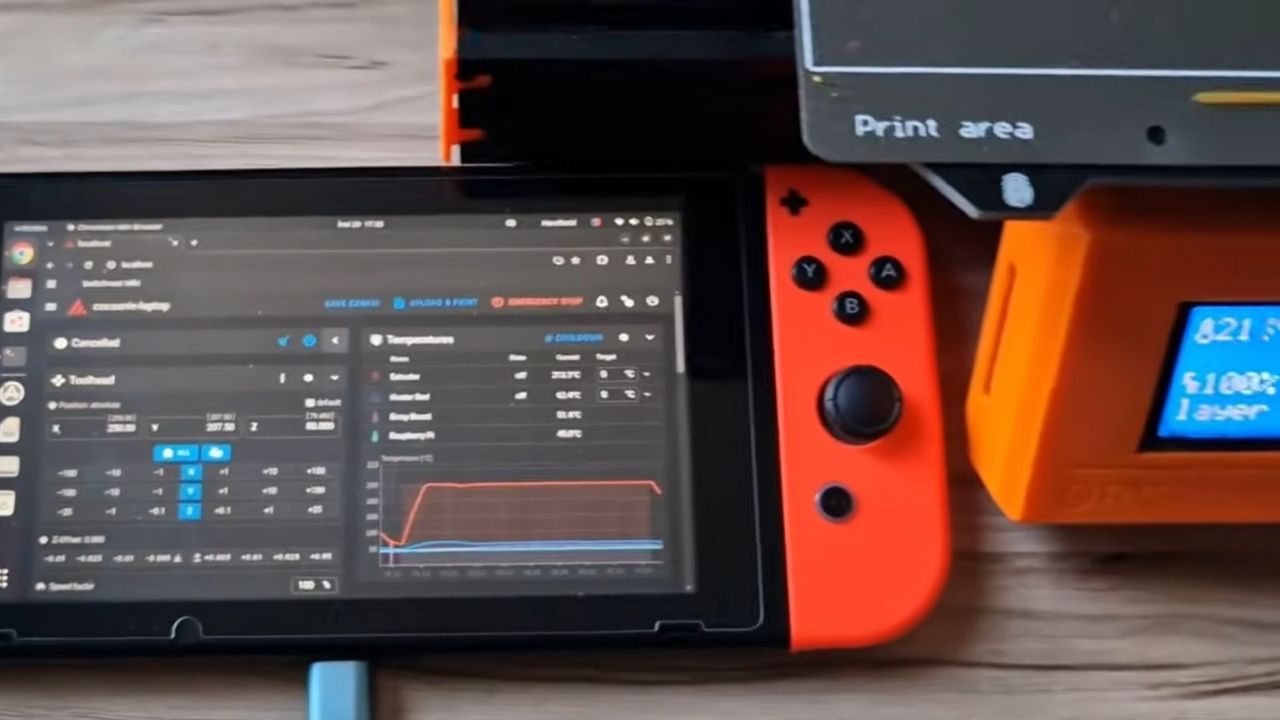
By leveraging Linux on a Nintendo Switch and the open-source firmware Klipper, YouTuber Cocoanix has demonstrated a staggering 1000% increase in 3D printing speed. In a recent video, a model that typically requires 90 minutes to complete was printed in just eight minutes.
This discovery, originally highlighted by Hackaday, showcases an unconventional approach to offloading computational tasks from the printer itself. While the Nintendo Switch serves as the processing unit, the underlying principle is applicable to various hardware setups.
The Klipper Advantage Over Traditional Firmware
To understand the magnitude of this upgrade, it is crucial to compare Klipper with standard firmware like Marlin. Traditional firmware runs directly on the 3D printer’s microcontroller. This often limits processing power, akin to asking a basic calculator to run a complex spreadsheet.
Klipper solves this by offloading heavy lifting to a separate device. In Cocoanix’s setup, the Switch handles:
- Complex mathematical calculations.
- G-code processing.
- Real-time instruction sending to the printer.
This separation of duties does more than just increase speed; it significantly enhances print quality. The result is a cleaner output with reduced ringing and ghosting artifacts, which are common issues in high-speed printing.
Achieving Extreme Acceleration Limits
Cocoanix connected the Switch to the 3D printer via its unique serial ID and began testing the hardware's boundaries. The system successfully achieved:
- Speed: 400 mm/s
- Acceleration: 17,000 mm/s²
These figures are impressive for the hardware in question. However, the ultimate speed ceiling was not determined by the Switch’s processing power, but rather by the printer’s physical limitations, specifically its stock hotend, extruder, and lack of advanced cooling.
Cocoanix notes that Klipper makes it easier to edit files and adjust code on the fly. Users do not need to recompile firmware or restart the system to implement changes, streamlining the workflow for advanced users.
Why a Raspberry Pi Might Be the Better Choice
Despite the impressive results with the Nintendo Switch, Cocoanix explicitly states that "for most people, a Raspberry Pi is a better choice."
While the Switch proves that gaming handhelds can run Klipper efficiently, a Raspberry Pi offers:
- Cost-Effectiveness: It is generally cheaper than repurposing a gaming console.
- Dedicated Functionality: Designed specifically for continuous computing tasks.
- Community Support: Extensive documentation and troubleshooting resources.
Cocoanix argues that Klipper is one of the best upgrades for older printers because it is free, powerful, and surprisingly versatile. The Switch experiment serves as a proof of concept that the firmware can run on almost any Linux-capable device, even those not originally intended for industrial use.
Conclusion
While upgrading to a Nintendo Switch 2 won’t magically produce shinier 3D printed models, the current generation Switch proves that high-performance computing can be repurposed for manufacturing. For enthusiasts looking to breathe new life into old hardware, Klipper offers a powerful, free solution that transcends traditional hardware limitations.
It remains to be seen if future hardware will utilize ray tracing capabilities for more accurate material simulation, but for now, the focus remains on raw speed and precision.