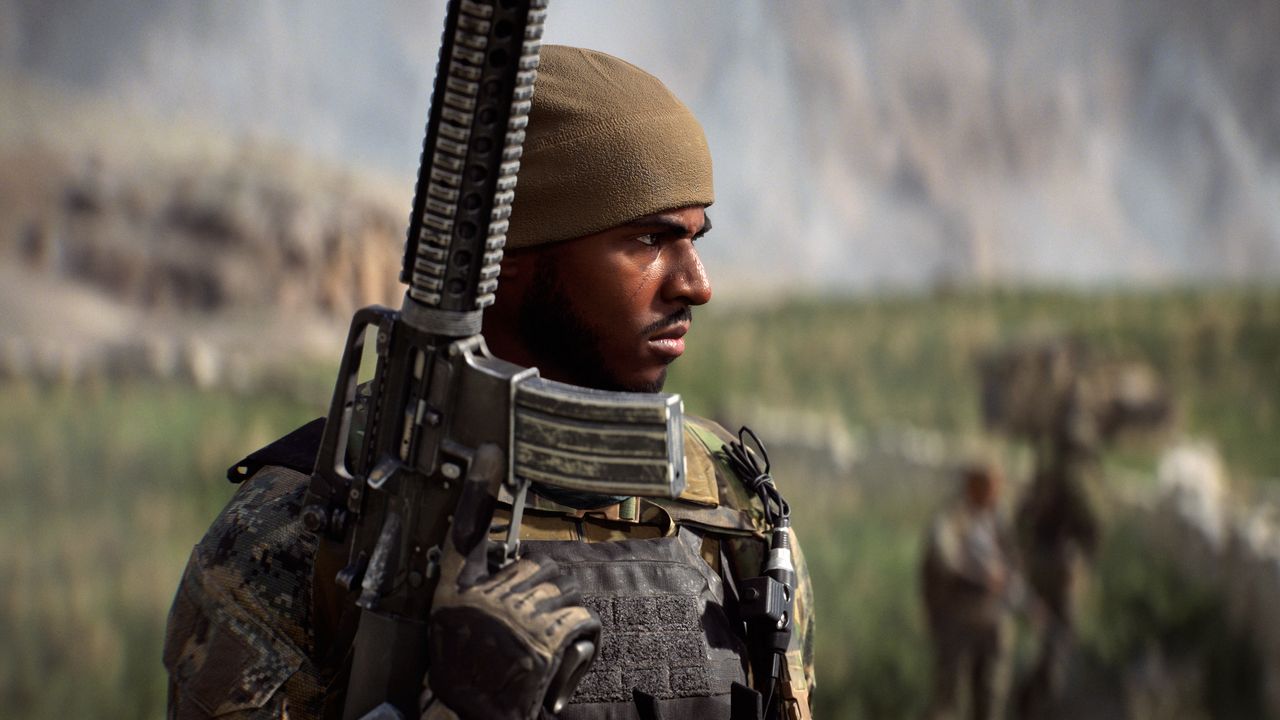
The first time I spawned in the hilltop village of Golmud in Battlefield 6's new Railway to Golmud update, I climbed a watchtower to survey the horizon. Below me, the chaos was cinematic: an attack chopper rained fire on a moving train, engineers advanced on a heavy tank, and a rider pulled a backflip on a dirtbike. It was a massive, awe-inspiring moment that captured the spirit of the franchise.
Yet, the most surprising aspect of this new map wasn't the spectacle. It was the peace.
For the first time since launch, I felt a moment of genuine downtime. My sniper’s nest in Golmud was relatively safe, temporarily disengaged from the contested hot zones. In a lobby of 64 players, I was effectively alone. This is the element of Battlefield that has been missing: the ability to breathe. Railway to Golmud, a remake of the legendary Battlefield 4 map, represents the series’ first truly massive space since its launch, and it feels like playing a fundamentally better game.
The Return of Scale and Strategic Depth
The original Golmud in Battlefield 4 was a beloved but brutal environment for on-foot players. It was defined by vast, open fields with sparse cover, creating a tense experience where running across the map felt like a death sentence. This remake tackles that issue head-on, not by shrinking the map, but by intelligently redesigning the terrain.
Beyond a stunning graphical overhaul, the new Golmud introduces settlements, rolling hills, and natural divots that break up sightlines. This design choice allows stranded squads to find shelter and stand a chance against hillside snipers without feeling unfairly targeted.
The result is a smart reimagining that serves every playstyle:
- Comprehensive Vehicle Support: All vehicle classes are present and accounted for, from ground armor to aerial dominance.
- Diverse Playstyles: Whether you prefer close-quarters combat or long-range suppression, the map’s layout supports it.
- Iconic Mechanics: The moving train that splits the map in half remains as awesome a centerpiece now as it was in 2013.
Golmud has instantly become the best map in Battlefield 6. It proves that Battlefield doesn’t need to abandon its large-scale roots to remain relevant.
Why "Old School" Means Downtime, Not Just Size
Much of the recent discourse around Battlefield 6 has focused on its lacking map pool and restrictive play spaces. Fans often ask for "old school Battlefield maps," a phrase I’ve used myself without fully defining it. Initially, I wondered if it simply meant bigger maps, especially considering DICE spent the year after Battlefield 2042’s launch shrinking down spaces that players agreed were too large.
However, playing Golmud has clarified what "old school" truly means. It is not just about square mileage. The defining test of a great Battlefield map is the ability to disengage.
In a perfect Battlefield moment, you are a participant in the awe-inspiring scale of the battle, only to become a temporary observer the next. You need downtime. You need to get away from it all. Currently, this is impossible elsewhere in Battlefield 6.
- Siege of Cairo offers no true downtime.
- Liberation Peak lacks quiet watchtowers for reflection.
- Mirak Valley is too centralized to offer any genuine dead zones.
In these maps, spaces between objectives are small, sightlines are wide open, and flight zones are cramped. While BF Studios has framed the map pool as serving a "wide range of players," the consistent trend suggests a vision of Call of Duty-type intensity at all times, sacrificing the traditional large scale. Golmud is proof that this approach was a mistake.
Honest Scale vs. "Big Map Fraud"
Variety is important. Some maps should be smaller than others, and a uniform experience would be boring. Maps like Siege of Cairo and Manhattan Bridge are excellent examples of medium-sized spaces that target specific fantasies. Cairo focuses on tanks as power weapons, while Manhattan delivers manic helicopter duels amidst skyscrapers.
The problem arises with what I call big map fraud. These are launch maps—such as New Sobek City—that have air vehicles and take place in a vast valley or desert, yet the actual play space is confined to a tiny rectangle at the center. DICE originally described New Sobek City as "large," but the functional combat area tells a different story.
Compare that footprint to Railway to Golmud. Look at the open air to the north and south, and the huge gap between objectives B and D. This map possesses honest outskirts, a feature previously praised in Mirak Valley and Operation Firestorm. It respects the player’s time by allowing them to traverse the world, not just the map.
A Redemption Arc for Battlefield 6
Battlefield 6 is firmly in its "we've heard your feedback" era, and it is refreshing to see the developers showing their work. After months of burnout, an afternoon with Golmud—and the terrifying new L115 sniper rifle—has drawn me back into the game.
This map isn't just a nostalgic trip; it’s a correction. It reminds us that Battlefield is at its best when it balances intense combat with the freedom to explore, observe, and breathe. If future updates follow Golmud’s lead, the franchise may finally find its footing again.