The Millennium Bug, Simpsons Panic, and a Forgotten PC Game
Weird Weekend is our regular Saturday column where we celebrate PC gaming oddities, peculiar games, strange bits of trivia, and forgotten history. Pop back every weekend to find out what Jeremy, Josh and Rick have become obsessed with this time, whether it's the canon height of Thief's Garrett or that time someone in the Vatican pirated Football Manager. This week, the obsession centers on a time when global tech anxieties peaked, making the Millennium Bug a household nightmare rather than a niche programming footnote.
In The Simpsons: Treehouse of Horror X segment "Life's a Glitch, Then you Die," Homer Simpson fails to fix the Y2K problem in the computers of Springfield's Nuclear Power Plant, triggering the apocalypse. The segment features some of my favourite Simpsons gags, like Krusty's pacemaker getting stuck on hummingbird mode, and Homer's plaintive cry of "Oh no, Rosie O'Donnell!" inside the rocket ship full of B-listers as it cruises toward immolation in the sun.
When the Millennium Bug Met Interactive Fiction
Incredibly, "Life's a Glitch" is not the only work of fiction in which Homer's voice actor Dan Castellenetta grapples with the Y2K problem. There is another, and some might say more culturally significant, artwork featuring both the world's most famous voice actor and a narrowly averted digital Armageddon. Ladies and gentlemen, let me introduce Y2K: The Game. While the tech anxieties of the late nineties were rarely addressed directly in video games, this title wins by default as the greatest and indeed only game specifically about the Millennium Bug ever made.
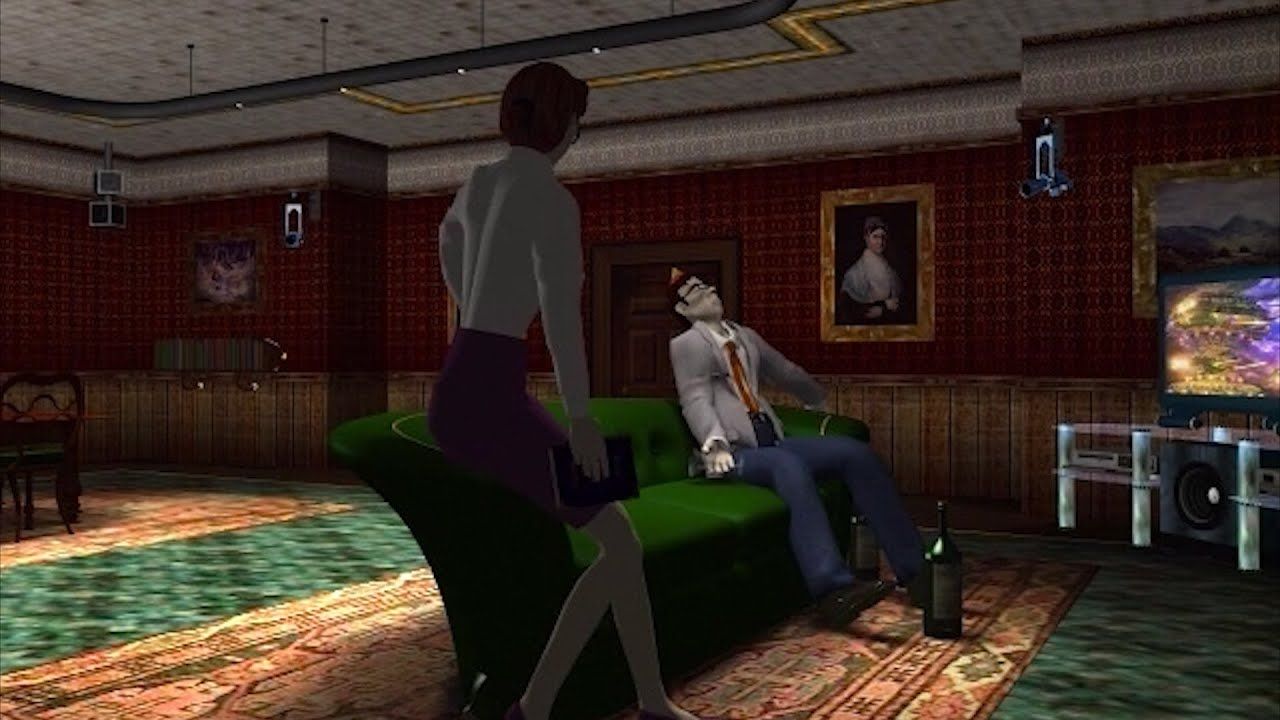
Published by Interplay and developed by Runecraft, the premise is delightfully convoluted. You play as Buster, a sentient white pudding squeezed into a university lecturer's jacket who, prior to the game's commencement, just so happens to have won the lottery. With his winnings, he buys a mansion which just so happens to have been owned by a recently deceased robotics genius, who just so happens to have filled his house with all manner of computer gizmos and talking automata. Oh, and Buster just so happens to move into his new digs on New Year's Eve, 1999.
A Mansion That Defies Logic
Any story premise that involves this many layers of happenstance probably needs a rework, by which I mean setting fire to the script and starting again. But developer Runecraft sallies boldly forth with this bizarre jumble of nonsense. As Buster collapses onto his bed in a stupor induced by a $100 bottle of wine, the clock strikes midnight. Immediately, Buster's freshly acquired smart house loses 500 IQ points and turns evil. The game represents this through the computer's voice switching from a cool, detached HAL 9000 intonation to an aggressive caricature of a Noo Yoik dialect. Your sole objective in Y2K is to patch out the Millennium Bug from the supercomputer that runs the house.
The challenge in achieving this derives from the fact that Buster's house makes no sense whatsoever. Imagine if the island from Myst was lifted out of the ocean by a gigantic tsunami, then driven into the Spencer Mansion from Resident Evil at a speed so fast the two instantly fused together. If you think I'm exaggerating, here's a brief rundown of spaces you can explore:
- A room filled with ancient relics and dusty artifacts
- An elevator with the score for Three Blind Mice etched into the wall, playing completely unrelated elevator music
- A dining room with three AI-powered stuffed animal heads who speak in British accents, including a rhinoceros referred to as 'The Colonel'
- A basement housing a recycling robot that gets so angry at Buster for not bringing trash that it tries to kill him (this robot also has a New York accent)
- A dungeon prowled by a murderous robotic executioner, which is somehow less aggressive than the recycling robot
I will say that the pre-rendered backgrounds and robot animations are quite detailed for 1999, even if it is all wholly incoherent. Unfortunately, the thing you look at the most—Buster—is also the least visually appealing part in the game. He is a slouching, shuffling blob so offputtingly pasty he looks like he stepped out of a Softmints advert.
Voice Talent and Sonic Design
In fact, calling his movement "shuffling" is probably generous. Even if everything else about Y2K: The Game was brilliant, it would still be interminable simply because Buster is so slow. He's such a tortoise that, if a solution to a puzzle suddenly clicks into place for you, you should write it down, because there is a non-zero chance you will have forgotten it by the time Buster arrives at his destination.
There are two things I like about the title, the first being the voice acting. Castellaneta puts the effort in, and he isn't the only heavy-hitting voice actor in Y2K either. Candace is played by Grey Desisle, only a year into her career at this point, with other actors including Danny Mann and John Mariano. Unfortunately, they are all let down by a weak script riddled with non-liners such as "I'm glad I'm smart enough to use the extension cord" and "Like Candace says, you'll never know when you'll need some batteries!"
Comfortably the best thing in the game, though, is the music. Every room has its own specific theme, each of which is so much more artistically accomplished than anything contained in the room itself. The antiques room, for example, is accompanied by a sitar-led melody that's quintessentially adventure game. One corridor theme wouldn't be out of place on a Pure Moods CD, while Corridor 3 starts like Laura Palmer's theme and slides into some Tangerine Dream. And then there's the music for the dining room, which could happily accompany the scene's absurdity without missing a beat.